902-second window · 3 observations · Measured Oct 3, 2026, 8:56 AM UTC · Provider: go_recent_snapshot_v2
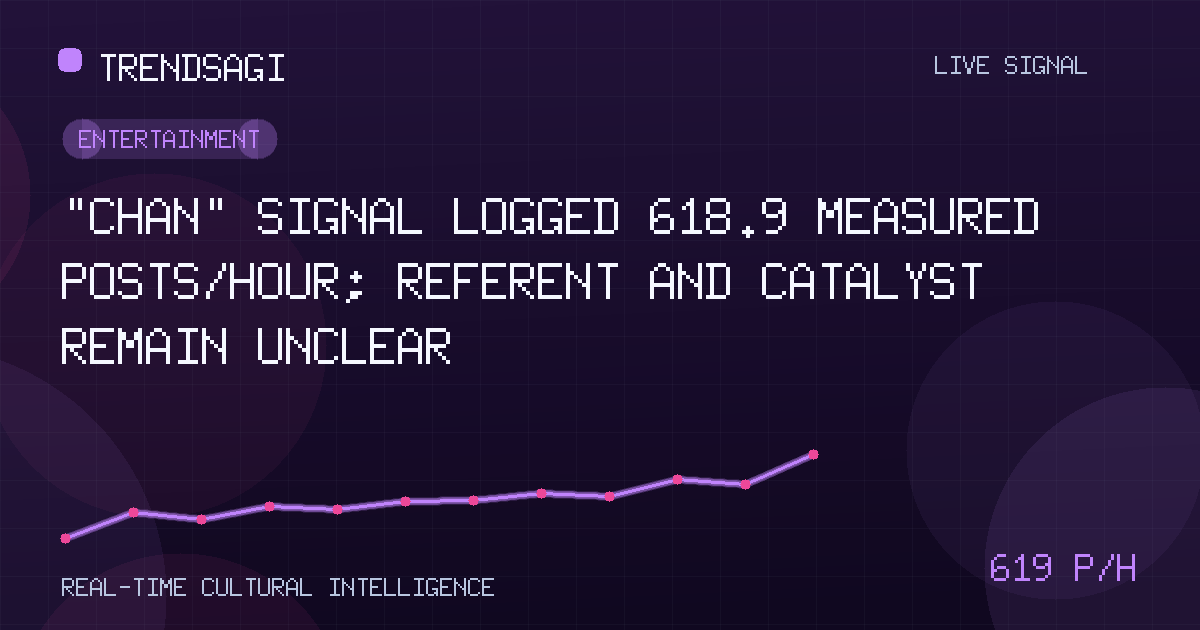
“Chan” signal logged 618.9 measured posts/hour; referent and catalyst remain unclear
“Chan” shows 1090 posts and a measured snapshot rate of 618.9 posts/hour; its referent and catalyst are unclear, so editors should verify first.
Automated briefing. Generated from stored signal measurements and source-backed research; it is not manually reviewed. Read the methodology and limitations.
Metrics in this briefing are a snapshot associated with its publication date and may not reflect current conditions.
What changed
The stored entertainment signal labeled “Chan” shows 1090 posts at 2026-10-03T08:56:57Z and a measured snapshot rate of 618.9 posts/hour over an exact 902-second window based on 3 stored observations. That establishes an observed run of posting activity captured under the label. It does not identify what “Chan” refers to or what caused the activity. No specific person, work, event, or character is identified in the record, and no public catalyst has been verified. The reason it may be moving remains unclear.
The 618.9 posts/hour figure is a measured snapshot rate, not a live or current rate, forecast, reach figure, engagement count, or unique-person count. The separate 1090 figure is the latest snapshot volume. Because no prior rate or normal baseline is supplied, the record cannot establish that activity was accelerating, how far it differed from usual, or whether the pace persisted. The defensible reading is limited to matching posts appearing at the supplied rate during the exact observation window.
| Observation time | 2026-10-03T08:56:57Z |
|---|---|
| Measurement window | Exact 902-second window |
| Stored observations | 3 |
| Measured snapshot rate | 618.9 posts/hour |
| Latest snapshot volume | 1090 posts |
| Stored category | Entertainment |
Velocity is a prompt to investigate, not proof of a cause: the data establishes when labeled activity was observed, not why it occurred or who drove it.
What the signal can establish
At the level of the record, it establishes when the snapshot was observed, how many labeled posts it contained, the measured pace during the window, and its assigned entertainment category. Those facts can trigger editorial review and provide a reference point for later observations. They do not reveal what the posts say, whether they agree, whether the same text was copied, or whether people were acting independently.
The label also remains semantically unresolved. “Chan” may match a name, a title or role, a character, a transliteration, or an unrelated use; the entertainment category narrows context but does not prove which meaning dominates. Without referent-level validation, even a correctly measured concentration of posts could combine separate conversations rather than capture one coherent public discussion.
Why this topic may be moving
No supported causal explanation is present in the stored record. Several mechanisms remain possible, and they should be treated as hypotheses rather than reported facts:
- Event-driven attention: A dated release, appearance, announcement, or controversy could trigger posting, but no specific event is verified here.
- Label collision: Unrelated people, works, places, characters, or phrases may share the label, causing one monitoring label to combine separate conversations.
- Repetition or coordination: Duplicate reposts, templated messages, or a concentrated account cluster could lift post velocity without representing broad organic participation.
- Capture effects: Changes in collection coverage or matching behavior could alter the measured set even if user activity did not change.
Until candidate explanations are tested, attributing the movement to a particular work, event, or controversy would be speculation. A valid explanation must align with the observed timestamp, resolve the label, and survive duplication and account-concentration checks.
Why it matters
For entertainment editors, the signal is useful for triage, not yet for a headline. It says that a label accumulated enough captured activity at the stated time to merit checking. It does not establish that the activity is sustained, meaningful, newsworthy, or connected to a named event. Prematurely naming the referent could misdirect coverage.
Different teams face different risks. Social and community teams need to know whether the discussion is coherent or an unrelated term is being bundled together. Brand-safety and reputation teams need to prevent an ambiguous cluster from being attached to the wrong person or property. Researchers need matching rules, coverage details, and a baseline before comparing this signal with others. In no case should 1090 posts be described as 1090 people, or 618.9 posts/hour as reach.
Used carefully, the snapshot tells teams where to look first. Used as a conclusion, it invites a false narrative from a high-velocity but poorly resolved signal.
What to watch next
- Resolve the referent. Inspect a representative sample, including the earliest available posts, and record what “Chan” means in each. Check whether one entity dominates or several unrelated senses are mixed. Stable contextual use is a necessary confirmation signal.
- Date the catalyst. Run Google searches for the exact label around 2026-10-03T08:56:57Z, then test candidate events against official posts and independent reporting. A credible catalyst should be timestamped before or at the onset and explain the specific content, not merely share a name.
- Audit originality. Compare repeated wording, links, media, account histories, and posting timing. A dense duplicate chain or narrow set of accounts would weaken the interpretation that distinct participants drove the activity, but it would not by itself prove automation.
- Build a real baseline. Compare equal-length windows immediately before and after the observation, then add subsequent snapshots. Look for persistence rather than assuming the measured snapshot rate continued. Compare the rate with snapshot volume to distinguish a brief cluster from a sustained flow.
- Test breadth and meaning. Segment by language, geography, account type, relevant terms, and sentiment. Broad distribution across independent communities would support wider attention; one community or one repeated frame would suggest a narrower phenomenon. These are validation checks, not conclusions from the current record.
Stronger confirmation would combine one coherent referent, a dateable public catalyst, original posts from multiple accounts, persistence in later snapshots, and independent corroboration. The case should weaken if the label splits across meanings, posts are mostly duplicates, or the rate quickly returns to an established baseline.
Methodology and limitations
The measured snapshot rate was supplied by the monitoring record from 3 stored observations across an exact 902-second window, with the observation timestamp shown above. The latest snapshot volume was supplied separately as 1090 posts. The record does not disclose the matching rule, platform coverage, deduplication method, historical baseline, or collection gaps.
Consequently, the rate may reflect both user behavior and monitoring design. It offers no direct evidence about sentiment, engagement, unique users, location, or causation. No verified public context establishes why the label was moving. The appropriate status is an early, ambiguous entertainment signal that warrants verification before being reported as a confirmed trend.
Track This Topic for New Signals
Set alerts for future velocity or sentiment changes around this topic.
Explore Tracking PlansAbout TrendsAGI research
TrendsAGI's automated research pipeline publishes dated signal snapshots, methodology notes, and practical workflows for teams evaluating cultural momentum. Read how signals are scoped, scored, and limited in our research methodology.