899-second window · 3 observations · Measured Oct 5, 2026, 5:56 PM UTC · Provider: go_recent_snapshot_v2
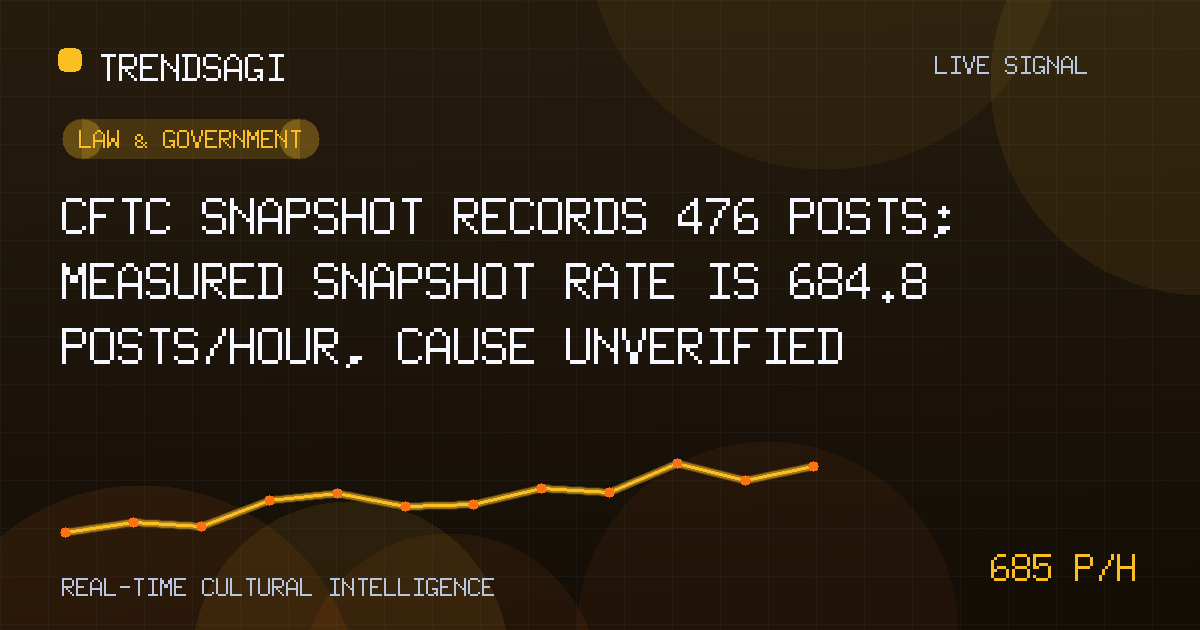
CFTC snapshot records 476 posts; measured snapshot rate is 684.8 posts/hour, cause unverified
CFTC posts totaled 476 in the latest snapshot, with a measured 684.8 posts/hour rate; the trigger is unverified and next checks are outlined.
Automated briefing. Generated from stored signal measurements and source-backed research; it is not manually reviewed. Read the methodology and limitations.
Metrics in this briefing are a snapshot associated with its publication date and may not reflect current conditions.
What changed
The latest monitored CFTC snapshot contained 476 posts, but no specific public trigger has been verified. The defensible answer is limited: posting activity was concentrated in the monitored stream at that observation. It does not show that the CFTC announced an action, that a policy debate caused the activity, or that market sentiment changed.
The measured snapshot rate was 684.8 posts/hour over an exact 899-second window using 3 observations, recorded at 2026-10-05T17:56:23Z. This is a measured snapshot rate, not a live or current rate, forecast, reach, engagement estimate, or unique-person count. The 476-post snapshot volume is a separate count and should not be treated as an hourly rate.
| Observation time | Measured snapshot rate | Latest snapshot volume |
|---|---|---|
| 2026-10-05T17:56:23Z | 684.8 posts/hour | 476 posts |
Why this topic may be moving
No verified public item can be tied to the timing, so the reason for the movement remains unclear. For a topic labeled CFTC, plausible investigation paths include an official release, an enforcement or rulemaking development, testimony or legislative activity, a market-related event, or a broader political dispute. These are hypotheses to test, not events established by the snapshot.
Alternative explanations also need testing. The label may be collecting reposts, commentary about an older event, unrelated uses of an acronym, or automated posting. Without post-level samples and source provenance, the signal cannot separate an event-driven response from mechanical repetition or noise.
What the signal can establish
The observation establishes when the sample was captured, how many posts were recorded, and the defined measured snapshot rate. Its Law & Government category is a classification, not proof that a government action occurred.
It cannot establish:
- the initiating event or a causal connection;
- whether different posts came from different people;
- whether posting was organic, coordinated, or automated;
- the prevalence of positive, negative, or neutral views;
- the factual accuracy of claims made in posts;
- reach, engagement, or impact; or
- whether activity continued beyond the exact window.
That distinction matters because raw post volume is an attention measure. It is not, by itself, a measure of market importance, institutional consensus, or economic consequence.
Why it matters
For regulatory, legal, compliance, and market-monitoring teams, a short-window burst is useful as a triage alert. It says where to look first, not what happened or what it means. A compliance analyst should verify the underlying official record before changing a watchlist; a market professional should avoid treating mention volume as evidence of direction, probability, or economic impact.
Editors, communications teams, and policy researchers also have a clear use: test whether the volume reflects a real information event or an attention spike. The topic label alone offers too little context to support a confident headline or causal conclusion.
A high posting rate is an alert to investigate, not evidence that an event happened, that it is important, or that the market agrees.
What to watch next
The most useful follow-up work moves from volume to provenance:
- Locate the earliest substantive posts. Work backward from the snapshot and record their exact wording, claimed source, and whether they add information or merely repeat one another.
- Match the timing to primary material. Look for a dated CFTC release, order, filing, testimony, hearing, or market publication whose timestamp plausibly precedes the cluster. A close time match is a lead, not confirmation.
- Require independent corroboration. Determine whether credible outlets cite the same primary document or whether they are recycling an unsourced social claim.
- Check repetition and distribution. Repeated identical wording, a narrow account set, or near-simultaneous posts would raise automation or coordination questions, but would not answer them by themselves.
- Compare like with like. Use subsequent snapshots with the same collection method and window definition. Repeated elevated readings would support a persistence claim; a decline would suggest a brief cluster.
- Watch for confirmation, correction, or denial. A matching official record would strengthen an event explanation. Clarifications or corrections would show whether the initial narrative was accurate.
The decisive next check is whether the earliest posts can be traced to a dated primary item and independently confirmed. If not, the CFTC activity should be described as an unexplained posting cluster rather than a policy event.
Methodology and limitations
This briefing reports the supplied observation exactly: 476 posts in the latest snapshot and a measured snapshot rate of 684.8 posts/hour across an exact 899-second window based on 3 observations. The figures remain separate because one is snapshot volume and the other is the supplied rate measure. The short window and limited observation set constrain generalization.
No verified public context accompanies the observation, so no cause is assigned. The available record does not provide enough post-level evidence to assess authenticity, duplication, sentiment, or real-world impact. The timestamp describes a historical snapshot and should not be read as a live market or policy status.
Track This Topic for New Signals
Set alerts for future velocity or sentiment changes around this topic.
Explore Tracking PlansAbout TrendsAGI research
TrendsAGI's automated research pipeline publishes dated signal snapshots, methodology notes, and practical workflows for teams evaluating cultural momentum. Read how signals are scoped, scored, and limited in our research methodology.