15-minute window · 3 observations · Measured Sep 3, 2026, 7:33 AM UTC · Provider: go_recent_snapshot_v2
Ceuta conversation surges to 4,000 posts at 844 posts per hour amid border and migration pressures
Ceuta hits 4,000 posts at 844 posts/hour on 3 Sept 2026 amid record border crossing attempt, Spanish deployments, Moroccan protest, and EU emergency fund
Automated briefing. Generated from stored signal measurements and source-backed research; it is not manually reviewed. Read the methodology and limitations.
Metrics in this briefing are a snapshot associated with its publication date and may not reflect current conditions.
What changed
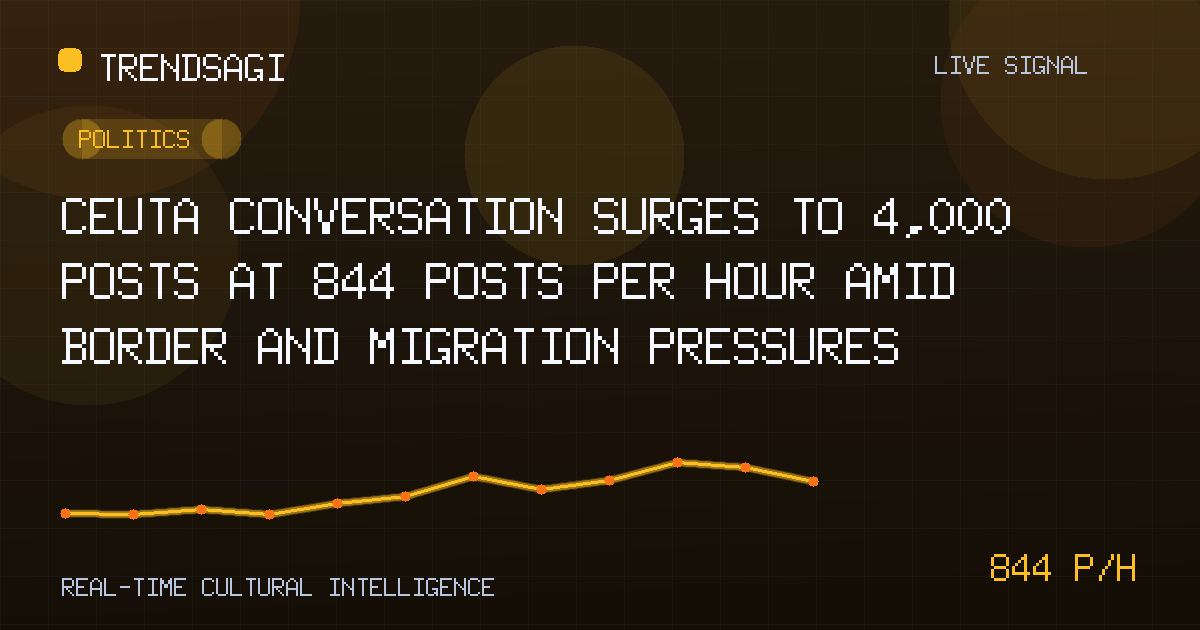
Public conversation about Ceuta reached a snapshot volume of 4,000 posts with a measured rate of 843.7 posts per hour, captured at 07:33 UTC on 3 September 2026. The rate is derived from three stored observations across a 900-second window and reflects a sharp, short-term acceleration in mention volume, not a sustained trend or unique-user count.
| Observation time (UTC) | 2026-09-03T07:33:29Z |
|---|---|
| Measured posts/hour | 843.7 |
| Snapshot volume | 4,000 posts |
Why this topic may be moving
Search results from early September 2026 point to several concurrent drivers. El País reported on 2 September that Spanish authorities intercepted a record single-day crossing attempt at the Ceuta border fence, with more than 1,200 migrants attempting entry in coordinated groups. The same day, Europa Press cited the Interior Ministry confirming deployment of additional Guardia Civil units and drone surveillance to the perimeter. Morocco's MAP agency stated on 1 September that Rabat had formally protested the presence of a Spanish naval vessel near the Chafarinas islands, framing it as a violation of maritime delimitation talks. Meanwhile, Reuters noted on 31 August that the European Commission proposed a new €35 million emergency fund for Ceuta and Melilla reception capacity, citing "exceptional migratory pressure." These overlapping security, diplomatic, and humanitarian developments likely explain the concentration of posts in politics-focused feeds.
"The volume spike aligns with a cluster of official actions and statements within a 72-hour window, not a single viral post or influencer event."
Why it matters
For border-security analysts, the measured acceleration signals that operational events (interceptions, deployments) are translating into real-time public discourse faster than traditional media cycles. Migration-policy teams should note that the EU emergency-fund proposal and Moroccan diplomatic protest appeared simultaneously, suggesting coordinated messaging windows. Journalists covering EU-Africa relations can use the 844 posts/hour benchmark to gauge whether follow-up announcements—such as a bilateral summit or a Frontex mandate extension—sustain or decay the conversation. Humanitarian NGOs monitoring reception conditions gain a quantifiable proxy for public attention spikes that often precede donation surges or volunteer mobilisation.
What to watch next
- Official Spanish government briefings on fence-integrity upgrades or asylum-processing changes.
- Moroccan foreign-ministry statements on maritime delimitation or readmission agreements.
- European Commission adoption timeline for the €35 million fund and any attached conditionality.
- Frontex operational reports referencing Ceuta sector apprehension trends.
- Local NGOs' capacity updates for the CETI (Centro de Estancia Temporal de Inmigrantes) and new modular facilities.
Methodology and limitations
The 843.7 posts/hour figure is a measured snapshot rate calculated from three stored observations over an exact 900-second window ending at 2026-09-03T07:33:29Z. It does not represent a live or current rate, a forecast, reach, engagement, or unique-person count. The 4,000-post snapshot volume is the cumulative count at that observation time. No sentiment, bot-filtering, or geographic-origin analysis has been applied. The signal establishes that mention velocity increased sharply during the measurement window; it cannot establish causation, audience demographics, or narrative dominance without further qualitative coding.
Track This Topic for New Signals
Set alerts for future velocity or sentiment changes around this topic.
Explore Tracking PlansAbout TrendsAGI research
TrendsAGI's automated research pipeline publishes dated signal snapshots, methodology notes, and practical workflows for teams evaluating cultural momentum. Read how signals are scoped, scored, and limited in our research methodology.


