902-second window · 3 observations · Measured Sep 28, 2026, 11:07 AM UTC · Provider: go_recent_snapshot_v2
Catholic topic has a measured snapshot rate of 355.1 posts/hour; cause remains unclear
The Catholic topic recorded a 355.1 posts/hour measured snapshot rate; the cause is unverified, with practical checks for editors and researchers.
Automated briefing. Generated from stored signal measurements and source-backed research; it is not manually reviewed. Read the methodology and limitations.
Metrics in this briefing are a snapshot associated with its publication date and may not reflect current conditions.
What changed
The monitored Catholic topic is moving in the latest measured snapshot, but the reason is unclear. The defensible conclusion is limited: the topic warrants closer inspection, not attribution to a particular Church development or news event.
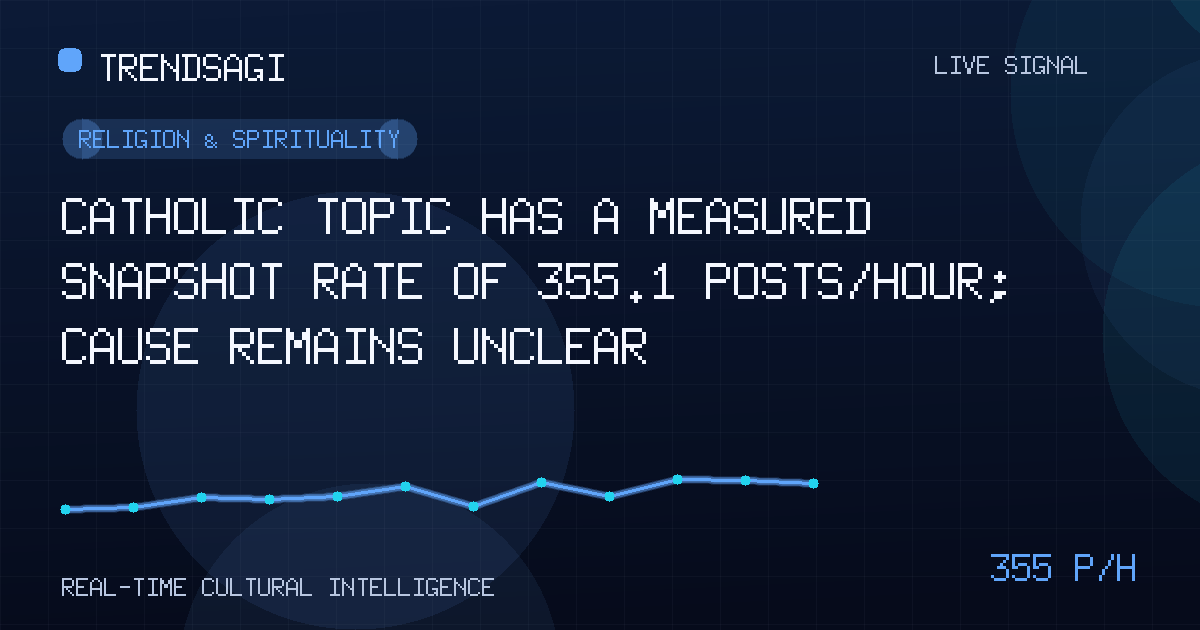
At 2026-09-28T11:07:06Z, the latest supplied snapshot contained 212 posts. The measured snapshot rate was 355.1 posts/hour over an exact 902-second window using 3 stored observations. This is a measured snapshot rate for that historical window, not a live or current rate, forecast, reach, engagement total, or unique-person count; the 212 posts are a snapshot volume, not a rate.
| Observation time | 2026-09-28T11:07:06Z |
|---|---|
| Snapshot volume | 212 posts |
| Measured snapshot rate | 355.1 posts/hour |
| Rate window | Exact 902-second window |
| Observations used | 3 stored observations |
The rate establishes how quickly the measured count changed within the defined window. It does not show whether that pace is high relative to a normal baseline, because no baseline is supplied. The 212-post volume and 355.1 posts/hour rate are separate measures and should not be treated as interchangeable.
Why this topic may be moving
The aggregate comes without a post-level sample or explanatory description, and no specific public event has been corroborated. The cause is therefore unclear. The following are mechanisms to test, not verified explanations:
- Event-driven attention: A timed news development may have prompted immediate reaction.
- Recurring observance: A scheduled religious occasion may have increased posting.
- Prominent focus: A named person, institution, decision, or controversy may account for much of the activity.
- Distribution effects: Recommendations, quote-posts, or duplicate collection may have raised visible volume without equivalent growth in original posts.
The label Catholics is semantically broad. Without coding the actual items, the signal cannot distinguish institutional reporting, personal religious discussion, political content, or reaction to a prominent person. What looks broad in aggregate may be a narrow subtheme repeated many times.
Interpretation: A measured posting rate establishes pace within its window, not motive. It cannot by itself show agreement, mobilization, unique participants, or causal origin.
Why it matters
Fast-moving religious topics carry an editorial risk: repeated reactions can resemble consensus, while one shared source can resemble broad adoption. The measured rate is useful for prioritizing verification, but it is not enough to support a causal narrative or claim that a conversation is growing in influence.
- News editors and public-affairs desks should check whether a concrete event links the posts before treating the burst as a trend.
- Researchers should preserve the sampling method, remove duplicates where possible, and code subthemes, stance, geography, and language.
- Community and institutional communicators should distinguish volume from sentiment, representation, or meaningful participation.
- Trend and data teams should test whether the pattern survives the same query, collection window, and deduplication rules.
What to watch next
The next useful step is not another uncontextualized rate. It is a matched evidence chain connecting posts, time, subject, and external verification.
- Inspect the burst. Review records immediately before and after the observation time. Note repeated names, claims, and source references, and separate original posts from quote-posts, reposts, and likely duplicates.
- Code the content. Classify sampled items by subtheme, stance where clear, language, and geography if available. This shows whether the activity is diverse or concentrated around a repeated subject.
- Test event alignment. Look for the same named event, statement, or controversy across independent posts. Check that a public source existed at a relevant time; temporal alignment supports context but does not establish causation.
- Build a comparable series. Use adjacent snapshots with the same query, collection rules, and deduplication. Determine whether the pace persists, accelerates, fades, or was isolated.
- Verify before explaining. Seek a primary public statement and independent reporting when available. Attribute any external fact to its publisher only after verification; otherwise retain uncertainty.
Concrete watch signals
- Comparable snapshots sustain a comparable measured pace rather than showing a single isolated observation.
- A verifiable event repeatedly named in the sample has a source timestamp aligned with the cluster.
- Activity appears across independent sources, geographies, and languages, with more original posts rather than copied wording.
- Substantive replies increase alongside original reporting, providing evidence of participation rather than repetition.
- The apparent movement weakens after duplicate and query controls, which would point toward a measurement effect.
Methodology and limitations
This briefing uses only the supplied aggregate: timestamp, 212-post snapshot, 355.1 measured snapshot posts/hour, an exact 902-second rate window, and 3 observations. The rate and volume are reported separately; no conversion or extrapolation has been made.
The available record does not supply a baseline, raw posts, account-level data, sentiment, engagement, location, language, platform mix, query history, or deduplication method. Accordingly, the signal cannot establish reach, unique participants, popularity, agreement, statistical unusualness, or causation.
No external cause is asserted because no specific public development could be verified from the available context. The signal should remain provisional until post-level evidence and independently verified public context point to the same explanation.
Track This Topic for New Signals
Set alerts for future velocity or sentiment changes around this topic.
Explore Tracking PlansAbout TrendsAGI research
TrendsAGI's automated research pipeline publishes dated signal snapshots, methodology notes, and practical workflows for teams evaluating cultural momentum. Read how signals are scoped, scored, and limited in our research methodology.