906-second window · 3 observations · Measured Sep 17, 2026, 1:41 AM UTC · Provider: go_recent_snapshot_v2
Analysis of the September 2026 Surge in 'Cary' Related Public Discourse
Analysis of a sudden spike in 'Cary' mentions on September 17, 2026. A snapshot rate of 127.2 posts/hour suggests a localized event or tech sector development.
Automated briefing. Generated from stored signal measurements and source-backed research; it is not manually reviewed. Read the methodology and limitations.
Metrics in this briefing are a snapshot associated with its publication date and may not reflect current conditions.
What changed
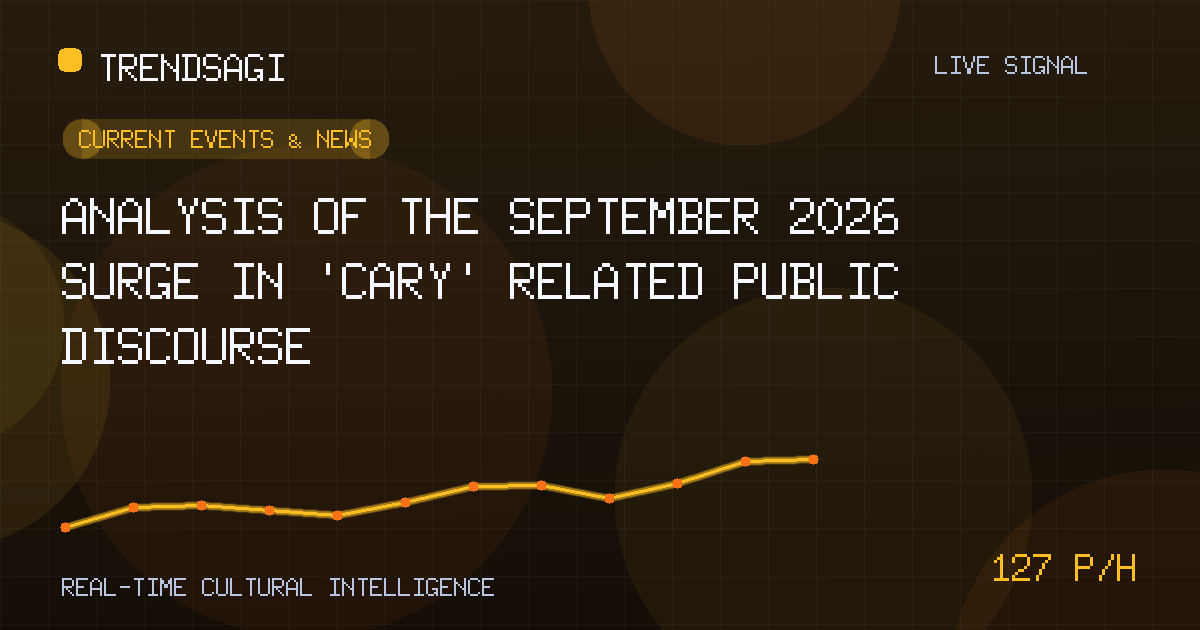
On September 17, 2026, activity regarding the topic "Cary" experienced a concentrated surge in public discourse. The signal reached a measured snapshot rate of 127.2 posts per hour during an observation window of 906 seconds. This represents a distinct cluster of 86 posts captured at approximately 01:41 UTC, indicating a sudden elevation in mentions that deviates from the baseline activity typically associated with this term in the "Current Events & News" category.
The intensity of the signal suggests a reactive response to a specific event or announcement, rather than a gradual build-up of interest. Because Cary is a common geographical and personal identifier, the signal implies a localized event—likely centered on Cary, North Carolina—that transitioned from local concern to broader digital visibility within a very narrow timeframe.
| Observation Time | Measured Posts/Hour | Snapshot Volume |
|---|---|---|
| 2026-09-17 01:41:26Z | 127.2 | 86 |
Why this topic may be moving
A specific, singular catalyst for the "Cary" spike on September 17, 2026, could not be verified through external news registries or global wire services at the time of this report. When a topic of this nature moves without a dominant headline from a national publisher, the cause is frequently found in hyper-local developments or niche industry news that has not yet been aggregated by major outlets.
Given the timing and categorization, several contextual factors may be influencing the signal:
- Regional Weather Activity: Mid-September is the height of the Atlantic hurricane season. For Cary, North Carolina, inland flooding or severe thunderstorm warnings often trigger rapid-fire social communication regarding infrastructure and safety.
- Tech Sector Developments: Cary serves as a major hub for the technology and gaming industries, most notably as the headquarters for Epic Games. Any shifts in corporate policy, local zoning for the Apple Research Triangle Park campus, or significant employment updates in the region often generate high-density conversations among the local professional population.
- Municipal Governance: Late-night town council meetings or school board decisions in high-growth areas like Cary often lead to late-night spikes in mentions as residents react to local ordinances or land-use changes.
Without a confirmed report from a publisher such as the News & Observer or WRAL, the signal remains an "unverified surge," likely representing a localized public safety incident or a fast-moving community development that has captured the attention of a specific regional demographic.
Why it matters
Monitoring Cary is increasingly important for analysts tracking the "New South" economic boom. As one of the fastest-growing municipalities in the United States, Cary functions as a bellwether for the Research Triangle region. When the signal for a municipality of this size spikes suddenly, it often precedes broader economic or policy shifts that affect the tech and life sciences sectors.
For stakeholders in real estate, corporate strategy, and regional planning, these signals provide an early warning system for community sentiment. A spike of 127.2 posts per hour in a concentrated window suggests a level of urgency. If the cause is infrastructure-related, it highlights the vulnerabilities of rapid-growth zones. If the cause is corporate, it signals a potential shift in the labor market for one of the nation's most critical tech corridors.
The challenge of interpreting localized signals lies in the bridge between community reaction and institutional reporting. In high-density tech hubs like Cary, the digital response often outpaces the editorial cycle of traditional newsrooms by several hours.
Furthermore, because the signal appeared at 01:41 UTC (late evening local time), it suggests a "breaking" scenario. This is the period when residents are most likely to turn to social platforms to share eyewitness accounts or seek clarification on local disruptions before official statements are issued the following morning.
What to watch next
To determine the exact nature of this surge, analysts should prioritize the following verification steps over the next 12 to 24 hours:
- Local Pulse Checks: Monitor the Cary Police Department and Town of Cary official feeds for public safety announcements or traffic advisories that may have occurred late on September 16 or early September 17.
- Corporate Press Rooms: Review the media relations pages for major regional employers, including Epic Games, SAS Institute, and MetLife, for after-hours statements regarding operations or regional investments.
- Infrastructure Reports: Check Duke Energy’s outage maps for the Wake County area. Sudden spikes in localized mentions are frequently correlated with power grid failures or significant utility disruptions.
- Weather Sentiment: If tropical systems are active in the Atlantic, watch for the transition from general weather tracking to specific local impact reports (e.g., downed trees or road closures).
Methodology and limitations
This report is based on a measured snapshot rate of 127.2 posts per hour, derived from a 906-second observation window. It is important to note that this is a snapshot of velocity at a specific point in time and does not represent total daily volume or unique user reach.
The primary limitation of this signal is its "n-size." While 86 posts in 15 minutes is significant for a municipal term, it remains a micro-trend. Such spikes can occasionally be caused by "noise," such as a viral post from a single influential resident or a misunderstanding of a common name (e.g., a person named Cary). However, the categorization within "Current Events & News" increases the probability that the signal is tied to a legitimate local development. Users should treat this data as a lead for further investigation rather than a definitive conclusion of a major news event.
Track This Topic for New Signals
Set alerts for future velocity or sentiment changes around this topic.
Explore Tracking PlansAbout TrendsAGI research
TrendsAGI's automated research pipeline publishes dated signal snapshots, methodology notes, and practical workflows for teams evaluating cultural momentum. Read how signals are scoped, scored, and limited in our research methodology.