887-second window · 2 observations · Measured Oct 5, 2026, 3:41 AM UTC · Provider: go_recent_snapshot_v2
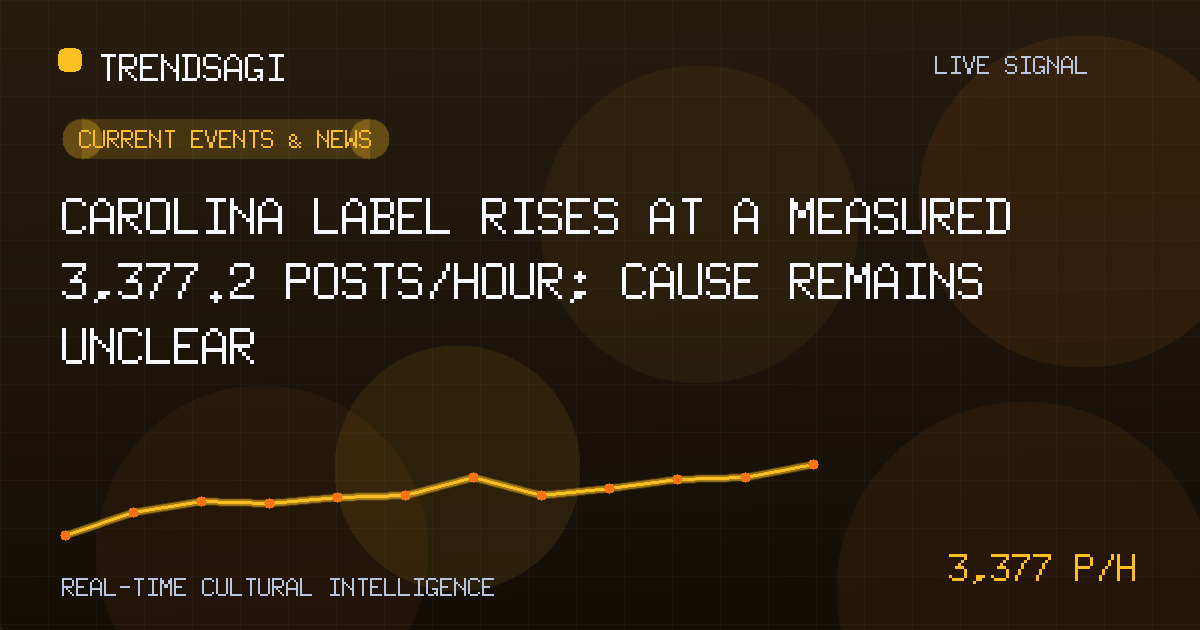
Carolina label rises at a measured 3,377.2 posts/hour; cause remains unclear
Carolina recorded a measured 3,377.2 posts/hour over 887 seconds; the trigger is unverified, so editors should verify referent and persistence.
Automated briefing. Generated from stored signal measurements and source-backed research; it is not manually reviewed. Read the methodology and limitations.
Metrics in this briefing are a snapshot associated with its publication date and may not reflect current conditions.
What changed
The recorded signal shows a short-window increase in posts carrying the label “Carolina”: 3,377.2 posts/hour over an exact 887-second window using 2 stored observations. The latest snapshot contained 2,117 posts at 2026-10-05T03:41:22Z. The defensible conclusion is that labeled posting activity increased at the measured rate during that interval; the record does not identify the event that produced the increase.
This is a measured snapshot rate, not a live rate at the time of reading. “Carolina” is also not a resolved subject. The label alone does not reveal whether posts concern a geography, organization, team, person, or another subject, and the available record contains no event description. The measured movement is clear within the monitored data, but its news meaning remains unconfirmed until the posts and their trigger are checked.
| Observation time | Measured snapshot rate | Latest snapshot volume |
|---|---|---|
| 2026-10-05T03:41:22Z | 3,377.2 posts/hour Exact 887-second window; 2 stored observations |
2,117 posts |
The snapshot volume and change rate answer different questions. The 2,117 figure counts posts in the latest observation; it is not the hourly rate and not a count of unique people. The rate describes change across the 887-second comparison, not reach, engagement, or proof that a claim inside the posts is accurate.
Why this topic may be moving
No verified public context establishes why the label moved, so the cause remains unclear. The assigned category, Current Events & News, indicates that the monitoring system regarded the label as potentially newsworthy, but it does not supply an event, entity, location, or source. An empty signal description leaves the causal gap intact.
The safest explanation is descriptive: the monitored stream registered more Carolina-labeled posts over the comparison interval. The record does not show whether that change reflects a genuinely new development, an existing story returning, repeated copying, or several unrelated meanings being combined under one label. Those are testable possibilities, not established facts.
- Referent: Which place, organization, team, or person do sampled posts mean?
- Trigger: What specific development aligns with the start of the change?
- Composition: Is the volume broad discussion, repetition by a smaller group, or a mixture?
- Duration: Is this one short burst or part of sustained activity?
External verification should follow the sample, not precede it. Editors should first identify the dominant intended meaning, then look for a credible report or official statement that explains the timing. A page containing the word “Carolina” is not sufficient attribution for a cause.
Why it matters
A sharp-looking label can still be analytically weak if its referent is unknown. Regional newsrooms and local officials risk drawing the wrong conclusion if they treat every Carolina mention as one event. Teams, companies, or institutions with Carolina in their name could act on a false match. Trend and trust teams should use the signal to prioritize review, not to declare a narrative.
The signal establishes momentum in the monitored label, but not the story behind that momentum; verification must connect the referent, timing, and source.
The useful distinction is between detection and interpretation. Detection is present: there were 2,117 posts in the latest snapshot and a measured 3,377.2 posts/hour change rate over the stated window. Interpretation is incomplete: there is no verified explanation, sentiment reading, geographic breakdown, or evidence that the pattern persisted after the latest observation.
Who should care most? News editors deciding whether to cover the movement; communications staff monitoring a potentially relevant organization or region; and analysts assessing whether this is a real topic, a naming collision, or a coordinated burst. General readers should wait for a specific referent before treating the label as a developing current event.
What to watch next
- Disambiguate the sample. Review representative posts from across the 887-second window and code the intended Carolina referent and any event-specific terms.
- Verify the trigger. Match the dominant meaning to a credible publisher’s report or an official statement, checking that its publication and event times fit the measured window.
- Test persistence. Add comparable snapshots using the same label and collection rules. Compare them with a historical baseline before calling the movement sustained.
- Separate volume from influence. If available, examine distinct accounts, original versus copied posts, source concentration, and engagement. None should replace the basic need to identify the subject.
- Use comparison labels. Check matched regional, team, or topic labels to determine whether the change is specific to Carolina or reflects wider platform activity.
- Set decision thresholds in advance. Decide what evidence would justify escalation, correction, or a published explanation, rather than lowering the bar after an uncertain spike.
Concrete watch signals
- Specific names, locations, or event terms repeatedly replacing the bare label “Carolina.”
- Independent reporting and an official source converging on the same development and timeline.
- Comparable later windows remaining elevated against a reliable baseline, rather than a single burst appearing once.
- A shift from concentrated repetition to broad, distinct participation—or the reverse, which would raise different editorial concerns.
Methodology and limitations
The reported 3,377.2 posts/hour figure is a measured snapshot rate calculated across an exact 887-second window from 2 stored observations, timestamped 2026-10-05T03:41:22Z. It is not a live or current rate, forecast, reach estimate, engagement measure, or unique-person count. The separate latest snapshot volume is 2,117 posts.
The underlying series, collection query, sampling method, comparison baseline, and account-level details are not included. That prevents an assessment of representativeness, automated activity, sentiment, or persistence. No verified publisher or official source is cited because the available record does not establish a cause. The appropriate editorial action is to verify the referent and timing before assigning a narrative.
Track This Topic for New Signals
Set alerts for future velocity or sentiment changes around this topic.
Explore Tracking PlansAbout TrendsAGI research
TrendsAGI's automated research pipeline publishes dated signal snapshots, methodology notes, and practical workflows for teams evaluating cultural momentum. Read how signals are scoped, scored, and limited in our research methodology.