591-second window · 3 observations · Measured Oct 3, 2026, 3:21 PM UTC · Provider: go_recent_snapshot_v2
“Carlson” signal measures 402.2 posts/hour; identity and cause remain unverified
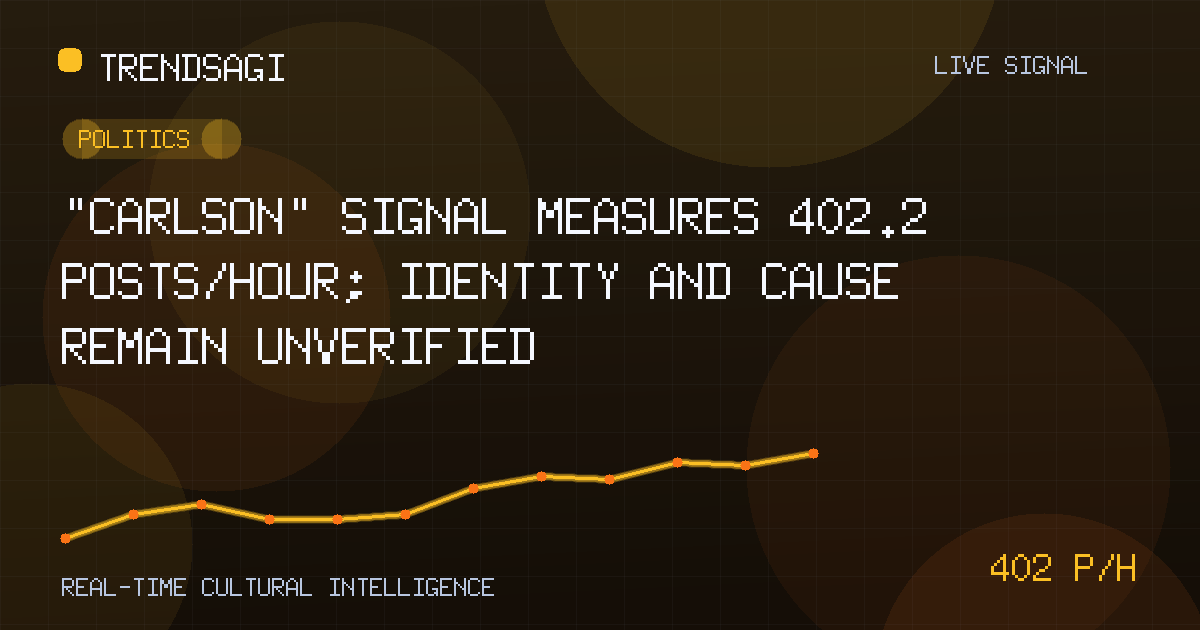
The “Carlson” signal shows 349 posts and a measured 402.2 posts/hour snapshot, while the identity and cause behind the activity remain unverified.
Automated briefing. Generated from stored signal measurements and source-backed research; it is not manually reviewed. Read the methodology and limitations.
Metrics in this briefing are a snapshot associated with its publication date and may not reflect current conditions.
What changed
The stored signal records active posting under the label “Carlson,” but it does not identify which Carlson matters or what event caused the activity. The latest snapshot contains 349 posts, establishing observed volume rather than reach, audience size, or the topic’s broader importance.
The measured snapshot change rate is 402.2 posts/hour, observed at 2026-10-03T15:21:29Z over an exact 591-second window using 3 stored observations. This is a measured snapshot rate, not a live or current rate, forecast, reach figure, engagement count, or unique-person count. The record also lacks a historical baseline, so it cannot establish whether the rate is unusually high or whether momentum is still increasing.
| Observation time | Measured snapshot rate | Snapshot volume |
|---|---|---|
| 2026-10-03T15:21:29Z | 402.2 posts/hour | 349 posts |
Why this topic may be moving
No verified public context accompanies the signal that ties “Carlson” to a specific person, statement, controversy, or event. The cause therefore remains unclear. The stored Politics category is a classification, not proof of the underlying story, and the topic label is too ambiguous to support a confident attribution.
Several explanations remain compatible with the observed posting rate and should be treated as hypotheses rather than findings:
- A single news event: Posts may repeatedly reference one verified development involving a person identified as Carlson.
- A label collision: The same label may combine discussion of unrelated people, places, organizations, or usages.
- Repeated content: A quotation, clipping, screenshot, or disputed claim may be copied across many posts, increasing volume without adding distinct information.
- A platform effect: Recommendation changes, a trending feature, or automated repetition could amplify the label without a corresponding increase in broader public attention.
Until the posts are grouped by identity and origin, choosing one of these explanations would be speculation. The available evidence supports reporting the spike while explicitly leaving its cause unresolved.
What the signal can establish
The strongest finding is temporal: the stored series recorded 349 posts in its latest snapshot and a 402.2 posts/hour change rate during the specified observation window. That makes the label a candidate for editorial review. It does not reveal what the posts said, whether they expressed agreement, or whether they concerned the same subject.
The rate answers “How quickly was the stored signal changing when it was measured?” It does not answer “Which Carlson is involved?”, “Why did activity increase?”, or “How many people were participating?”
The rate and snapshot volume are related measures but are not interchangeable. The record does not provide the full collection window for the 349-post snapshot, so the two figures should not be treated as covering the same interval or used to derive an additional rate. Neither figure establishes unique authors, reactions, originality, or the geographic and linguistic distribution of participants.
No sentiment, factual accuracy, source mix, account overlap, or duplication information is supplied. A high volume of posts can therefore indicate coordinated attention, repeated material, organic discussion, or a measurement artifact. The signal alone cannot distinguish among them.
Why it matters
For a politics desk, an unexplained label creates a difficult choice: publish a guessed story and risk misidentification, or ignore a genuine development. Verification is more useful than premature attribution. The correct immediate characterization is elevated activity in a stored topic signal with an unresolved cause.
- Editors should avoid naming a Carlson or event until relevant posts establish that connection.
- Researchers can use the observation as a trigger for collection, but not as evidence of public opinion or platform-wide behavior.
- Communications and fact-checking teams should look for repeated claims and determine whether an identifiable original source exists.
- Readers should treat the label as ambiguous and seek entity-specific context before drawing conclusions.
What to watch next
The next useful observation is not another volume number alone; it is evidence that resolves the label’s identity and origin. Concrete checks should include:
- Entity resolution: Review the full post text, associated names, profile descriptions, and linked references to determine which Carlson—or which unrelated entities—the label is collecting.
- Earliest substantive posts: Identify the earliest posts that add original information, then trace their claims backward to the referenced statement, recording, announcement, or other primary material.
- Duplication patterns: Compare repeated wording, quotations, media, and destinations. Widespread copies of the same item are a different signal from independent posts discussing separate developments.
- Verified reporting: Use public search to locate reporting that explicitly connects the relevant Carlson to the claimed event. Check the publisher, publication time, and cited source before treating the connection as established.
- Persistence and migration: Compare later stored observations to see whether activity persists, fades, or shifts into more specific labels. A move from “Carlson” to a named person, place, or event could clarify what the broad label contained.
- Scope: Check whether the posts remain within politics or spread into other categories. Cross-category movement may indicate a broader identity collision rather than one political event.
Methodology and limitations
The reported 402.2 posts/hour figure is retained as supplied. It was measured at 2026-10-03T15:21:29Z over an exact 591-second window using 3 stored observations. The 349-post figure is the latest snapshot volume. No additional rate, acceleration, forecast, or extrapolated reach has been calculated because the two values do not have a documented common collection scope.
This briefing describes a stored topic signal, not the entire platform or society. The available record contains no comparison period, sampling frame, deduplication method, account-overlap measure, sentiment analysis, or verified causal context. Consequently, the observation establishes measurable posting activity but not who generated it, why the label appeared, whether the content was accurate, or whether the movement was exceptional.
Track This Topic for New Signals
Set alerts for future velocity or sentiment changes around this topic.
Explore Tracking PlansAbout TrendsAGI research
TrendsAGI's automated research pipeline publishes dated signal snapshots, methodology notes, and practical workflows for teams evaluating cultural momentum. Read how signals are scoped, scored, and limited in our research methodology.


