764-second window · 3 observations · Measured Sep 29, 2026, 11:54 AM UTC · Provider: go_recent_snapshot_v2
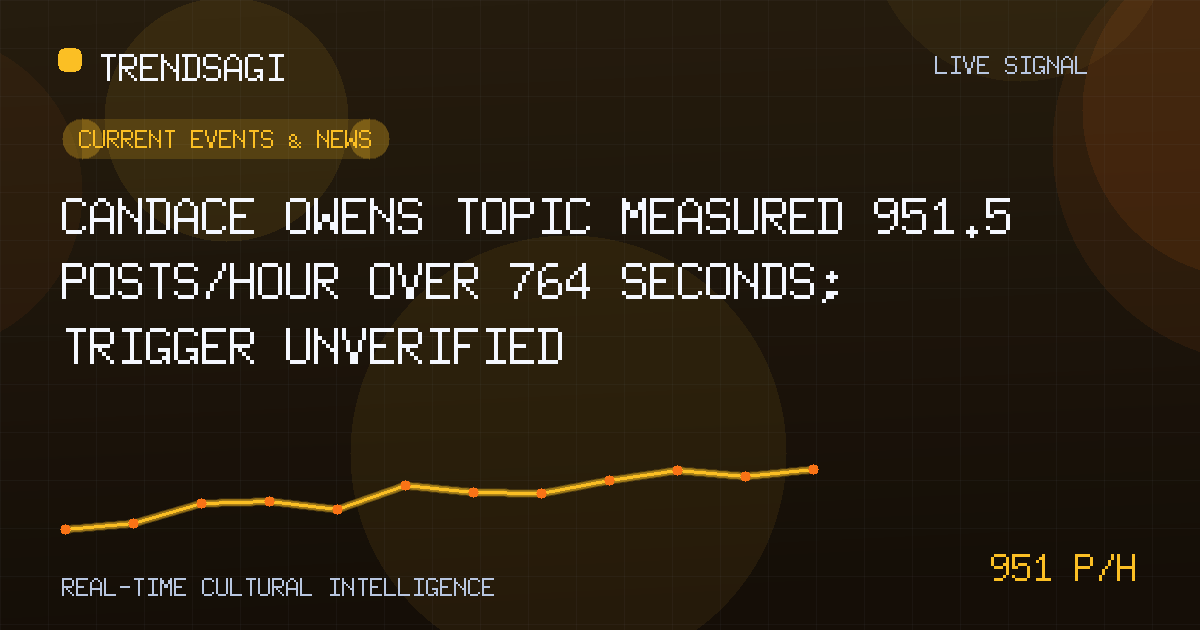
Candace Owens topic measured 951.5 posts/hour over 764 seconds; trigger unverified
A stored Candace Owens snapshot logged 389 posts and a measured 951.5 posts/hour over 764 seconds; the trigger and persistence remain unverified.
Automated briefing. Generated from stored signal measurements and source-backed research; it is not manually reviewed. Read the methodology and limitations.
Metrics in this briefing are a snapshot associated with its publication date and may not reflect current conditions.
What changed
The Candace Owens topic shows a concentrated short-window burst in the stored signal, but the reason for the movement is not verified. The latest snapshot, observed at 2026-09-29T11:54:07Z, contains 389 posts. The supplied change measurement is 951.5 posts/hour across an exact 764-second window using 3 stored observations.
The 951.5 figure is a measured snapshot rate, not a live or current rate, forecast, reach figure, engagement metric, or unique-person count. The 389 figure is the volume captured in the latest snapshot, not a rate. Together they establish a concentrated change inside this window, but not whether activity persists, why it occurred, or whether it represents broad public interest.
| Metric | Stored value |
|---|---|
| Observation time | 2026-09-29T11:54:07Z |
| Measured snapshot rate | 951.5 posts/hour, based on 3 observations across 764 seconds |
| Snapshot volume | 389 posts |
Why this topic may be moving
The signal is categorized as Current Events & News, but that category is not evidence of a specific trigger. No descriptive cause was stored, and the record contains no independently verified public context tying the observation to a particular event. Naming an event as the cause would therefore be speculation.
Several mechanisms could create this pattern and should be treated as hypotheses to test:
- New public material: A newly published interview, statement, video, or report could prompt a rapid response. The test is whether the earliest high-volume posts cite that item.
- Resurfacing content: Older material could re-enter the feed through recommendations or sharing. Timestamps and source lineage would distinguish recirculation from a genuinely new event.
- Amplification rather than new discussion: Quote-posts, repeated text, or automated accounts could lift volume without equally broad participation. Account-level and duplication checks are needed.
- Distribution changes: A platform surface could give existing posts more visibility without a new real-world development. This remains possible only if feed-level evidence supports it.
- Topic-classification noise: Ambiguous or unrelated uses of the name could be included. A manual sample of the earliest and most frequent posts would show whether classification error contributed.
A measured burst establishes that posts accumulated quickly in the observed feed. It does not establish which event caused them, who participated, or whether the attention was organic, amplified, or sustained.
Why it matters
The signal is useful as an alert, not as a verdict. Its practical value is to direct verification toward the relevant time window and source trail before the burst disappears.
- For editors and newsrooms: A fast-moving topic may warrant checking for a developing public event, but it should not be assigned a cause from volume alone.
- For communications and monitoring teams: The alert can expose a potential exposure issue or conversation spike; source concentration and duplication help determine whether a response is warranted.
- For researchers: The measurements are not a public-opinion sample and cannot establish sentiment, demographics, geography, or organic reach.
- For readers: High posting velocity does not mean importance, accuracy, or consensus. In this record, it means that the monitored topic changed quickly at the stated observation time.
The key decision is whether the signal is sufficiently corroborated to explain, report, or respond. On the present record, it is sufficient to prompt a check, but not to make a causal claim.
What to watch next
The next checks should separate persistence, cause, and participation:
- Persistence: Compare later stored windows of comparable length. Continued elevation would support an ongoing topic, while a quick decline would mark the current signal as transient. The current rate should not be extrapolated forward.
- Causal alignment: Inspect the earliest high-volume posts and the primary pages they cite. Their timestamps should precede or align with the onset of the measured burst.
- Account concentration: Check whether a small group of accounts supplies much of the volume. Concentration raises an amplification concern, although it does not prove automation or coordination.
- Content duplication: Measure repeated text, quote-posts, and near-identical messages. A high duplicate share would mean that raw post count overstates distinct conversation.
- Narrative diversity: Review whether participants discuss different claims and contexts or merely repeat one phrase. Narrative variety is a better indicator of distinct discussion than raw totals.
- Verified public context: Use Google Search to find exact phrases and candidate artifacts from the earliest posts, then verify the matching publisher or primary page. Search snippets alone are not confirmation.
- Independent pickup: Look for timestamped reporting or public references that identify the same trigger. Independent confirmation is stronger than many posts repeating an unverified claim.
A credible explanation should align with the onset, appear in the earliest posts, and be followed by activity in later windows. If that chain is missing, the cause should remain explicitly unknown.
Methodology and limitations
This briefing uses the supplied topic record. The latest observation is timestamped 2026-09-29T11:54:07Z and contains 389 posts. The reported change rate of 951.5 posts/hour is a measured snapshot rate derived from 3 stored observations across an exact 764-second window.
No baseline, longer time series, platform breakdown, account-level records, engagement data, geographic mix, sentiment coding, or verified causal source is present. The counting rules for originals, replies, quote-posts, and duplicates are also unspecified. As a result, the signal cannot establish persistence, reach, sentiment, authenticity, coordination, or causation.
Confidence is high that these are the supplied stored measurements, but confidence in any explanation of why the topic moved is insufficient. No external event is asserted because the record contains no independently verified match.
Track This Topic for New Signals
Set alerts for future velocity or sentiment changes around this topic.
Explore Tracking PlansAbout TrendsAGI research
TrendsAGI's automated research pipeline publishes dated signal snapshots, methodology notes, and practical workflows for teams evaluating cultural momentum. Read how signals are scoped, scored, and limited in our research methodology.