1787-second window · 3 observations · Measured Sep 30, 2026, 12:55 AM UTC · Provider: go_recent_snapshot_v2
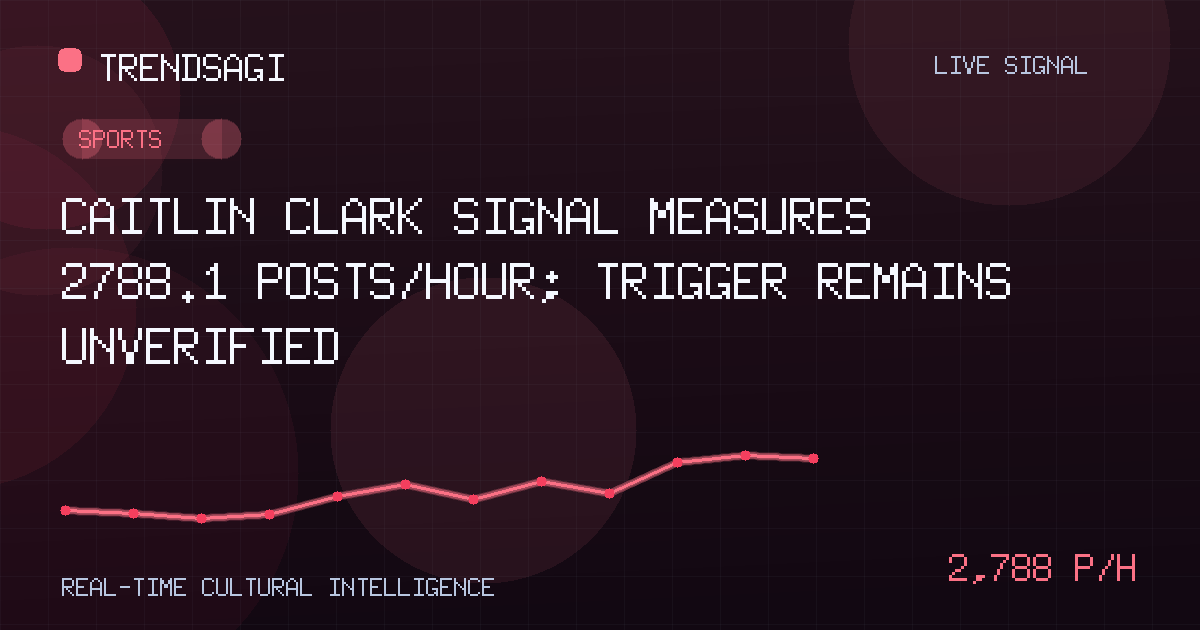
Caitlin Clark signal measures 2788.1 posts/hour; trigger remains unverified
The Caitlin Clark signal measures 2788.1 posts/hour over 1787 seconds; the trigger is unverified, so editors should verify before acting.
Automated briefing. Generated from stored signal measurements and source-backed research; it is not manually reviewed. Read the methodology and limitations.
Metrics in this briefing are a snapshot associated with its publication date and may not reflect current conditions.
What changed
The latest stored snapshot records Caitlin Clark-related activity at a measured 2788.1 posts/hour, but the cause of the movement is not verified. The signal is enough to justify a fast check of sports news and official channels; it is not enough to attribute the activity to a game, injury, announcement, record, or controversy.
The 2788.1 figure is a measured snapshot rate over an exact 1787-second window using 3 stored observations, with an observation time of 2026-09-30T00:55:40Z. The latest snapshot volume is 1800 posts. Volume is not a rate, and neither figure is a live or current estimate, forecast, reach, engagement, or unique-person count.
| Observation time | Measured posts/hour | Snapshot volume |
|---|---|---|
| 2026-09-30T00:55:40Z | 2788.1 posts/hour | 1800 posts |
Why this topic may be moving
The available record contains no event, statement, result, or timestamped public report that can be verified as the trigger. The cause is therefore unclear. A concentrated flow of topic posts can have several origins, and the aggregate numbers do not distinguish among them.
These possibilities should be treated as verification targets, not conclusions:
- Competition: A result, milestone, schedule item, or change in an event could be generating reaction. Confirm it with a dated first-party item before naming it as the cause.
- Availability: A roster, participation, health, or status update could be driving attention. Check the relevant official announcement and distinguish confirmed information from speculation.
- Media: A new interview, quote, transcript, or reported exchange could be the source. Verify the original wording and publication time.
- Secondary spread: A clip, screenshot, controversy, or inaccurate recap could be spreading through reposts. Trace it to the original material and determine whether the posts are independent reactions or copies.
Sampling the 1800 posts by source and timestamp would help show whether discussion centers on one development, several developments, or mostly repetition. That check is essential before assigning a cause.
A measured posting rate is a prompt to verify, not proof of what happened. Until a public source identifies the event, the defensible conclusion is activity at the measured rate, with no established cause.
What the signal can establish
The observation establishes that the Caitlin Clark topic was generating posts during the measured window and provides a checkpoint for later comparison. It supports a narrow operational conclusion: fact-checking deserves priority.
- The topic snapshot contained 1800 posts at the stated observation time.
- The separately measured posting rate was 2788.1 posts/hour over 1787 seconds.
- The combination is sufficient to trigger verification and source-level review.
It does not establish that activity was high relative to Clark’s normal baseline because no earlier rate is supplied; that it exceeded other sports topics because no comparator is supplied; or that it continued after the measured window. The aggregate also cannot show who posted, whether accounts were unique, whether content was authentic, or whether sentiment was positive or negative.
Why it matters
For sports and social editors, the immediate risk is a causal error. A posting measurement can guide checking effort, but it cannot supply the missing event or justify a headline on its own. Reporting should wait for the distinction between “discussion increased after a verified development” and the much stronger, unsupported claim that the development caused the activity.
For communications teams, a high-volume topic is not evidence of broad awareness, consumer intent, or a crisis. It should not be used as a count of affected people or as a forecast of attention. A verified first-party event would provide context for assessing editorial relevance, while persistence would still require a separate subsequent measurement.
Who should care
The users with the most immediate need are sports and social editors, reporters, audience analysts, and communications staff monitoring sports-related conversation. Readers seeking an explanation also need a clear separation between the measured activity and the unverified cause. For all of these groups, the correct response is to investigate the source and timing, not simply repeat the metric or amplify an unconfirmed explanation.
What to watch next
- First-party trigger: Look for a dated result, schedule, roster or status notice, official statement, interview, or transcript that aligns with the observation window. Record its exact publication time.
- Independent corroboration: Check whether credible public reporting identifies and describes the same item. Posts that merely mention Clark do not corroborate a cause.
- Source distribution: Review the 1800-post sample for original posts, official links, replies, quotations, screenshots, and duplicates. Concentration around one source would support focused verification; dispersed posts would require a broader explanation.
- Subsequent window: Gather another 1787-second measurement using the same topic definition and collection method. That comparison can test persistence rather than treating the snapshot rate as live activity.
- Historical baseline: Compare earlier Clark snapshots and contemporaneous sports topics. Without those comparisons, any claim that the activity was unusual would remain unproven.
- Content integrity: Verify visual and audio material, quoted text, dates, names, and surrounding context. A widely repeated item can be inaccurate even when its posting volume is high.
- Follow-on response: Watch for an official clarification, correction, participant reaction, or additional reporting, each with its own timestamp. Any resulting response would be a distinct signal rather than proof of the original trigger.
Methodology and limitations
This briefing reports the supplied observation series: 3 stored observations across an exact 1787-second window, measured at 2026-09-30T00:55:40Z. The latest snapshot contains 1800 posts, while the separately supplied measured snapshot rate is 2788.1 posts/hour. The two numbers answer different questions and should not be substituted for one another.
The available record does not specify the platform, geography, collection thresholds, observation overlap, deduplication method, account counts, sentiment, or comparison periods. It also provides no verified external event. For that reason, this briefing reports the activity but does not name a cause. The rate remains a measured snapshot rate rather than a live estimate; any later causal or comparative claim should be tied to timestamped public evidence and a consistent subsequent measurement.
Track This Topic for New Signals
Set alerts for future velocity or sentiment changes around this topic.
Explore Tracking PlansAbout TrendsAGI research
TrendsAGI's automated research pipeline publishes dated signal snapshots, methodology notes, and practical workflows for teams evaluating cultural momentum. Read how signals are scoped, scored, and limited in our research methodology.