1433-second window · 3 observations · Measured Aug 30, 2026, 2:42 PM UTC · Provider: go_recent_snapshot_v2
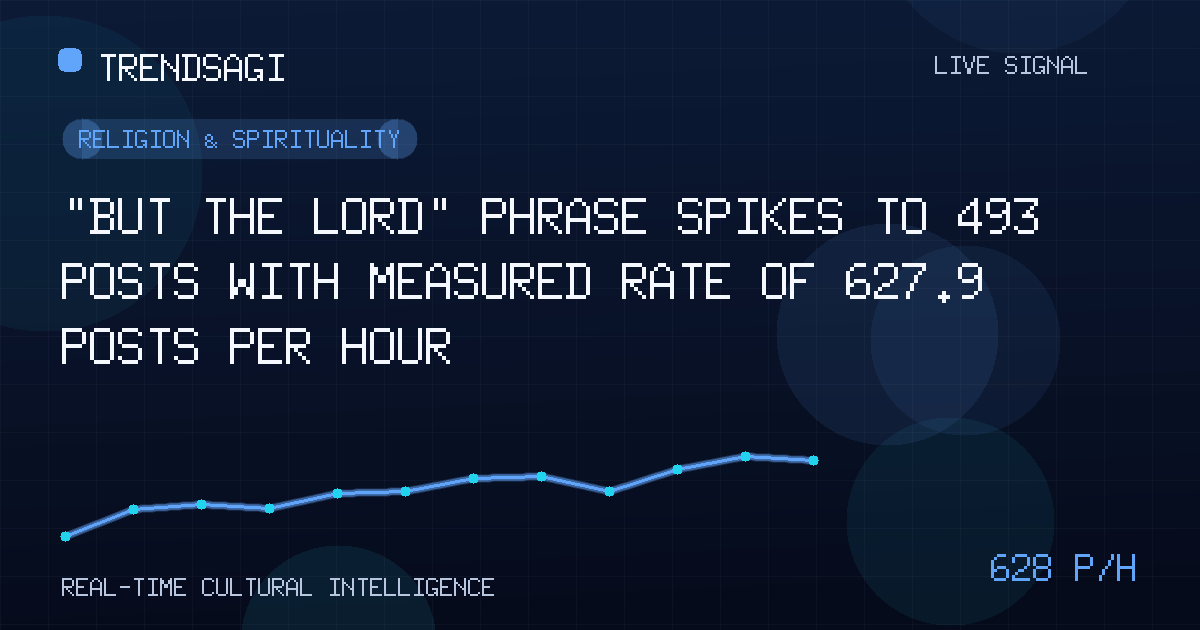
"But the Lord" phrase spikes to 493 posts with measured rate of 627.9 posts per hour
Measured snapshot shows 493 posts for "But the Lord" at 627.9 posts/hour; cause unverified. Briefing explains signal limits, stakeholder relevance, and
Automated briefing. Generated from stored signal measurements and source-backed research; it is not manually reviewed. Read the methodology and limitations.
Metrics in this briefing are a snapshot associated with its publication date and may not reflect current conditions.
What changed
The phrase "But the Lord" generated 493 posts in a single snapshot captured at 2026-08-30T14:42:19Z. Over a 1,433-second window (approximately 23.9 minutes) spanning three stored observations, the system measured a snapshot rate of 627.9 posts per hour. This rate reflects the velocity observed during that specific measurement window, not a live or projected figure. The signal falls under the Religion & Spirituality category, but the stored description is empty, leaving the immediate driver unidentified.
| Metric | Value |
|---|---|
| Observation time (UTC) | 2026-08-30T14:42:19Z |
| Measured posts/hour (snapshot rate) | 627.9 |
| Snapshot volume | 493 posts |
Why this topic may be moving
The phrase "But the Lord" appears in multiple biblical passages, most notably 2 Thessalonians 3:3 ("But the Lord is faithful") and 2 Timothy 4:17 ("But the Lord stood with me"). It also surfaces in hymn lyrics, sermon titles, and devotional content. Without a verified external trigger—such as a viral sermon clip, a denominational controversy, a celebrity faith announcement, or a liturgical calendar event—the cause of this spike remains unclear. The measured rate of 627.9 posts per hour over a short window suggests a coordinated or reactive burst rather than steady organic growth. Possible catalysts include a trending audio clip on short-form video platforms, a scheduled lectionary reading shared across church social accounts, or a meme format appropriating the phrase for humorous or polemical effect. Until platform-level context (hashtags, account types, media attachments) is examined, attribution is speculative.
Why it matters
For researchers of digital religion, this signal illustrates how scriptural fragments can detach from their liturgical context and circulate as standalone linguistic units. A spike of nearly 500 posts in one snapshot, with a measured hourly velocity exceeding 600, indicates that the phrase reached a threshold of algorithmic amplification on at least one platform. Content moderators and trust-and-safety teams should note that religious language spikes can precede coordinated inauthentic behavior, targeted harassment of faith communities, or the spread of misinformation framed as theological authority. Marketers and communications teams at faith-based organizations may see an unplanned opportunity to insert relevant resources into the conversation, provided they authenticate the conversation's tone first. Journalists covering religion and technology should treat the volume as a lead, not a story: the phrase itself carries no inherent news value without the surrounding discourse.
A measured snapshot rate above 600 posts per hour for a three-word scriptural fragment signals platform-level amplification, not necessarily theological relevance. The signal tells us that attention clustered; it does not tell us why or by whom.
What to watch next
- Platform distribution: Check whether the volume concentrates on X (Twitter), TikTok, Instagram Reels, YouTube Shorts, or Facebook Groups. Cross-platform spread suggests broader cultural resonance; single-platform clustering suggests algorithmic or community-specific drivers.
- Media format: Determine if posts are text-only, image macros, video clips with caption overlays, or audio-driven trends. Video and audio formats often indicate a specific creator or sound bite as the catalyst.
- Account typology: Identify whether posters are verified clergy accounts, institutional church pages, lay influencers, anonymous meme accounts, or bot-like amplifiers. A high ratio of new or low-follower accounts posting identical phrasing warrants scrutiny for coordinated activity.
- Geographic and linguistic spread: Map the spike to regions and languages. A U.S.-centric, English-only burst points to domestic church calendar or media events; multilingual spread suggests a global denominational trigger or translated viral content.
- Adjacent hashtags and phrases: Collect co-occurring tags (e.g., #faith, #scripture, #dailyverse, #christiantiktok, #exvangelical) to infer the conversation's frame—devotional, apologetic, deconstruction, or satire.
- Persistence: Monitor the next 6–24 hours for decay or secondary peaks. A rapid drop-off suggests a fleeting trend; a sustained plateau or second wave indicates an ongoing event or narrative.
Methodology and limitations
The snapshot volume of 493 posts and the measured rate of 627.9 posts per hour derive from three discrete observations spanning exactly 1,433 seconds, anchored at 2026-08-30T14:42:19Z. The rate is a calculated snapshot velocity for that window only; it is not a real-time feed, a forecast, a reach estimate, an engagement metric, or a count of unique individuals. The stored signal carries no descriptive metadata, so the category assignment (Religion & Spirituality) is the sole contextual label. No external verification of a triggering event was possible at publication time; the cause remains unspecified. Readers should treat the figures as observational artifacts of the monitoring system, not as comprehensive measures of public discourse volume.
Track This Topic for New Signals
Set alerts for future velocity or sentiment changes around this topic.
Explore Tracking PlansAbout TrendsAGI research
TrendsAGI's automated research pipeline publishes dated signal snapshots, methodology notes, and practical workflows for teams evaluating cultural momentum. Read how signals are scoped, scored, and limited in our research methodology.