15-minute window · 3 observations · Measured Sep 29, 2026, 9:21 PM UTC · Provider: go_recent_snapshot_v2
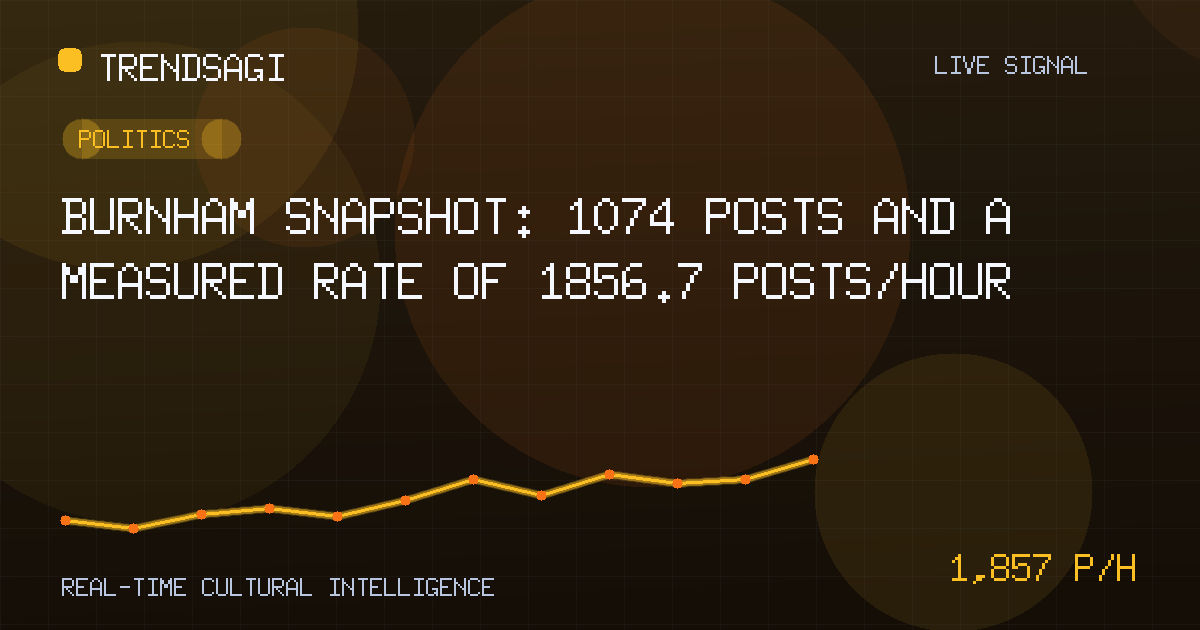
Burnham snapshot: 1074 posts and a measured rate of 1856.7 posts/hour
Burnham shows 1074 posts in the latest snapshot and a measured 1856.7 posts/hour rate, with key evidence gaps and next checks.
Automated briefing. Generated from stored signal measurements and source-backed research; it is not manually reviewed. Read the methodology and limitations.
Metrics in this briefing are a snapshot associated with its publication date and may not reflect current conditions.
What changed
The direct answer is that Burnham shows a high-volume posting burst, but the reason for it is not established. The latest snapshot, observed at 2026-09-29T21:21:33Z, contains 1074 posts. Across an exact 900-second window using 3 stored observations, the measured change is a snapshot rate of 1856.7 posts/hour.
This is a measured snapshot rate, not a live or current rate, forecast, reach, engagement, or unique-person count. It also does not prove that the topic is higher than its own prior baseline because no comparable earlier rate is supplied. The 1074 figure is snapshot volume, not a rate. The two values should not be treated as covering the same period: the snapshot aggregation window and its relationship to the exact 900-second rate window are unspecified. The defensible conclusion is therefore narrow: substantial recorded activity occurred around the Burnham label, but both the comparison baseline and the trigger need further checking.
| Measure | Stored value |
|---|---|
| Observation time | 2026-09-29T21:21:33Z |
| Measured snapshot rate | 1856.7 posts/hour |
| Latest snapshot volume | 1074 posts |
Why this topic may be moving
The cause is unclear. The stored record includes no descriptive text or verified public context connecting the label to a specific event. Its Politics category is a classification, not proof of a political trigger, and the label itself does not establish which entity is being discussed.
The following are checks to investigate, not causal findings:
- Entity mismatch: Posts may use the same label for different people, topics, places, or stories, causing a high count to combine unrelated conversations.
- Event reaction: A verified announcement, speech, poll, controversy, or other news event may be generating replies. No such trigger has been verified here.
- Repetition and recirculation: Copied posts, quote posts, or repeated linking can lift topic volume without an equivalent amount of original reporting or commentary.
- Platform or coordination effects: Scheduled publishing, a coordinated account cluster, or exposure through platform trend systems could contribute. The stored totals do not distinguish these patterns.
A fast topic label is a reason to investigate, not evidence that a particular event caused the activity.
What the signal can establish
The signal establishes that the monitored label recorded 1074 posts in the latest stored snapshot and that the supplied calculation produced 1856.7 posts/hour over its defined window. It provides a time-stamped monitoring point that can support comparison only if later observations use compatible collection and measurement methods.
It does not establish:
- why the volume changed or whether an identifiable event preceded it;
- whether activity is sustained, accelerating, or already fading;
- how many unique people participated or whether they were highly active;
- the reach, engagement, sentiment, geography, or authenticity of the posts;
- whether every item is political, despite the stored category.
The rate is also based on only 3 stored observations. That is enough to describe the supplied measurement, but not enough to establish a durable trajectory or compare the burst with normal activity for this topic.
Why it matters
For editors and publishers, entity resolution is the immediate risk. Assigning the spike to the wrong Burnham could attach a real number to an incorrect story. The volume is measurable; the identity and meaning are not yet secure.
For political researchers and watchers, the signal identifies a conversation cluster worth sampling. It does not show public consensus, importance, or the origin of the discussion. Raw volume can exaggerate both significance and persistence when repeated or coordinated posts are mixed with original contributions.
For communications and monitoring teams, the practical warning is to avoid acting on the label alone. A response built on an assumed event or person could amplify confusion. Identity, source provenance, and a verified trigger should be confirmed before the spike is described as a reaction to news.
What to watch next
- Resolve the entity: Review a representative sample from the measured window, group posts by the full names and descriptions used, and separate conversations that merely share the label.
- Find original provenance: Trace the earliest verifiable item and subsequent citations. Distinguish original posts from copies, quote posts, summaries, and reactions that reuse the same source.
- Look for independent convergence: Check whether verified publishers, official accounts, or other primary sources point to the same event. Repetition of one claim is weaker evidence than independent confirmation.
- Test persistence: Compare subsequent snapshots only when collection rules, topic matching, and measurement windows are compatible. A single burst should not be presented as an ongoing trend.
- Examine composition: Compare account history, posting cadence, language, geography, and source mix. Volume alone cannot establish automated or coordinated behavior.
- Watch for a combined confirmation signal: The strongest explanation would connect a clearly identified entity to a verified event, precede the increase in time, and appear across multiple independent original posts.
Until those checks converge, the useful watch signal is not simply more raw volume. It is a named entity plus a verified event and traceable original sources.
Methodology and limitations
The reported 1856.7 posts/hour figure was measured at 2026-09-29T21:21:33Z from 3 stored observations across an exact 900-second window. It is a measured snapshot rate, not a live or current rate. The 1074-post figure is the latest snapshot volume. Because the relationship between the snapshot aggregation window and the rate window is not specified, the rate should not be converted into a post total or used to revise the snapshot count.
No comparable earlier rate, account-level data, geographic breakdown, or verified event context is supplied. Those omissions prevent a causal explanation, baseline comparison, or assessment of unique participation. The cause of the Burnham movement therefore remains unresolved rather than being filled with speculation.
Track This Topic for New Signals
Set alerts for future velocity or sentiment changes around this topic.
Explore Tracking PlansAbout TrendsAGI research
TrendsAGI's automated research pipeline publishes dated signal snapshots, methodology notes, and practical workflows for teams evaluating cultural momentum. Read how signals are scoped, scored, and limited in our research methodology.