911-second window · 3 observations · Measured Oct 5, 2026, 10:55 PM UTC · Provider: go_recent_snapshot_v2
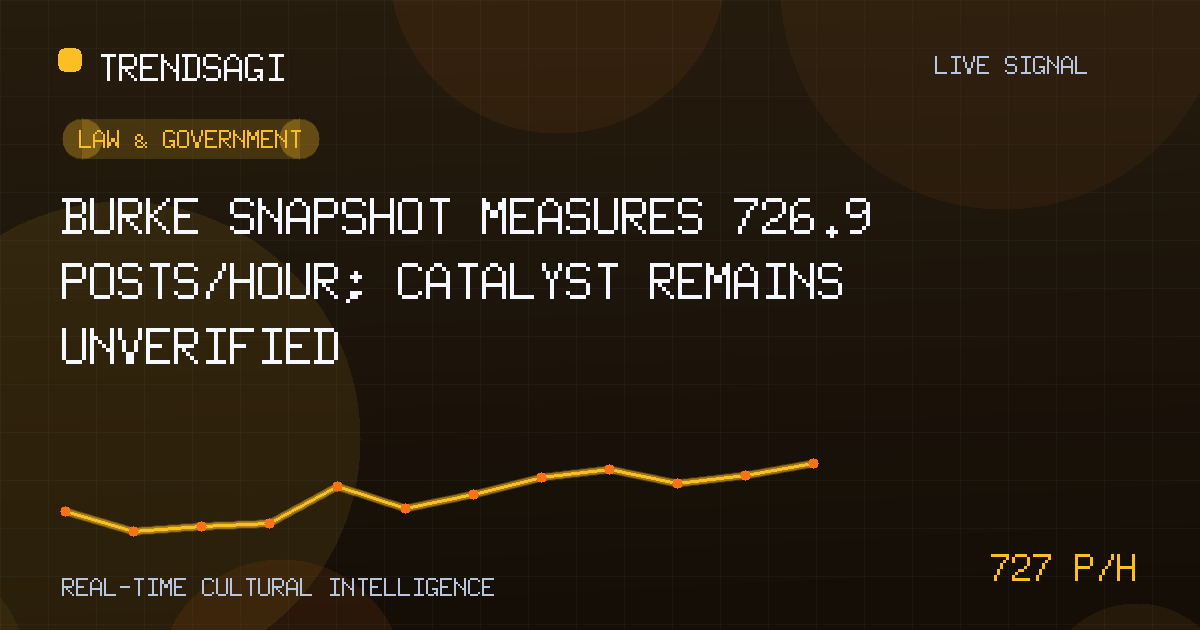
Burke snapshot measures 726.9 posts/hour; catalyst remains unverified
Burke's snapshot shows 726.9 posts/hour and 320 posts, but the subject and cause require verification before interpretation.
Automated briefing. Generated from stored signal measurements and source-backed research; it is not manually reviewed. Read the methodology and limitations.
Metrics in this briefing are a snapshot associated with its publication date and may not reflect current conditions.
What changed
Burke showed a burst of posting activity in the latest stored signal, but the record does not identify which Burke was involved or verify a public event as the cause. The measured snapshot rate was 726.9 posts/hour.
That figure covers an exact 911-second window using three stored observations and was measured at 2026-10-05T22:55:20Z. The latest snapshot volume was 320 posts. The rate is not a live or current rate, forecast, reach measure, engagement count, or unique-person count; the 320-post figure is snapshot volume, not another hourly rate.
| Observation time | Measured posts/hour | Snapshot volume |
|---|---|---|
| 2026-10-05T22:55:20Z | 726.9 | 320 posts |
In practical terms, the signal establishes a positive change in labeled post activity during a short, defined observation window. It does not show that attention persisted after the snapshot, nor that all 320 posts concerned one subject, event, organization, or person.
Why this topic may be moving
The signal is filed under Law & Government, but that is only a classification. No explanatory description or cited, verified public development is attached to the increase. A broad category cannot resolve the label or establish causation.
Several mechanisms could produce a short burst, but each remains a hypothesis until tested against post content and timestamps.
- A time-specific legal or government development involving a person, place, institution, or matter called Burke—for example, a filing, hearing, decision, appointment, investigation, vote, or statement—could drive fresh discussion.
- A previously prominent legal or government story could resurface through a report, hearing, anniversary, or renewed social conversation.
- Several unrelated people, places, organizations, or cases could share the word Burke, causing one monitoring label to combine separate conversations.
- Broad matching, automated accounts, repeated text, or collection changes could inflate the apparent movement without a single underlying event.
These explanations make different predictions. A real catalyst should connect an identifiable subject and a public event that precedes the activity. An ambiguity or artifact should instead show mixed identities, duplicated content, or a pattern confined to the measurement system.
Why it matters
For editors, the first question is not simply whether Burke is busy; it is what the label denotes and whether the activity reflects a consequential development. A vague label can send a breaking-news team toward the wrong subject.
- Legal and government analysts should care if the posts resolve to a court, office, agency, elected official, or policy matter, because discussion may precede or amplify institutional change.
- Communications and public-affairs teams should monitor whether verified reporting converges on one subject; volume alone is not evidence of a crisis, scandal, or policy impact.
- Researchers should preserve the label ambiguity and avoid treating posts as unique people, consensus, sentiment, or geographically representative public opinion.
- Readers should receive the event name, timestamp, and evidence before being told why the topic is moving.
A high posting rate establishes temporal activity under a label; it does not establish that the label denotes one person, one event, or one cause. A causal explanation becomes credible only when identity, timing, and source provenance converge.
Misreading this signal could create false urgency, attribute discussion to the wrong Burke, or bury a real legal or government development in unrelated noise.
What to watch next
The next useful step is to turn the aggregate rate into a verifiable timeline without pretending the label already has a known referent.
- Resolve the referent. Inspect a representative sample of post text, account names, linked source names, and quoted entities. Separate references to people, places, organizations, proceedings, and unrelated uses; do not infer identity from the surname alone.
- Keep measurement comparable. Record subsequent snapshots with the same collection method and cadence, then compare whether the measured rate persists, recedes, or reverses. Do not compare the 320-post snapshot volume as though it were an hourly rate.
- Build an event chronology. Check whether a court filing, hearing, government decision, official statement, appointment, vote, or investigation occurred before the measured window. A verified event timestamp is more informative than later commentary about it.
- Seek independent corroboration. Determine whether multiple credible publishers or official bodies describe the same Burke-related event. Repetition across sources strengthens identity and timing; repetition of one unsupported post does not.
- Examine composition and spread. Look for repeated wording, coordinated posting, geographic and language concentration, high-authority sources, and changes in the mix of original reporting versus commentary. These are diagnostics, not proof by themselves.
- Test the alternatives. If sampled posts refer to different subjects, if no primary record matches the timing, or if activity disappears outside one window, the case for a single event-driven catalyst should weaken.
A stronger causal assessment would require the same named subject, a verified event before the burst, independent reporting, and persistence across comparable observations. Continued volume without those features should remain an unresolved monitoring signal rather than a news conclusion.
Methodology and limitations
The reported 726.9 posts/hour is a measured snapshot rate derived from three stored observations over an exact 911-second window ending at 2026-10-05T22:55:20Z. It describes change during that interval. It is not a live or current rate, forecast, reach, engagement, or unique-person count.
No post-level examples, baseline history, source distribution, sentiment, geography, audience data, or verified public catalyst is included in the available signal record. With three observations, the measure cannot establish a durable trend, a normal baseline, or what happened afterward. The latest snapshot volume of 320 posts records size at that observation, while 726.9 posts/hour records the measured change rate. The Law & Government tag may help route the signal, but it cannot identify the underlying Burke. The defensible conclusion is therefore narrow: labeled activity rose during the measured window, and the reason remains unverified.
Track This Topic for New Signals
Set alerts for future velocity or sentiment changes around this topic.
Explore Tracking PlansAbout TrendsAGI research
TrendsAGI's automated research pipeline publishes dated signal snapshots, methodology notes, and practical workflows for teams evaluating cultural momentum. Read how signals are scoped, scored, and limited in our research methodology.