756-second window · 3 observations · Measured Oct 7, 2026, 3:09 PM UTC · Provider: go_recent_snapshot_v2
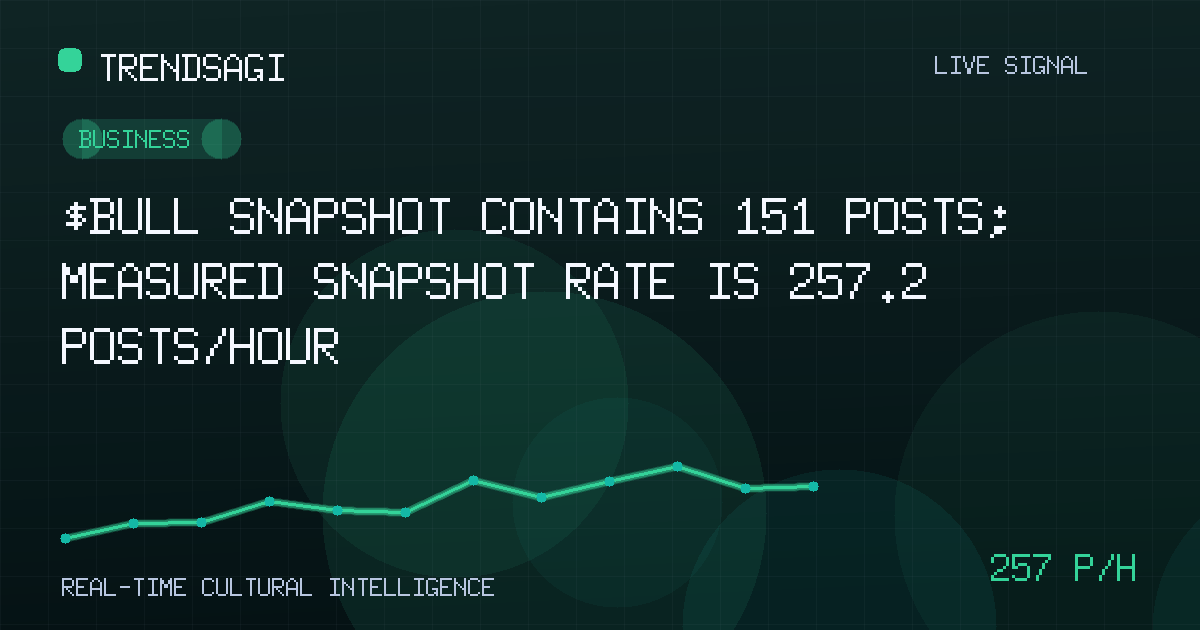
$BULL snapshot contains 151 posts; measured snapshot rate is 257.2 posts/hour
The $BULL snapshot held 151 posts with a measured snapshot rate of 257.2 posts/hour; volume is not a verified catalyst.
Automated briefing. Generated from stored signal measurements and source-backed research; it is not manually reviewed. Read the methodology and limitations.
Metrics in this briefing are a snapshot associated with its publication date and may not reflect current conditions.
What changed
The latest snapshot for the stored $BULL topic contained 151 posts, observed at 2026-10-07T15:09:26Z. Across an exact 756-second window using 3 stored observations, the signal's measured snapshot rate was 257.2 posts/hour. The direct read is a short-window cluster of posting around the label at that observation. This is a measured snapshot rate, not a live or current rate, forecast, reach, engagement, or unique-person count.
Why the topic was moving is not verified. No confirmed public catalyst was established for this briefing, and the stored Business category, without a supporting description, does not identify the company, security, person, product, or other entity that $BULL denotes. The signal establishes label-level activity in the sampled window, but not sentiment, organic spread, financial relevance, or a causal event.
| Observation time | 2026-10-07T15:09:26Z |
|---|---|
| Measured snapshot rate | 257.2 posts/hour |
| Latest snapshot volume | 151 posts |
Why this topic may be moving
With no verified cause, the responsible conclusion is unresolved. Several explanations remain testable rather than proven:
- Entity ambiguity. A cashtag-style string is not enough to establish what is being discussed. The underlying posts may need to show a consistent company name, ticker, exchange, asset type, or other identifier before the signal can be assigned to a subject.
- Repetition or automation. Duplicate language, quote posts, repost chains, or automated accounts could contribute to a short-window rate. The stored measure does not separate those patterns from distinct human discussion.
- A real-world catalyst. A verified announcement, filing, news report, or market event could explain a cluster, but no attributable event has been established here. Publication time and the first observed posting time should be compared before causality is claimed.
- Category effects. Business is a classification, not proof that a business event occurred. It may describe a collection bucket or dominant context rather than the reason the label was posted.
None of these possibilities is confirmed by the supplied signal. The rate can therefore function as an investigative lead, not a diagnosis.
The signal is an investigation trigger, not a market conclusion: it measures posting activity around the label, while the subject, cause, authorship pattern, and consequence remain unverified.
Why it matters
For investors and traders: A rising post count can encourage closer inspection of a cashtag-like label, but it provides no evidence of buying pressure, price direction, or market importance. Entity resolution and a verified catalyst should come before any investment interpretation.
For editors and corporate communications teams: An ambiguous label creates a separate risk: teams may monitor, mention, or respond to the wrong entity. The 151-post snapshot is a reason to inspect the underlying conversation, not evidence that a particular organization is involved or under pressure.
For researchers and data teams: The observation is useful for anomaly detection and queue prioritization. It should be deduplicated and compared with authorship and historical patterns before it is used as evidence of organic attention, coordinated activity, or sentiment.
What to watch next
The next checks should turn a volume anomaly into a decision-ready signal:
- Resolve the entity. Inspect representative original posts and author context for a repeated full name, symbol, venue, or sector. Consistent identification across the cluster matters more than the label alone; similar spellings should not be merged without evidence.
- Establish chronology. Locate the first concentration of posts, then compare it with timestamped announcements or reporting about the exact entity. A verified event that clearly precedes the cluster is stronger context than an event found afterward.
- Test authenticity. Count distinct authors, repeated text, quote-post ratios, account concentration, and cross-platform spread. Activity led by a small set of repetitive accounts calls for a different interpretation from broad participation.
- Build a comparable baseline. Compare equal windows under the same collection rules and query. Watch whether activity persists, reverses, or remains isolated; a single snapshot cannot establish a durable trend.
- Separate content types. Classify directional claims, factual references, questions, jokes, quotations, and generic tag use before assigning sentiment. Keyword presence alone is not evidence that participants agree.
- Confirm any downstream effect. If the resolved subject is financial, check independently verified price and liquidity data. If it is not, use the relevant audience or adoption measure. Social volume alone does not establish impact.
Concrete watch signals are a consistent full-name match across the cluster, a verified catalyst timestamped before the activity, participation by additional distinct authors, independent cross-platform spread, and persistence in later comparable windows. A reversal or concentration among duplicate accounts would weaken the trend interpretation.
Methodology and limitations
This briefing uses the supplied observation at 2026-10-07T15:09:26Z, the latest snapshot volume of 151 posts, and the measured snapshot rate of 257.2 posts/hour across an exact 756-second window using 3 stored observations. The snapshot volume and rate window are separate supplied measures; the 151 posts are not assumed to be the numerator of the rate, and the rate is not extrapolated beyond the observed window.
Only 3 observations support the measured rate, so its stability cannot be assessed. The signal does not provide post-level text, a historical baseline, distinct-author count, geography, language, engagement, source mix, sentiment, price data, or a verified catalyst. No attributable public explanation was established, so the reason for the movement remains unclear. The appropriate working conclusion is that $BULL generated measurable posting activity around the stated observation and warrants verification, not that a specific business or market event caused it.
Track This Topic for New Signals
Set alerts for future velocity or sentiment changes around this topic.
Explore Tracking PlansAbout TrendsAGI research
TrendsAGI's automated research pipeline publishes dated signal snapshots, methodology notes, and practical workflows for teams evaluating cultural momentum. Read how signals are scoped, scored, and limited in our research methodology.