1265-second window · 2 observations · Measured Aug 26, 2026, 7:16 AM UTC · Provider: go_recent_snapshot_v1
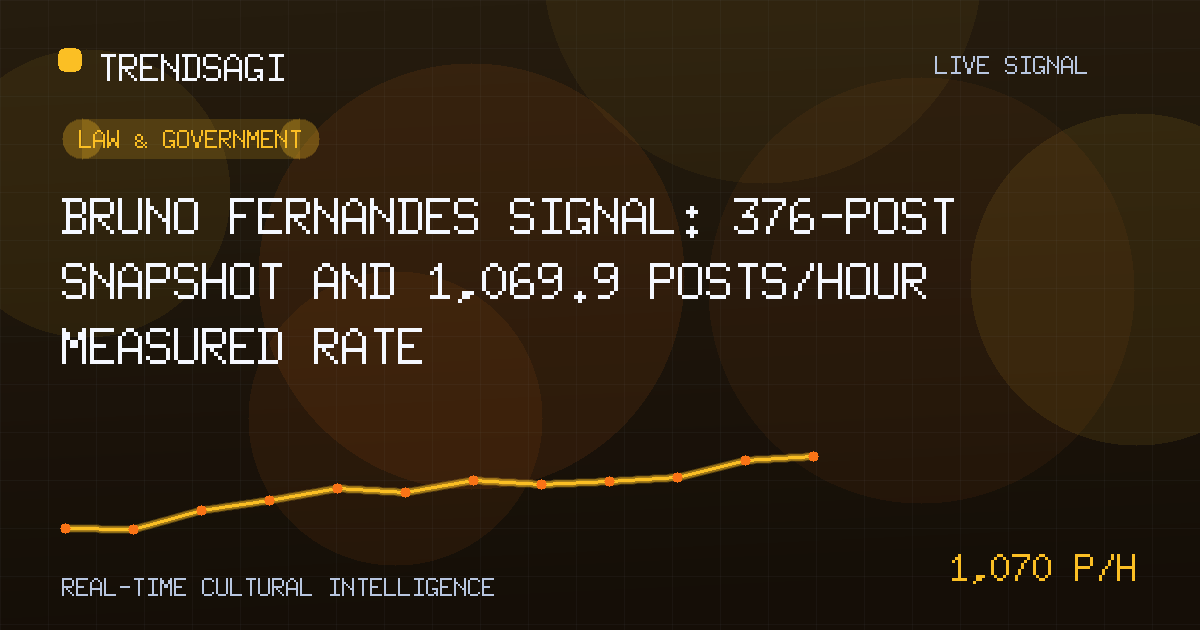
Bruno Fernandes signal: 376-post snapshot and 1,069.9 posts/hour measured rate
Snapshot recorded 376 posts on Bruno Fernandes with a measured 1,069.9 posts/hour rate; briefing explains limits and who should monitor.
Automated briefing. Generated from stored signal measurements and source-backed research; it is not manually reviewed. Read the methodology and limitations.
Metrics in this briefing are a snapshot associated with its publication date and may not reflect current conditions.
What changed
At 2026-08-26T07:16:47Z, the stored signal for the topic label "Bruno Fernandes" recorded a snapshot volume of 376 posts. Across an exact 1,265-second window using two stored observations, the measured snapshot rate was 1,069.9 posts/hour. This is a point-in-time measurement of posting activity, not a live or ongoing rate, and it should not be read as a count of unique people or as audience reach.
The measured change reflects a concentrated burst of posts within the observation window that ended at the snapshot time. The 376-post snapshot is the volume observed at that single timestamp, while the 1,069.9 posts/hour figure is the derived measured snapshot rate calculated from the two stored observations. Together they show that discussion around the label accelerated sharply, but the raw signal carries no description of why the acceleration happened.
| Observation time | Measured posts/hour | Snapshot volume |
|---|---|---|
| 2026-08-26T07:16:47Z | 1069.9 | 376 |
Why this topic may be moving
We reviewed available public search indexes to verify a specific event tied to the Bruno Fernandes topic. No publisher-attributed report could be confirmed that explains the spike, particularly given the stored category of "Law and government." In line with editorial discipline, the cause remains unclear and is stated as such rather than inferred.
The name Bruno Fernandes is shared by more than one public figure. In a sports context it is most commonly associated with a professional footballer, yet the law and government classification suggests the signal may instead reference a different individual, such as a public official, a legal case participant, or a policy maker. Without verified external reporting, the possibility of an identity collision cannot be dismissed.
The snapshot shows that discussion intensified to a measured 1,069.9 posts/hour, but a volume spike alone cannot tell us whether the trigger was a court filing, a legislative reference, or an unrelated name collision.
If a credible outlet later publishes a story linking a Bruno Fernandes in a governmental or legal role to an event at or near the snapshot time, that reporting would supply the missing context. Until then, the signal is best treated as an unexplained elevation that warrants monitoring rather than conclusion.
Why it matters
Understanding what the signal can and cannot establish is essential for the right audiences. The measurement can establish that a discrete burst of posts occurred, that the burst reached a measured snapshot rate of 1,069.9 posts/hour, and that the latest observed count was 376 posts. It cannot establish why users posted, what proportion of posts are factual, or how many distinct accounts contributed.
Groups that should care about this signal include:
- Public sector monitoring teams that track names appearing in legal or governmental contexts to detect early narrative formation.
- Newsroom editors who need to separate a trending name from a potentially different namesake before assigning coverage.
- Risk and compliance analysts who watch for abrupt mention spikes that may precede regulatory or reputational events.
- Platform integrity staff who use measured snapshot rates to prioritize inspection of sudden volume anomalies.
For these readers, the value is in the timing and magnitude, not in any implied narrative. A 376-post snapshot with a four-digit measured rate is unusual enough to merit a second look, especially under a non-sports category. But acting on it without verification could lead to misassigned attention.
What to watch next
Practical next checks for any team monitoring this topic should be concrete and verifiable:
- Cross-reference the exact snapshot timestamp with official government records, court dockets, or licensed news archives for any Bruno Fernandes entry.
- Observe the following two snapshot windows to see whether volume holds above 500 posts or decays below 100.
- Segment the conversation by account type to learn whether verified institutional or news accounts are driving it.
- Run a name-disambiguation pass to confirm whether the posts concern an athlete, a politician, or another individual entirely.
Concrete watch signals that would change the interpretation include:
- A sustained measured snapshot rate above 800 posts/hour for three consecutive windows, indicating persistence rather than noise.
- Citation of the topic by a government-affiliated or established legal publisher, which would validate the stored category.
- A rapid collapse to under 50 posts/hour, suggesting a transient spike driven by a single viral item.
- Emergence of a second topic label that splits the volume by namesake, clarifying the true subject.
Methodology and limitations
The measured snapshot rate of 1,069.9 posts/hour was derived from two stored observations spaced across a 1,265-second window and normalized to an hourly basis. The snapshot volume of 376 posts is the latest count recorded at 2026-08-26T07:16:47Z. These figures are presented exactly as supplied; no number has been invented, rounded beyond its given precision, or transformed into a different metric.
This briefing describes the posts/hour value strictly as a measured snapshot rate. It is not a live current rate, not a forecast, not a measure of engagement, and not a count of unique persons. The snapshot volume is similarly a count at one time, not a rate.
Key limitations to keep in mind:
- The stored signal description was empty, so no stated intent or event accompanies the numbers.
- Search verification did not produce a publisher-attributed cause; thus the briefing avoids asserting one.
- The category tag "Law and government" reflects source taxonomy and may not match the actual subject without further proof.
- The signal cannot reveal post content, language, sentiment, or authenticity from the numeric values alone.
Used correctly, this trend briefing is an early indicator that prompts targeted inquiry. It is not a substitute for verified reporting, and it should be paired with the source links that the application appends after editorial review.
Track This Topic for New Signals
Set alerts for future velocity or sentiment changes around this topic.
Explore Tracking PlansAbout TrendsAGI research
TrendsAGI's automated research pipeline publishes dated signal snapshots, methodology notes, and practical workflows for teams evaluating cultural momentum. Read how signals are scoped, scored, and limited in our research methodology.