895-second window · 3 observations · Measured Oct 24, 2026, 4:59 AM UTC · Provider: go_recent_snapshot_v2
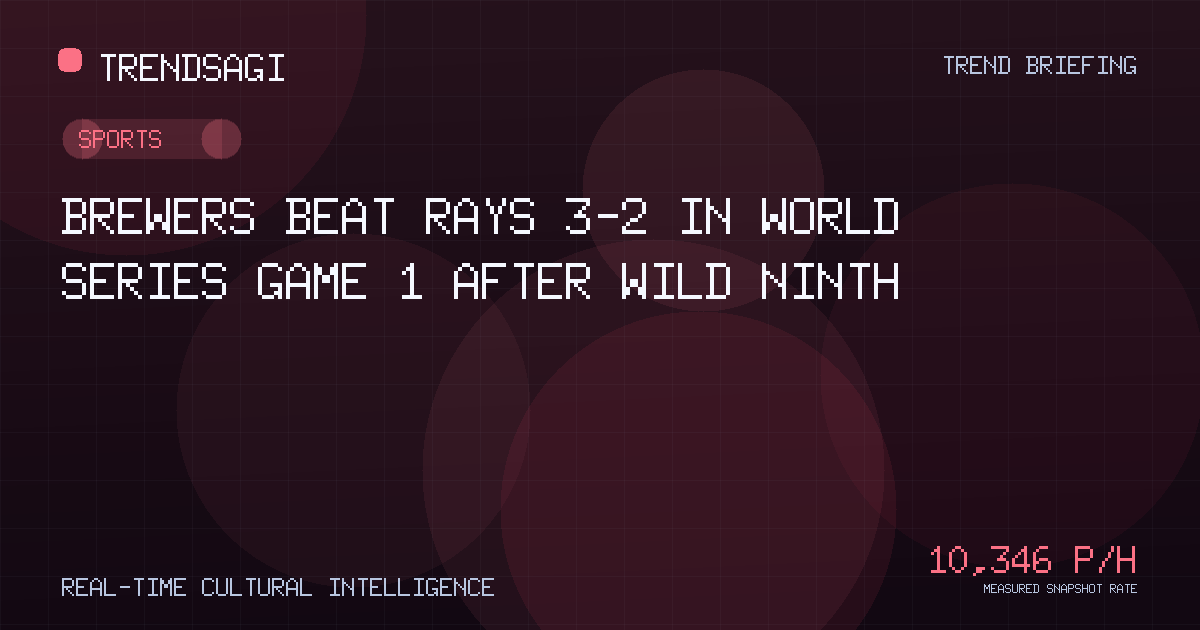
Brewers Beat Rays 3-2 in World Series Game 1 After Wild Ninth
Brewers beat Rays 3-2 in World Series Game 1 after a ninth-inning replay overturned a double play. Timeline, replay rule, and series impact.
Automated briefing. Generated from stored signal measurements and source-backed research; it is not manually reviewed. Read the methodology and limitations.
Metrics in this briefing are a snapshot associated with its publication date and may not reflect current conditions.
What changed
The Milwaukee Brewers won World Series Game 1 against the Tampa Bay Rays 3-2 on Friday night, surviving a chaotic ninth inning in which an apparent game-ending double play was overturned on replay review before closer Trevor Megill struck out Jonny DeLuca with runners on second and third. The result is the freshest and dominant driver of attention around the search phrase “Brewers Rays World Series Game 1 result,” according to the verified search-intent brief. A separate WNBA Finals Game 1 between the Valkyries and Dream also generated record-viewership discussion, but that is a distinct event and not the primary cause of this surge.
TrendsAGI’s stored measurement shows the topic moving at roughly 10,345.6 posts per hour across an exact 895-second window ending at 2026-10-24T04:59:31Z, based on three stored observations, with a latest snapshot volume of 5,142 posts. That is a measured snapshot rate, not a live or forecast figure, and it should be read as a timestamped measure of how fast attention was accumulating around the game and its ninth-inning controversy — not as reach, engagement, or a count of unique people.
| Observation time | Measured posts/hour | Snapshot volume |
|---|---|---|
| 2026-10-24T04:59:31Z | 10,345.6 | 5,142 posts |
Why this topic may be moving
The verified reason is straightforward: Game 1 of the 2026 World Series was played Friday night and ended in a 3-2 Milwaukee win after a ninth-inning replay review overturned an apparent game-ending double play. The brief attributes reporting on the chaotic finish to The Guardian and a hold-off account to Times Leader, while Yahoo Sports published three takeaways from the victory. The unusual sequence — a game that looked over, then was not, then ended on a strikeout — is the kind of moment that produces a burst of searches from people who saw conflicting reports in real time and want the sequence confirmed.
What the signal can establish is that attention accelerated sharply in a measured window around the game. What it cannot establish is why any individual reader searched, how many distinct people were involved, or whether the replay controversy rather than the final score was the dominant driver of each post. The brief notes that the ninth-inning controversy, not just the score, is what audiences appear to be reacting to, but that is an inference from the verified facts, not a separately measured breakdown. Exact review duration and timestamp are not verified and are therefore left out.
The clearest takeaway is that Game 1 turned on a review, not a clean final out: the Brewers led 3-2, the Rays appeared to turn a game-ending double play, the call was overturned, and Megill then closed it out against DeLuca with runners in scoring position.
Why it matters
For readers who saw the game live, the value is a clean chronological account of the ninth inning. For the series, the result matters because Milwaukee has drawn first blood in a short series, and bullpen usage in a tense opener can shape availability later. The brief flags that franchise-history context — Milwaukee’s first World Series win since Game 5 of 1982 — appears in only one ranking result and is not tied to series implications. The brief also notes that most recaps mention the overturned double play but do not plainly explain the replay rule and Cooper Pratt’s foot being off the bag for casual fans. That is the gap this briefing fills: the call changed because the fielder’s foot was judged off the base, not because the throw or catch was in question, per the verified framing in the brief.
Who should care: Brewers and Rays fans confirming the outcome, casual viewers who saw mid-game confusion, fantasy and betting readers checking key plays, and anyone planning to follow Game 2. The brief does not verify a full box score beyond quoted details, so individual stat lines beyond what is stated here should be treated as unconfirmed. Christian Yelich’s triple and Jacob Misiorowski’s contribution are referenced as reader questions in the brief, but the brief does not supply verified stat lines for them, so this article does not invent them.
What to watch next
- Whether the replay-rule explanation drives a second wave of searches as casual fans catch up on what happened.
- Bullpen availability on both sides after a high-leverage opener — a practical series check the brief flags as under-covered.
- Game 2 pitching matchup, which the brief lists as a related search but marks as unverified, so treat matchup details as pending confirmation.
- Whether the separate WNBA Finals Game 1 viewership story keeps surfacing in “Game 1” searches and creates confusion with the World Series opener.
- Watch signals for the stored signal: a sustained rise in snapshot volume across subsequent observations would suggest the story has legs beyond the immediate recap window; a fast fade would suggest it was a single-night burst.
Frequently asked questions
Who won World Series Game 1 between the Brewers and Rays and what was the score?
The Milwaukee Brewers won 3-2 over the Tampa Bay Rays in Game 1 of the 2026 World Series on Friday night, per the verified search-intent brief.
Why was the apparent game-ending double play overturned in the ninth inning?
The brief states the review turned on Cooper Pratt’s foot being off the bag, meaning the fielder was judged not to have held the base on the turn. The exact review duration and timestamp are not verified.
How did the Brewers hold on with runners on second and third?
After the double play was overturned, Trevor Megill struck out Jonny DeLuca with runners on second and third to end the game, according to the verified brief.
How significant is this win for the Brewers franchise historically?
The brief notes it is Milwaukee’s first World Series win since Game 5 of 1982, a franchise-history marker that appears in only one ranking result. It is a meaningful opener win, but the brief does not verify broader historical claims beyond that.
What does the Game 1 result mean for the rest of the World Series?
Milwaukee takes a 1-0 series lead, and the tense ninth-inning usage may affect bullpen availability going forward. Game 2 date, starters, and matchups are not verified in the brief and should be confirmed before relying on them.
Methodology and limitations
The measured change rate of 10,345.6 posts per hour comes from three stored observations over an exact 895-second window ending 2026-10-24T04:59:31Z, with a latest snapshot volume of 5,142 posts. This is a measured snapshot rate, not a live rate, forecast, reach, engagement, or unique-person count. The signal can establish that attention accelerated in that window, but it cannot establish per-reader intent or attribute the surge to a single cause. Facts about the game are attributed in prose to The Guardian, Times Leader, Yahoo Sports, and FOX Sports where the brief verifies them; the brief does not verify a full box score, Game 2 details, or the exact replay timing, so those are omitted or marked unconfirmed. The topic label “Game 1” is ambiguous and may also refer to the WNBA Finals opener; this briefing treats the World Series game as the primary driver based on the verified brief.
Sources
- Brewers survive chaotic ninth-inning replay drama to beat Rays in World Series opener (The Guardian) — theguardian.com
- Brewers hold off Rays to win World Series opener (Times Leader) — timesleader.com
- Three Takeaways from Brewers World Series Game 1 Victory vs. Rays (Yahoo Sports) — sports.yahoo.com
- Now introducing... THE BAZOOKA (FOX Sports) — foxsports.com
Track This Topic for New Signals
Set alerts for future velocity or sentiment changes around this topic.
Explore Tracking PlansAbout TrendsAGI research
TrendsAGI's automated research pipeline publishes dated signal snapshots, methodology notes, and practical workflows for teams evaluating cultural momentum. Read how signals are scoped, scored, and limited in our research methodology.