903-second window · 3 observations · Measured Oct 9, 2026, 8:36 PM UTC · Provider: go_recent_snapshot_v2
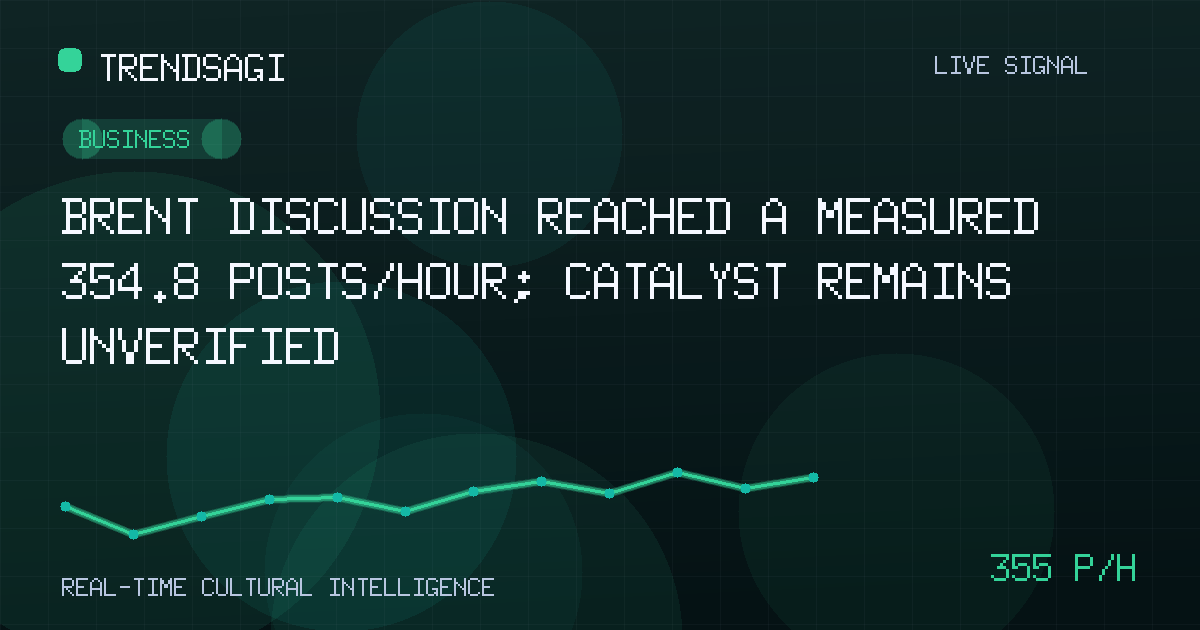
Brent discussion reached a measured 354.8 posts/hour; catalyst remains unverified
Brent generated 234 posts in the latest snapshot and a measured 354.8 posts/hour, while the catalyst remains unverified.
Automated briefing. Generated from stored signal measurements and source-backed research; it is not manually reviewed. Read the methodology and limitations.
Metrics in this briefing are a snapshot associated with its publication date and may not reflect current conditions.
What changed
Direct answer: The stored signal shows “Brent” drawing a concentrated burst of posts at 2026-10-09T20:36:48Z. The latest snapshot contained 234 posts, while the measured change rate was 354.8 posts/hour over an exact 903-second window using 3 stored observations. This is an attention alert within the sampled period, but it does not establish why the activity occurred.
The 354.8 posts/hour figure is a measured snapshot rate, not a live or current rate, forecast, reach figure, engagement measure, or count of unique people. The 234-post snapshot answers a different question: how many posts were present in the latest stored collection. The signal also does not resolve what “Brent” denotes or verify a catalyst, so the defensible conclusion is that the topic was highly active in the monitored stream while its cause and significance remain uncertain.
| Measure | Recorded value |
|---|---|
| Observation time | 2026-10-09T20:36:48Z |
| Measured snapshot rate | 354.8 posts/hour |
| Latest snapshot volume | 234 posts |
Why this topic may be moving
The stored category, “Business,” provides only a broad editorial bucket. It does not show whether “Brent” refers to a person, company, place, product, project, benchmark, or another subject. With no post excerpts, account names, source links, or event markers, assigning the signal to a specific entity would be guesswork. The available record contains no verified public catalyst that explicitly matches both the referent and the observation period, so the cause remains unclear.
Possible explanations must therefore remain hypothetical:
- News or a scheduled event: An announcement, incident, release, or debate could create a burst of discussion, but no particular event is verified here.
- Conversation amplification: Replies, quote-posts, repeated headlines, or reposting may increase the message count without equivalent growth in distinct initiators. The record does not report originality or duplication.
- Collection effects: Broad keyword matching, changes in source coverage, or a noisy account cluster could also create apparent concentration. No collection configuration or source distribution is supplied, so those possibilities cannot be tested.
A high posting rate is evidence of message accumulation, not proof of a real-world catalyst: the referent, source mix, and timing all still require confirmation.
Why it matters
For editors, entity ambiguity is the central risk. A one-word label can be attached to materially different subjects, and a business framing may encourage readers to assume a company or market interpretation that the evidence does not support. The topic warrants verification before it is used to shape a headline, investment interpretation, or broader trend narrative.
Communications, brand, and monitoring teams should also distinguish message volume from stakeholder impact. A large number of posts may reflect broad independent attention, repeated copying, or a narrow cluster. Without source and engagement context, it cannot show whether sentiment changed, whether authoritative accounts participated, or whether the discussion carries business consequences.
Analysts should keep the two supplied measures separate. Snapshot volume is the 234-post count in the latest collection; the measured snapshot rate is 354.8 posts/hour across the specified observation window. Neither measure alone establishes unique participants, market activity, future demand, or the importance of the underlying subject.
What to watch next
The most useful follow-up work is verification rather than extrapolation. Concrete checks include:
- Resolve the referent: Review original posts for a full name, account handle, location, sector, ticker, product description, or other identifier. The goal is to establish exactly what “Brent” means, not infer it from the category.
- Find a dated primary artifact: Look for an official statement, filing, release, transcript, publication, or other source that explicitly concerns the same subject. Its publication time should align plausibly with the observed discussion window.
- Inspect source architecture: Identify original posts, replies, quotations, repeated headlines, copied text, and likely duplicate submissions. Determine whether independent accounts are discussing the subject or whether a small set of accounts is driving the measured concentration.
- Establish chronology: Compare post timestamps with the timing of any candidate catalyst. This can show whether an event preceded the activity, but timing alone should not be treated as proof of causation.
- Collect a comparable follow-up: Use the same query, language settings, source coverage, and counting method. A consistent subsequent snapshot would help distinguish a continuing signal from a short-lived burst.
- Set confidence thresholds: Upgrade the signal only if the referent is stable, independent sources converge on the same subject, and a verifiable catalyst aligns with the timeline. Until then, retain it as an active but causally unconfirmed monitoring signal.
Methodology and limitations
The measured rate was supplied for an exact 903-second window using 3 stored observations and was recorded at 2026-10-09T20:36:48Z. It should not be presented as a live rate or extended beyond that observation. The latest snapshot contained 234 posts, but that volume must not be relabeled as a rate. No prior rate is provided, so the record does not support a percentage increase.
The signal does not provide post text, account identity, source diversity, geography, language, sentiment, engagement, originality, or duplication data. It therefore cannot establish who participated, whether participants were unique people, how the posts spread, or whether the activity was organic. It also cannot quantify market impact or business risk.
No external cause is attributed because the stored evidence does not identify the subject clearly and the available record does not verify a public catalyst for the same referent and period. The appropriate editorial takeaway is narrow: Brent generated 234 posts in the latest snapshot and a measured 354.8 posts/hour during the specified window; why it moved remains unverified.
Track This Topic for New Signals
Set alerts for future velocity or sentiment changes around this topic.
Explore Tracking PlansAbout TrendsAGI research
TrendsAGI's automated research pipeline publishes dated signal snapshots, methodology notes, and practical workflows for teams evaluating cultural momentum. Read how signals are scoped, scored, and limited in our research methodology.