766-second window · 3 observations · Measured Oct 5, 2026, 2:54 AM UTC · Provider: go_recent_snapshot_v2
Brazil snapshot measures 2236.2 posts/hour; underlying cause unverified
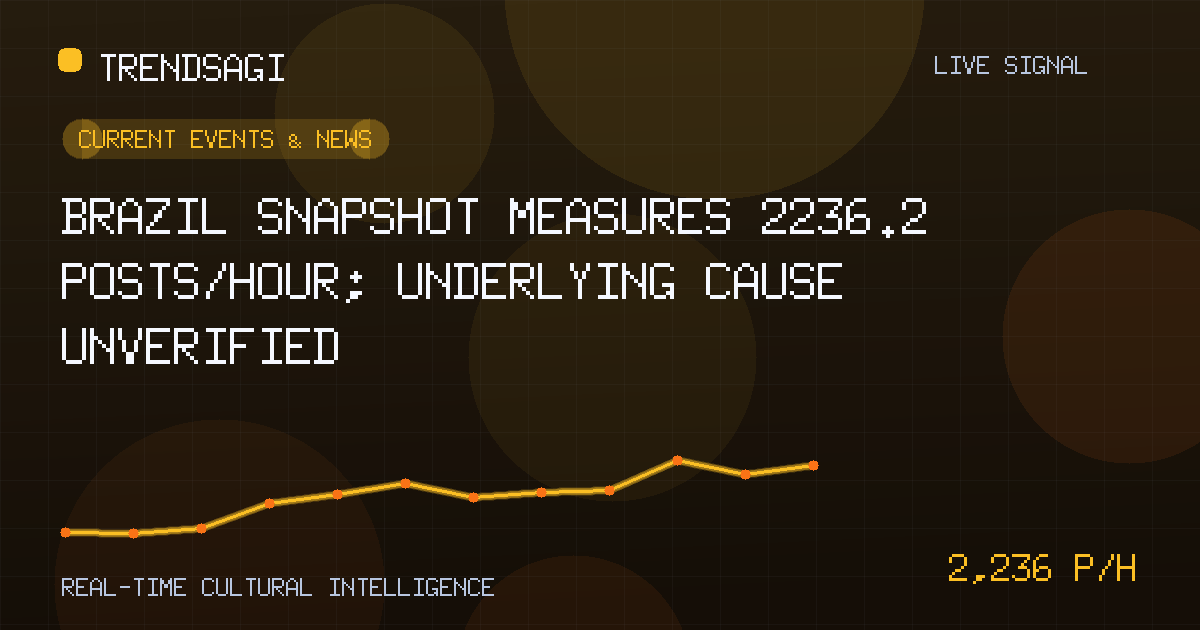
The Brazil monitoring snapshot held 2322 posts and measured 2236.2 posts/hour; the short-window signal is clear, but its cause is not verified.
Automated briefing. Generated from stored signal measurements and source-backed research; it is not manually reviewed. Read the methodology and limitations.
Metrics in this briefing are a snapshot associated with its publication date and may not reflect current conditions.
What changed
The monitored topic labeled Brazil registered 2322 posts in its latest snapshot, alongside a measured snapshot rate of 2236.2 posts/hour across an exact 766-second window using 3 stored observations. The direct answer is narrow but useful: a concentrated short-window cluster of activity was detected at 2026-10-05T02:54:24Z, but no verified event or issue explains why it occurred.
| Observation time | 2026-10-05T02:54:24Z |
|---|---|
| Measured snapshot rate | 2236.2 posts/hour |
| Snapshot volume | 2322 posts |
| Measurement basis | Exact 766-second window using 3 stored observations |
The measured change rate is 2236.2 posts/hour, not the snapshot volume. It is a stored-window measurement—not a live rate, forecast, reach estimate, engagement measure, or count of unique people. Because the record supplies no comparable earlier rate, it also cannot establish that activity was above its normal baseline. The signal shows where to investigate, not what happened.
Why this topic may be moving
The monitoring record contains no descriptive signal and identifies no event, person, institution, or publisher. That omission prevents responsible causal attribution. A broad country label can combine unrelated conversations, and the rate alone cannot show whether this cluster concerns politics, sport, markets, weather, culture, or another subject. It may also include general discussion of Brazil rather than a single Brazilian development.
No publisher-attributable public fact met the verification standard for this briefing. Sports results, election developments, court decisions, market moves, weather incidents, and official actions therefore remain hypotheses, not supported explanations. Without inspecting representative posts and matching a candidate account to verified reporting, choosing one cause would create a precise-looking but unsupported narrative.
The data establishes concentrated activity in a monitored topic stream, not a verified real-world cause.
That distinction limits editorial confidence. A volume alert can justify an immediate check, but it cannot by itself support a claim that Brazil is experiencing a major new development. The cause should remain explicitly unknown until the topic stream and public context converge.
Why it matters
Newsrooms and monitoring desks should care because a broad label can generate a fast editorial alert without identifying a story. The right response is to inspect the posts that drove the cluster, identify shared entities or claims, and verify the apparent event before assigning it a headline, alert level, or geopolitical significance.
Organizations with interests in Brazil should also distinguish attention from evidence. A concentrated cluster may matter for monitoring coverage or communication planning, but without event detail it cannot show whether a policy, market, reputation, or operational issue is affected. Teams should avoid inferring impact from volume alone.
For analysts and trend products, this is a useful triage case. It demonstrates why a measured rate, snapshot count, topic label, and verified cause should remain separate fields. Combining them too early can make an ambiguous stream look like a fully explained event and reduce trust in the briefing.
What to watch next
The next checks should resolve uncertainty rather than decorate it.
- Persistence: Collect subsequent comparable windows and determine whether the measured rate stays near, rises above, or falls below 2236.2 posts/hour.
- Event convergence: Sample the most repeated posts and check whether they name the same event, actor, action, place, or date. Divergent subjects would point to label aggregation.
- Public verification: Use Google Search to test candidate explanations. Count a cause only when a credible publisher page connects the same claim to the relevant timing.
- Source diversity: Check whether activity comes from many independent accounts and domains or is dominated by one source, a repost network, or duplicated wording.
- Timeline fit: Compare post timestamps with the candidate event and publication times. A later reaction should not be presented as the cause of an earlier cluster.
- Scope and integrity: Test whether posts are actually about Brazil, then review reposts, automation signals, and geographic or language mismatches before treating the cluster as organic public attention.
The clearest confirming signal would be repeated, independently sourced discussion tied to a verified event. The clearest warning sign would be continued rate strength with no shared subject, which would indicate that the country label is combining separate conversations.
Methodology and limitations
The rate was calculated from 3 stored observations over exactly 766 seconds. That supports a precise description of this measurement window, but not a claim about a sustained trend. It does not reveal whether activity arrived evenly, accelerated, peaked, or faded within the window, and the latest observation cannot establish seasonality or a normal range.
The 2322 figure is snapshot volume: posts present at the observation time. It is not the number added during the rate window, future demand, audience size, or evidence that 2322 distinct people contributed. The record also provides no account-level details for uniqueness, location, language, sentiment, source provenance, or bot activity.
A label of Brazil does not prove that a post was authored in Brazil, concerns the country, or reflects sentiment toward it. Nor does volume establish accuracy, importance, or causation. The defensible conclusion is therefore limited to concentrated activity under a broad label at the stated time; the responsible next step is event-level verification, not a guessed explanation.
Track This Topic for New Signals
Set alerts for future velocity or sentiment changes around this topic.
Explore Tracking PlansAbout TrendsAGI research
TrendsAGI's automated research pipeline publishes dated signal snapshots, methodology notes, and practical workflows for teams evaluating cultural momentum. Read how signals are scoped, scored, and limited in our research methodology.