904-second window · 3 observations · Measured Sep 29, 2026, 7:55 PM UTC · Provider: go_recent_snapshot_v2
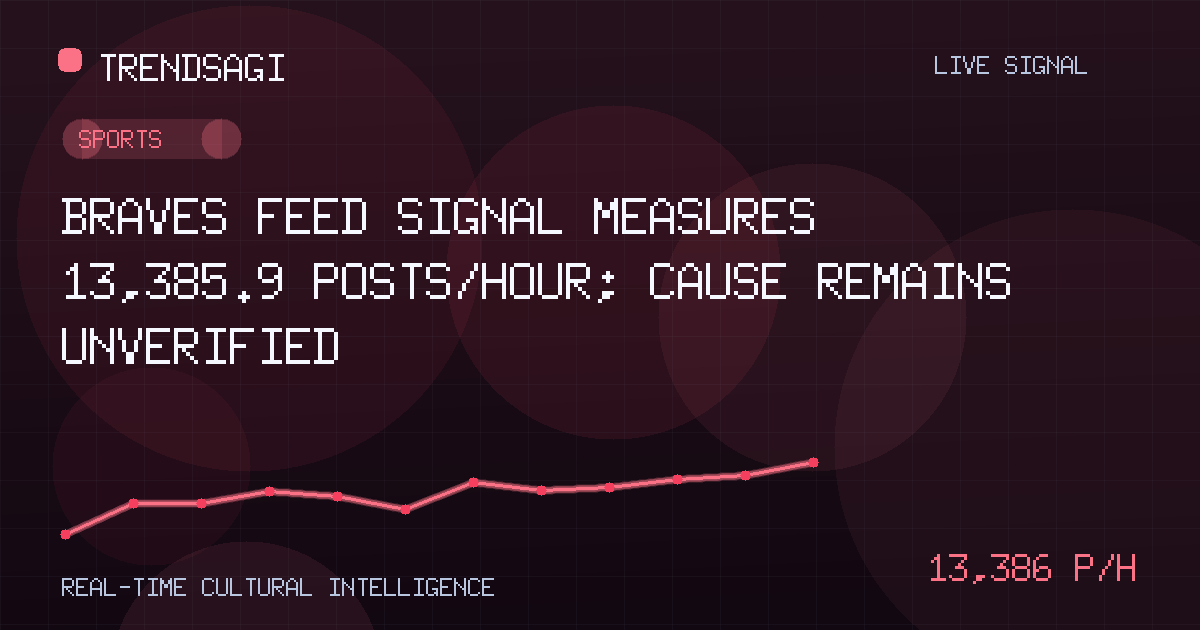
Braves feed signal measures 13,385.9 posts/hour; cause remains unverified
The stored Braves signal measured 13,385.9 posts/hour over 904 seconds, while its cause remains unverified; this checklist shows editors how to validate it.
Automated briefing. Generated from stored signal measurements and source-backed research; it is not manually reviewed. Read the methodology and limitations.
Metrics in this briefing are a snapshot associated with its publication date and may not reflect current conditions.
What changed
The stored “Braves” topic registered a measured change rate of 13,385.9 posts/hour over an exact 904-second window, using 3 stored observations, with the snapshot observed at 2026-09-29T19:55:46Z. The latest snapshot volume was 4,800 posts. The defensible takeaway is a concentrated burst in the monitored feed, not a verified explanation of what happened.
This figure is a measured snapshot rate, not a live or current rate, forecast, reach figure, engagement measure, or unique-person count. For editors, it is a prompt to investigate quickly. It is not enough on its own to say that a game, roster decision, player story, or other public event caused the activity. No verified public context is attached to this record, so the reason for the movement remains unclear.
| Observation time (UTC) | Measured snapshot rate | Latest snapshot volume |
|---|---|---|
| 2026-09-29T19:55:46Z | 13,385.9 posts/hour | 4,800 posts |
Why this topic may be moving
The stored category is “Sports,” but the label is only “Braves.” That makes a sports interpretation plausible without establishing that the subject is the Atlanta Braves rather than another team, organization, nickname, or term. The signal also has no stored event description. A dated headline or official update tied to the observation window would be needed before assigning a cause.
Possible drivers include game action, a lineup or roster update, a player-related report, a broadcast clip, or fan reaction. Those are verification targets, not facts about this signal. The volume could also be affected by repeated posts, quotation of another post, or a monitoring artifact. Post counts alone do not show which mechanism is operating.
The signal establishes velocity in the monitored corpus, not the real-world importance of the underlying event. Until the burst is tied to a named subject and a dated public development, the cause should be reported as unverified.
What the signal can establish
The record supports a narrow but useful conclusion: the monitored corpus registered substantial short-window velocity around the stated time, and editors now have a specific timestamp and volume against which to check later readings.
- Subject: Determine whether “Braves” consistently refers to one team or entity in the sampled posts.
- Content: Identify recurring names, match references, announcements, and claims rather than relying on the label.
- Provenance: Separate original posts from reposts, quotes, media copies, and coordinated or automated-looking repetition.
- Timing: Check whether a public development occurred before or during the 904-second window.
- Persistence: Compare later stored observations to see whether the measured rate stays elevated or recedes.
It cannot establish sentiment, motivation, organic reach, audience geography, authenticity, or real-world significance. It also cannot show that 4,800 snapshot posts came from different people. Those questions require post-level inspection and, where relevant, audience or platform data.
Why it matters
A fast-moving sports label can trigger same-day coverage, social response, and search interest, but naming the wrong driver would create a false narrative. If the subject is a club, fan pages, team media staff, and sports editors need to know whether the burst reflects meaningful news or an already-public event being recirculated.
For trend and communications teams, the alert is useful as a monitoring priority. It should not be treated as evidence of popularity, demand, or crisis. A high rate with no identifiable public event may point to amplification or labeling noise; a lower-volume burst tied to a credible development may be more consequential. Volume and importance are different measures.
Researchers should preserve the raw sample and timestamp before drawing conclusions. Otherwise it becomes difficult to distinguish a new conversation from repeated references to older material.
What to watch next
The next useful signals are corroboration, persistence, and clearer composition:
- Entity resolution: Do posts consistently point to the Atlanta Braves, or does “Braves” refer to something else?
- Public corroboration: Is there a dated official update or reputable report that can explain the timing, without relying on social volume alone?
- Post pattern: Are posts mostly original reactions, links, quotations, or near-duplicate text? A shared source may explain the concentration.
- Subtopic consistency: Do samples repeatedly mention the same match, person, announcement, or claim? Multiple unrelated meanings would weaken a single-cause explanation.
- Follow-up movement: Does the next stored observation remain elevated, and do new posts add information or merely repeat the original trigger?
- Account behavior: Are apparent participants independent, or are many posts linked through repeated phrasing, links, or synchronized activity? This is a check, not proof of automation.
A publishable update should clear both the content and timing tests: identify what “Braves” means, show that a specific development is connected to the window, and avoid turning a post count into a claim about people. If those checks fail, the accurate line is that the topic spiked in the monitored feed and its cause remains unverified.
Methodology and limitations
The measured change rate is used exactly as stored: 13,385.9 posts/hour over 904 seconds, from 3 observations, measured at 2026-09-29T19:55:46Z. The 4,800 figure is the latest snapshot volume, not a rate. The record does not supply a comparison baseline, feed coverage, sampling method, deduplication rules, or account and geography composition.
That limits statistical and causal interpretation. The signal can flag a change for review, but it cannot show why the change occurred or whether the monitored posts represent a wider population. It also cannot be projected forward. External explanations are omitted because no public fact tied to this signal could be verified.
The immediate editorial decision is therefore straightforward: investigate the raw posts and the exact time window, resolve the entity, seek independent dated context, and wait for subsequent observations before assigning significance.
Track This Topic for New Signals
Set alerts for future velocity or sentiment changes around this topic.
Explore Tracking PlansAbout TrendsAGI research
TrendsAGI's automated research pipeline publishes dated signal snapshots, methodology notes, and practical workflows for teams evaluating cultural momentum. Read how signals are scoped, scored, and limited in our research methodology.