782-second window · 3 observations · Measured Oct 2, 2026, 1:54 AM UTC · Provider: go_recent_snapshot_v2
Boswell signal measures 2297.7 posts/hour; public trigger remains unverified
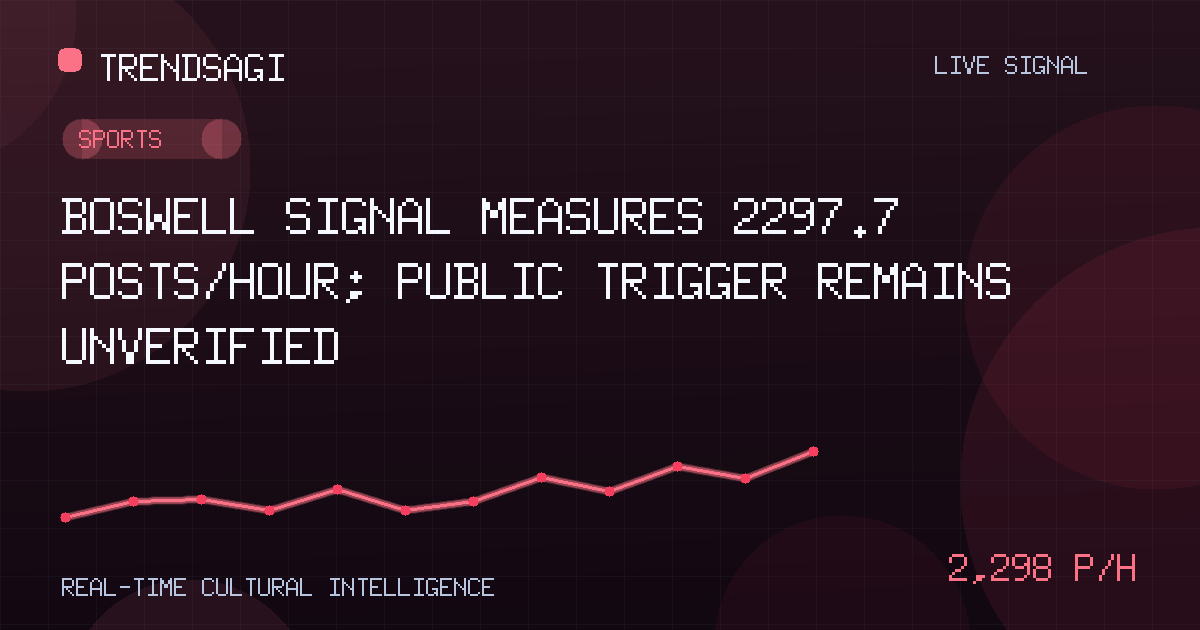
Boswell shows a measured 2297.7 posts/hour snapshot rate and 610 posts in the latest snapshot; the trigger remains unclear and needs verification.
Automated briefing. Generated from stored signal measurements and source-backed research; it is not manually reviewed. Read the methodology and limitations.
Metrics in this briefing are a snapshot associated with its publication date and may not reflect current conditions.
What changed
Boswell shows a concentrated posting burst in the latest stored observation: the snapshot contains 610 posts. The measured change signal is 2297.7 posts/hour, measured across an exact 782-second window using 3 stored observations, with the latest snapshot recorded at 2026-10-02T01:54:06Z. This figure is a measured historical snapshot rate, not a live or current rate, forecast, reach, engagement, or count of unique people.
The direct conclusion is that Boswell warrants investigation, not a causal headline. No verified public context in the available record explains the movement, and the label “Boswell” is not specific enough on its own to determine the subject. The stored Sports category narrows the context but does not identify a person, team, competition, or event. Naming a trigger now would be speculation.
| Measure | Stored value |
|---|---|
| Observation time | 2026-10-02T01:54:06Z |
| Measured snapshot rate | 2297.7 posts/hour |
| Exact measurement window | 782 seconds |
| Stored observations | 3 |
| Latest snapshot volume | 610 posts |
Why this topic may be moving
The trigger cannot be verified from the available record. Elevated posting activity can accompany a scheduled event, announcement, controversy, discovery cycle, or rapid redistribution of existing content. Those are possible mechanisms rather than findings about Boswell. The record supplies no event detail, and the Sports classification alone cannot distinguish among them.
Entity identification is the main obstacle. “Boswell” could refer to multiple people, organizations, places, or other subjects, including subjects outside sport. Posts about different subjects could be combined under the same label even when they have no substantive relationship. Any public explanation should therefore be tied to the exact Boswell identity and placed close to the observed timestamp before it is treated as a cause.
A result, roster decision, injury, game incident, or controversy should be named only if dated public reporting or first-party material confirms both the identity and the timing. Without that match, an editor would be turning an ambiguous search label into a specific narrative without evidence.
Why it matters
This signal establishes where and when a burst of posts was recorded. It gives editors, sports desks, community teams, and trend researchers a reason to inspect the underlying conversation before deciding whether the movement is meaningful. It does not establish that Boswell is more popular than usual, because the record provides no ordinary-volume baseline. It also does not show duration, sentiment, geography, platform distribution, or whether the posts are original, replies, reposts, quotes, duplicates, or automated activity.
A high posting rate can tell an editor where attention is concentrated, but it cannot identify the event, prove why attention changed, or show how many distinct people participated.
The 610-post snapshot and the 2297.7 posts/hour rate answer different questions. Snapshot volume describes the collection recorded at the observation time; the measured rate describes post movement across the defined observation window. Neither is audience reach. They should not be substituted for one another, added together, or presented as evidence of unique participation.
For a newsroom, the immediate implication is verification rather than publication. For sports publishers and fan communities, the signal may indicate a subject worth monitoring. For analysts, it is a candidate anomaly that requires post-level inspection and a longer time series. None of those uses justifies a specific event attribution yet.
What to watch next
- Resolve the entity: Determine which Boswell the Sports category intended, then compare the collected posts with that identity and its common aliases. Confusing separate subjects would invalidate the apparent trend.
- Inspect post composition: Sample the underlying items and classify original posts, replies, reposts, quotes, duplicates, and automation signals. Account for repeated wording and repeated source material.
- Extend the time series: Retrieve observations before and after the stated window using the same collection method. Persistence in later windows would support an ongoing movement; an isolated observation would not.
- Verify the catalyst: Look for dated, reputable reporting or a first-party statement that explicitly concerns the same Boswell and aligns with the activity. Reposts of an older item should not be mistaken for a new event.
- Compare distribution: Check whether activity is concentrated on one platform, in one geography, or within a community already associated with the subject. Distribution can help distinguish a broad response from repetition or coordinated posting.
Concrete watch signals
Evidence that would strengthen the interpretation includes sustained posting in subsequent stored windows, a verified public catalyst aligned with the timestamps, and original discussion distributed beyond repeated source material. Evidence that would weaken it includes an entity mismatch, a rapid disappearance of activity, a collection dominated by duplicates or automation, or a proposed trigger that substantially predates the measured movement. The key test is not merely whether more Boswell posts exist, but whether verified, distinct activity continues for a reason connected to the correct subject.
Methodology and limitations
The reported rate of 2297.7 posts/hour was measured over the exact 782-second window using 3 stored observations, all associated with the latest stored signal. The separate latest snapshot contains 610 posts. The observations can document the measured burst, but they do not establish a normal baseline, a longer-term trend, post authenticity, sentiment, or unique participation.
No verified public catalyst is included because an exact Boswell identity and a dated external explanation could not be confirmed. External claims should not be added merely to make the movement appear intelligible. Until entity resolution and timing are verified, the cause remains plainly unclear: the signal confirms concentrated measured activity, while the reason for it remains unverified.
Track This Topic for New Signals
Set alerts for future velocity or sentiment changes around this topic.
Explore Tracking PlansAbout TrendsAGI research
TrendsAGI's automated research pipeline publishes dated signal snapshots, methodology notes, and practical workflows for teams evaluating cultural momentum. Read how signals are scoped, scored, and limited in our research methodology.