907-second window · 3 observations · Measured Oct 1, 2026, 8:11 AM UTC · Provider: go_recent_snapshot_v2
Boston-labeled topic signal measured at 285.6 posts/hour; cause remains unverified
The Boston-labeled topic signal measured 285.6 posts/hour; the cause is unverified, and these checks can validate the trend.
Automated briefing. Generated from stored signal measurements and source-backed research; it is not manually reviewed. Read the methodology and limitations.
Metrics in this briefing are a snapshot associated with its publication date and may not reflect current conditions.
What changed
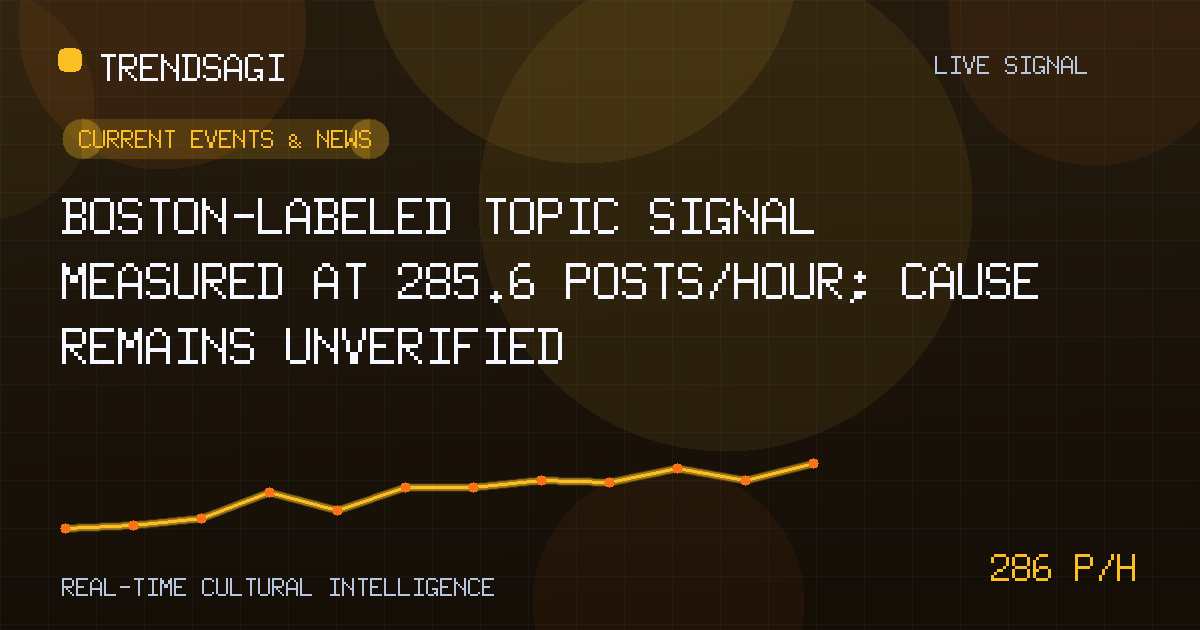
The Boston-labeled topic signal showed rising posting activity, measured at a snapshot rate of 285.6 posts/hour at 2026-10-01T08:11:47Z. No verified public event has been established as the cause, so this is an attention signal—not confirmation of a particular news story, emergency, or civic action.
The latest snapshot contained 180 posts. The rate was measured from 3 stored observations over an exact 907-second window. It is a retrospective snapshot measure, not a live rate, forecast, reach estimate, engagement count, or unique-person count. With no normal baseline supplied, the record also cannot show how unusual the burst is relative to the topic label’s usual activity.
| Observation | Stored value |
|---|---|
| Observation time | 2026-10-01T08:11:47Z |
| Measured snapshot rate | 285.6 posts/hour |
| Latest snapshot volume | 180 posts |
Why this topic may be moving
The stored record has no event description, headline, source, or named public trigger. Although it is categorized as Current Events & News, that category is metadata rather than verification. No time-matched public source has been verified to explain the movement, so the cause remains unclear.
- Time-sensitive news: A developing local story could drive repeated updates, but no specific story is identified in the record.
- Scheduled activity: A sports fixture, public meeting, release, or cultural event could produce concentrated discussion. These are possibilities to test, not attributed events.
- Source-led amplification: Repetition by a limited set of accounts, or redistribution of the same post, could raise volume without representing broad interest.
- Label ambiguity: “Boston” may be used as a location, organization name, event label, or broader reference. The record does not establish where each author or post is located.
The key distinction is between detecting momentum and explaining it. This signal supports the first; without verified, time-matched public context, it does not support the second.
Why it matters
The immediate value is triage, not explanation. A local newsroom can use the spike to decide what deserves reporting, but should first seek original, time-matched evidence. Public agencies and community organizations can scan for concrete questions or operational concerns without assuming that an incident exists simply because posting volume rose.
Residents, local institutions, event teams, employers, and businesses should care if the movement later connects to travel, services, public safety, events, or reputation. Researchers and trend analysts should care because a short observation window can be useful for detection while remaining poor evidence of duration. The current record does not establish any of those connections.
The scale also requires careful language. The 180-post snapshot is not an author count, and the posts/hour figure is not a unique-person count. Neither measure captures reach, views, agreement, or importance. Until content and provenance are reviewed, “fast-moving” is a safer description than “widely supported” or “citywide.”
What to watch next
The next useful checks are concrete and falsifiable. They should separate persistence, provenance, geography, and substance:
- Persistence: Collect the next comparable observation using the same platform, query, and collection method. If the rate quickly returns to baseline, the burst may be short-lived; sustained elevation supports ongoing attention but still does not identify a cause.
- Verified trigger: Look for an official statement or independent local reporting published in the same period. A cause becomes credible only when the source content and timing match the signal rather than merely sharing the word “Boston.”
- Geography: Inspect location fields, geotags where available, named institutions, and event references. Do not infer an author’s location from a display name or casual use of the topic label.
- Authenticity: Compare repeated text, redistribution patterns, account histories, and original reporting with reaction. A burst dominated by one account is not equivalent to broad, independent participation.
- Content: Classify what the posts assert: firsthand observation, recycled claim, question, reaction, promotion, or correction. Check consequential claims against primary evidence before repeating them.
- Operational effects: Watch for service changes, event instructions, safety guidance, cancellation notices, or official corrections. These are validation targets, not claims that any such effect is occurring.
Escalation is justified if independent evidence, geographic relevance, and repeated activity converge. If volume subsides, posts collapse into duplicates, or no public trigger appears, the signal should remain labeled transient or unexplained rather than being assigned an invented narrative.
Methodology and limitations
The available observation is timestamped 2026-10-01T08:11:47Z and contains 180 posts. The reported 285.6 posts/hour comes from 3 stored observations over the exact 907-second window. Snapshot volume is a count at the observation time; the measured rate describes movement across the window. Neither should be presented as activity continuing after the timestamp.
The record does not identify the platform, query, sampling frame, collection cadence, deduplication approach, author uniqueness, sentiment, or source mix. The Boston label alone does not establish city or metropolitan provenance. Without an earlier baseline, the signal cannot support a percentage increase or a claim that the measured rate is exceptional.
No external fact has been verified to explain the spike. The defensible conclusion is therefore narrow: the stored signal shows a measured change in posting activity, with a latest snapshot volume of 180 and a measured snapshot rate of 285.6 posts/hour. Why it moved remains unconfirmed.
Track This Topic for New Signals
Set alerts for future velocity or sentiment changes around this topic.
Explore Tracking PlansAbout TrendsAGI research
TrendsAGI's automated research pipeline publishes dated signal snapshots, methodology notes, and practical workflows for teams evaluating cultural momentum. Read how signals are scoped, scored, and limited in our research methodology.