903-second window · 3 observations · Measured Sep 29, 2026, 4:51 PM UTC · Provider: go_recent_snapshot_v2
“Boomers” label measures 1582.4 posts/hour in snapshot; cause remains unverified
The “Boomers” snapshot measured 1582.4 posts/hour; the cause is unverified, and these checks show what editors should investigate next.
Automated briefing. Generated from stored signal measurements and source-backed research; it is not manually reviewed. Read the methodology and limitations.
Metrics in this briefing are a snapshot associated with its publication date and may not reflect current conditions.
What changed
The clearest finding is a rapid measured burst of posts carrying the broad label “Boomers,” while the reason for the activity remains unverified. The signal is useful as an editorial alert, but it does not yet show that one event caused the change or that a particular view is widespread.
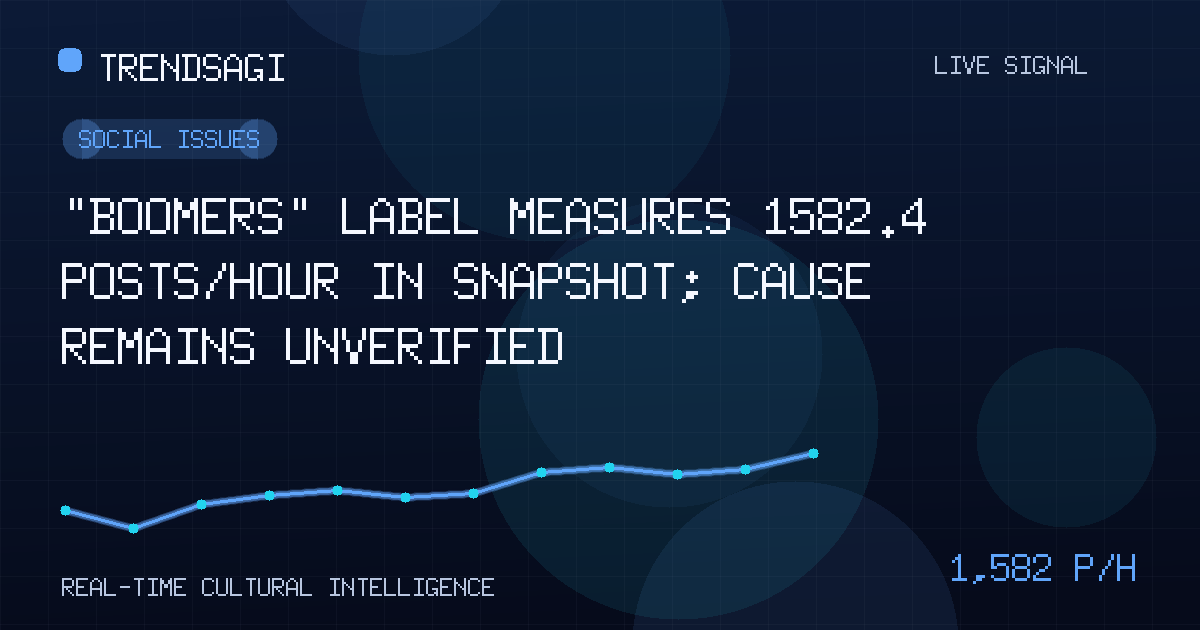
The stored observations record a measured change rate of 1582.4 posts/hour over an exact window of 903 seconds using 3 stored observations; the latest snapshot was observed at 2026-09-29T16:51:45Z. The latest snapshot volume is 757 posts. The posts/hour figure is a measured snapshot rate, not a live or current rate, forecast, reach figure, engagement measure, or count of unique people.
| Observation time | 2026-09-29T16:51:45Z |
|---|---|
| Measurement window | 903 seconds, using 3 stored observations |
| Measured snapshot rate | 1582.4 posts/hour |
| Latest snapshot volume | 757 posts |
Rate and volume are separate measures and should not be substituted for one another. Together, they establish the size and speed of counted activity within the monitored label at the observed moment, but provide no evidence by themselves of cause or audience size.
Why this topic may be moving
No specific external catalyst has been verified from the stored record. The signal is categorized as Social Issues, but that classification describes the monitoring bucket rather than the substance of any individual post. The broad label could be collecting reaction to several different subjects.
- Reaction to a policy, political statement or public figure;
- Aging-related issues such as health care, retirement, caregiving or employment;
- Criticism or commentary about media representation or ageism;
- A dispute over the nickname itself or intergenerational framing;
- A wave of quoting, reposting or repeated publication that made one source look like many conversations.
These are verification paths, not explanations. Until source-level evidence identifies a dominant narrative and its timing, the cause is unclear and should be reported as such.
A measured burst is a reason to investigate a label, not proof that the people associated with that label share a common view.
What the signal can—and cannot—establish
Within the monitored collection, the signal establishes that posts assigned to “Boomers” registered the stated rate during the stated window. It is enough to trigger a content review, but not enough to characterize the conversation.
- It does not show how many unique authors participated; repeated posts may come from a smaller base.
- It does not establish the posts’ sentiment, consensus, factual accuracy or whether a claim was widely accepted.
- It does not identify a catalyst, show that an event caused the activity or distinguish independent discussion from copied text.
- It does not establish the authors’ locations, languages, ages or intended audiences.
Nor does the label validate itself: some matches may use “Boomers” descriptively, critically or as a general grievance. Semantic review is required before assigning meaning.
Why it matters
Newsrooms and publishers should treat this as a verification lead, especially if age-related policy or cultural coverage is planned. The measured rate makes this an editorial opening, but only verified source material should establish what happened.
Researchers and audience teams need the post sample before drawing conclusions about sentiment, demographic identity or consensus. Community moderators and communicators should look for escalation, repeated claims or harmful stereotyping rather than treating the label as a measured population attitude.
For organizations serving older adults, the practical value is a prompt to listen more closely. The data do not justify saying what “Boomers” think, how they voted or how they behaved.
What to watch next
- Inspect the source trail around 2026-09-29T16:51:45Z. Identify the earliest distinct posts, then map replies, quotations, media pickups and follow-on claims.
- Build a baseline with the same query, collection rules and window of 903 seconds before and after the observed timestamp. This will show whether the result persists or was concentrated in the measured interval.
- Code the post sample by subject, claim, stance, evidence and named entity. Separate discussion of a public event from complaints about the label itself.
- Deduplicate quoted text, syndicated articles and reposts. Check account behavior for automation only as a technical possibility, not as a presumption.
- Segment the sample by geography, language and source type where the collection supports those fields. Do not infer location or identity from a nickname.
- Audit query and taxonomy fit. Review whether relevant conversations use other terms and whether irrelevant uses were swept into the label.
- Seek dated primary documentation or reputable reporting that predates the observed change. Compare its timing and claims with the earliest posts before naming a catalyst.
Concrete watch signals
- A verified, dated catalyst appears before the change and matches the dominant cluster of posts.
- New same-cadence observations show whether the measured rate persists, recedes or reverses.
- Independent outlets, individual accounts and primary documents converge on the same claim rather than merely repeating one another.
- The conversation broadens across locations, languages or source types, or remains confined to a single ecosystem.
- Snapshot volume and the measured rate move in different directions, which would call for a collection and deduplication audit.
Methodology and limitations
The rate was measured from 3 stored observations across 903 seconds and is reported here exactly as supplied. The figure of 757 posts is the latest snapshot count, not a rate. Neither number is a forecast, an estimate of unique participants or a measure of engagement.
The record does not include post text, source links, query parameters, geographic coverage, a longer baseline or deduplication details. It also provides no verified public explanation for the movement. Those limits prevent causal attribution.
The defensible conclusion is narrow: the “Boomers” label showed a measured burst in posting activity at the stated snapshot time and warrants immediate source review. It is not evidence of a generation-wide attitude or behavior.
Track This Topic for New Signals
Set alerts for future velocity or sentiment changes around this topic.
Explore Tracking PlansAbout TrendsAGI research
TrendsAGI's automated research pipeline publishes dated signal snapshots, methodology notes, and practical workflows for teams evaluating cultural momentum. Read how signals are scoped, scored, and limited in our research methodology.


