898-second window · 3 observations · Measured Sep 30, 2026, 1:21 AM UTC · Provider: go_recent_snapshot_v2
Bonnie Blue snapshot shows 642 posts and a measured 1519.7 posts/hour; cause unverified
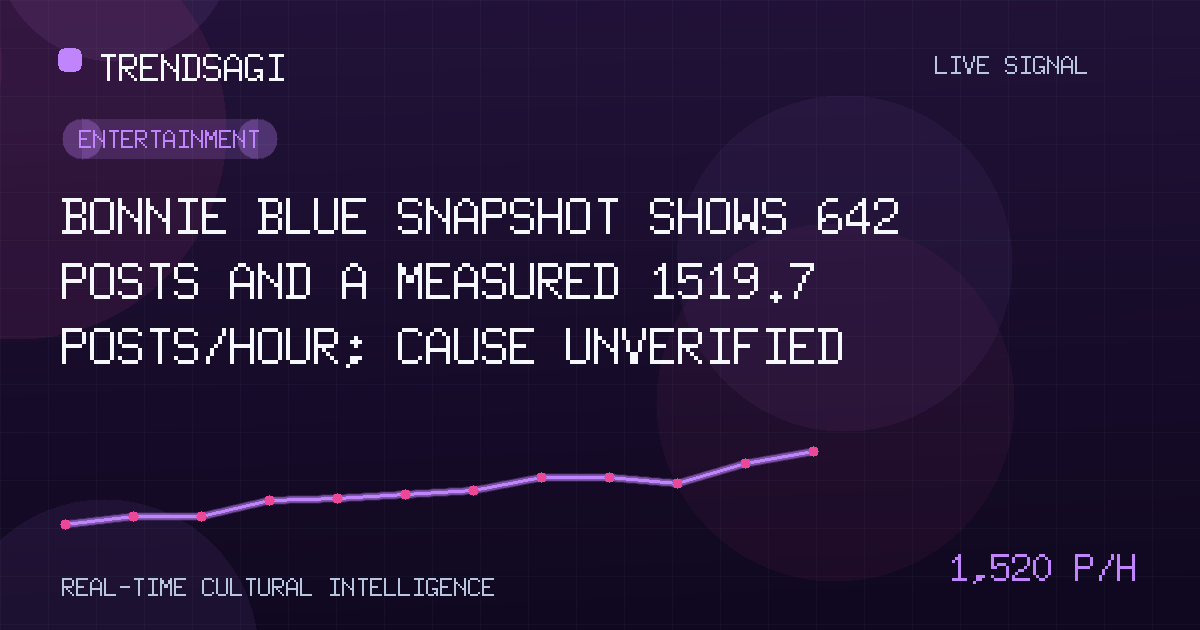
At 2026-09-30T01:21:29Z, the latest Bonnie Blue snapshot recorded 642 posts and a measured rate of 1519.7 posts/hour; the cause is unverified.
Automated briefing. Generated from stored signal measurements and source-backed research; it is not manually reviewed. Read the methodology and limitations.
Metrics in this briefing are a snapshot associated with its publication date and may not reflect current conditions.
What changed
The Bonnie Blue topic registered 642 posts in the latest stored entertainment snapshot at 2026-09-30T01:21:29Z. No verified public context explains the movement, so the defensible conclusion is limited: this label experienced a rapid measured change in posting activity, not a confirmed event or broader cultural trend.
Across an exact 898-second window using 3 stored observations, the measured change rate was 1519.7 posts/hour. This is a measured snapshot rate, not a live or current rate, forecast, reach, engagement total, or unique-person count. The figures measure different things: 642 is the latest snapshot volume, while 1519.7 posts/hour describes the rate of change during the observed window.
| Observation time | 2026-09-30T01:21:29Z |
|---|---|
| Measured snapshot rate | 1519.7 posts/hour |
| Latest snapshot volume | 642 posts |
Why this topic may be moving
The cause remains unclear. The stored record supplies an entertainment category but no topic description, named event, originating post, platform breakdown, or public context. It also does not establish which person, organization, character, or other entity “Bonnie Blue” denotes. Because the label is not self-disambiguating, even a verified development about one referent could not automatically explain every post counted under it.
The available material contains no attributable Google Search result that ties a specific development to this exact window. Accordingly, this briefing does not attribute the activity to a release, interview, appearance, controversy, social post, or search event. Those are hypotheses to test, not findings. Any of them would need dated evidence showing both the same identity and a timeline consistent with the rise in posts.
The signal establishes that post volume changed rapidly around a particular label at a particular time. It does not establish why it changed, who initiated it, or whether it reflects broad public interest.
Temporal concentration is also not the same as organic breadth. A short window can be amplified by a highly followed account, repeated copying, a coordinated repost cycle, or a platform recommendation event. None of those mechanisms is demonstrated here. The current evidence supports one editorial status: a high-velocity, low-context lead that warrants verification before publication or response.
Why it matters
For editors and audience researchers, the immediate value is prioritization. The combination of 642 posts and a measured 1519.7 posts/hour says the label deserves a timely check, but the missing cause limits interpretation. Publishing a claim that Bonnie Blue is trending without identifying the verified subject and driver would risk confusing a fast-moving label with a meaningful news event.
- Media teams should seek the earliest attributable item and confirm that it refers to the same Bonnie Blue before treating the burst as a story.
- Talent, brand, and public-interest teams should monitor only if identity resolution reveals potential reputation exposure; this snapshot alone does not establish one.
- Trust and safety teams should examine account concentration, duplicate wording, and recirculation before inferring organic interest or manipulation.
- Trend analysts should compare the rate with prior windows and the broader category. Without that baseline, the snapshot cannot be called unusually fast.
Readers also need separation between attention and importance. Post count does not show sentiment, factual accuracy, source quality, or whether people saw the content. A large volume may reflect repetition rather than independent participation.
What to watch next
The next useful update should add evidence, not merely repeat the volume. These are the most concrete checks:
- Resolve the label. Determine whether current posts consistently refer to the same public figure or entity. Record explicit names, handles, roles, and links that allow independent matching.
- Find the origin. Locate the earliest accessible post or announcement associated with the burst, then compare its timestamp with the 898-second measurement window.
- Verify attribution. Look for a direct statement, interview, release, appearance, reporting, or documented event from an attributable publisher or primary party. Reject timing that merely follows the spike without explaining it.
- Measure breadth. Check how many distinct accounts are posting, whether wording is duplicated, whether one source dominates, and whether activity spans more than one location or platform.
- Test persistence. Add later snapshots and compare both volume and measured rates with the same method. A single window cannot distinguish a durable shift from a momentary burst.
- Separate volume from response. If reactions, page views, or follower growth become available, report them separately rather than using posts as a proxy for reach or impact.
A cause becomes reportable when identity, timing, and attribution align. If those checks fail, the correct update is that the label showed rapid measured posting change but remained unexplained.
How to interpret the signal
The strongest supported takeaway is operational: at the recorded moment, Bonnie Blue was a fast-moving monitoring priority with insufficient context. The signal can establish the label, stored entertainment category, observation time, latest post count, and measured change rate. It cannot establish the event behind the activity, sentiment, authenticity, audience size, geography, platform, organic versus coordinated behavior, or future direction.
It is also not enough to call the activity a record, mainstream trend, or surge relative to normal. No historical baseline was supplied. The rate belongs to the exact stated window and 3 stored observations; it should not be extended beyond that window or converted into an estimate of people, impressions, or business impact.
Methodology and limitations
This briefing uses the canonical snapshot observed at 2026-09-30T01:21:29Z. The latest snapshot contains 642 posts. The 1519.7 posts/hour figure is the supplied measured change rate for an exact 898-second window using 3 stored observations. It is labeled here as a measured snapshot rate to prevent it from being read as ongoing activity.
No external fact is used to explain the movement because the available record contains no verified, attributable public context. The empty topic description limits disambiguation, and the absence of account-level, content-level, platform-level, and historical fields prevents stronger conclusions. A future report should preserve the observation time, window, and calculation method so readers can distinguish a new development from a change in measurement.
Track This Topic for New Signals
Set alerts for future velocity or sentiment changes around this topic.
Explore Tracking PlansAbout TrendsAGI research
TrendsAGI's automated research pipeline publishes dated signal snapshots, methodology notes, and practical workflows for teams evaluating cultural momentum. Read how signals are scoped, scored, and limited in our research methodology.


