897-second window · 2 observations · Measured Oct 4, 2026, 5:10 PM UTC · Provider: go_recent_snapshot_v2
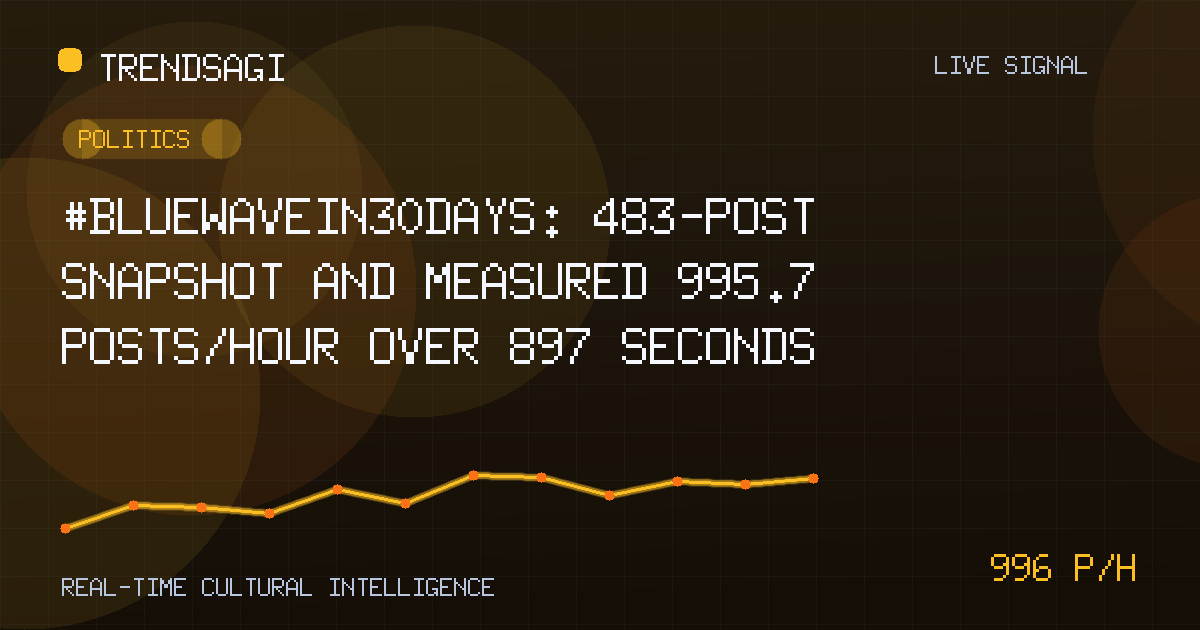
#BlueWaveIn30Days: 483-post snapshot and measured 995.7 posts/hour over 897 seconds
#BlueWaveIn30Days reached a 483-post snapshot and a measured 995.7 posts/hour over 897 seconds; the signal shows why causal verification is still needed.
Automated briefing. Generated from stored signal measurements and source-backed research; it is not manually reviewed. Read the methodology and limitations.
Metrics in this briefing are a snapshot associated with its publication date and may not reflect current conditions.
What changed
#BlueWaveIn30Days showed a pronounced short-window burst in the stored Politics signal, with the latest snapshot containing 483 posts at 2026-10-04T17:10:53Z. The available record does not verify a specific event, organization, location, or policy development as the cause, so the defensible conclusion is concentrated hashtag activity, not confirmed political impact.
The stored comparison records a measured snapshot rate of 995.7 posts/hour over an exact 897-second window using 2 stored observations, associated with the timestamp above. That figure is not a live or current rate, forecast, reach estimate, engagement measure, or unique-person count. The 483-post snapshot and the hourly-normalized change rate describe different aspects of the collection; the record does not provide enough methodology to reconcile them beyond reporting both exactly.
| Measure | Recorded value |
|---|---|
| Observation time | 2026-10-04T17:10:53Z |
| Measured snapshot rate, not live | 995.7 posts/hour |
| Exact comparison window | 897 seconds, using 2 stored observations |
| Latest snapshot volume | 483 posts |
What the signal establishes
The signal can show that exact-tagged content was present in the stored collection and that the observed post count changed sharply during the narrow comparison. Its stored Politics category makes the signal relevant to political monitoring. It cannot, on its own, establish who initiated the burst, whether posts are original, what they advocate, where participants are located, or whether the activity affects elections or policy. Two observations also cannot show that momentum persisted after the comparison window.
The strongest conclusion is measurement, not motivation: the record shows a rapid change in observed posting around an exact hashtag, but it does not identify who prompted that change or why.
Why this topic may be moving
No verified public context in the record identifies a catalyst. Several mechanisms could explain the movement, but each remains a hypothesis:
- Countdown framing: The wording may be designed to create urgency and prompt repeated use of an identical tag. It does not establish what the countdown refers to or confirm a real deadline.
- Coordinated amplification: An organizer, candidate, or issue-specific group could seed a uniform message. No account or group is identified, so coordination should not be asserted.
- Event proximity: A debate, vote, campaign action, fundraising deadline, filing, or protest announcement could trigger posting. None is linked in the available record.
- Platform circulation: A prominent account, repost chain, or recommendation cycle could carry the phrase beyond its original audience. No circulation path is documented here.
- Short-window measurement: With only 2 observations, the measured snapshot rate may be sensitive to collection timing and counting rules. Duplicated or reposted material could matter if present, but the record does not say how such posts were handled.
Why it matters
For political communications teams, the immediate question is not whether the tag is loud but whether it represents an actionable constituency, a coordinated push, a reaction to a verified event, or a measurement artifact. Those interpretations call for different responses. A campaign might prepare messaging; a journalist might seek the event or organizer behind the phrase; an analyst would need repeated observations before calling it sustained momentum.
Readers should also separate conversation velocity from consequence. A high posting rate can show attention inside a dataset without demonstrating persuasion, turnout, policy movement, or broad adoption beyond the posts counted.
What to watch next
- Resolve the label. Determine the geography, objective, target date, and any named organizer behind the exact hashtag. A real countdown should resolve to a specific action, not just a slogan.
- Trace provenance. Review the earliest accessible posts and the sequence that follows them. Ask whether an original post, account, or event notice predates the burst and whether later posts add information or merely copy it.
- Verify a catalyst. Seek timely attribution in official event material, statements by identified political accounts, or reputable reporting. A verified cause should have its own timestamp so it can be compared with the stored snapshot.
- Test coordination. Compare wording, links, posting sequences, and repost patterns across accounts. Similar language can support a coordination hypothesis, but similarity alone does not establish who coordinated it.
- Keep related tags separate. Compare the exact hashtag with spelling and wording variants rather than merging them automatically. Similar labels may refer to different events or communities.
- Collect a longer series. Use subsequent observations under the same query and counting rules. The key test is whether activity persists, reverses, or broadens after the 897-second comparison window.
Concrete confidence-increasing signals are a named organizer or date confirmed by public evidence, independent accounts repeating the same call after a verified event notice, traceable original posts before the rise, and continued activity in later snapshots. Confidence should fall if the tag is used for unrelated messages, if most apparent activity is duplicated, or if no consistent objective can be found.
Methodology and limitations
This briefing uses the canonical observation at 2026-10-04T17:10:53Z: 483 posts in the latest snapshot, plus the supplied measured snapshot rate of 995.7 posts/hour based on 2 stored observations across the exact 897-second window. There is no baseline, longer time series, collection scope, geographic coverage, sentiment classification, or account-level de-duplication. Snapshot volume is a post count, not a rate, reach estimate, or audience total.
Most importantly, no verified external context in the available record explains why the topic moved. That does not prove there was no catalyst; it means a causal claim is not supported yet. The safest analytical posture is to report the measured burst, preserve the distinction between the two measures, and seek provenance before assigning a political purpose.
Track This Topic for New Signals
Set alerts for future velocity or sentiment changes around this topic.
Explore Tracking PlansAbout TrendsAGI research
TrendsAGI's automated research pipeline publishes dated signal snapshots, methodology notes, and practical workflows for teams evaluating cultural momentum. Read how signals are scoped, scored, and limited in our research methodology.