15-minute window · 3 observations · Measured Oct 3, 2026, 5:22 AM UTC · Provider: go_recent_snapshot_v2
Blake label shows a measured snapshot rate of 384.0 posts/hour; cause unresolved
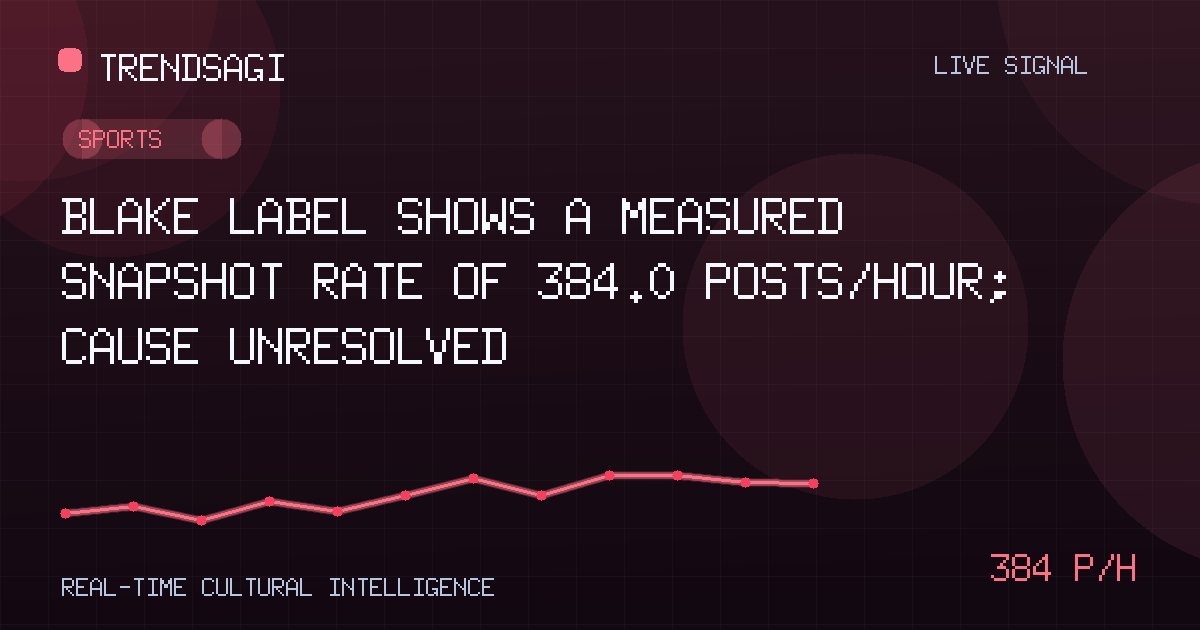
The “Blake” label shows a measured snapshot rate of 384.0 posts/hour and 672 snapshot posts; verify identity and cause before interpreting it.
Automated briefing. Generated from stored signal measurements and source-backed research; it is not manually reviewed. Read the methodology and limitations.
Metrics in this briefing are a snapshot associated with its publication date and may not reflect current conditions.
What changed
The monitored “Blake” label was moving at a measured snapshot rate of 384.0 posts/hour at 2026-10-03T05:22:18Z. This quantifies activity in the collection during the specified window, but the stored evidence does not securely identify which person, team, event, or story “Blake” denotes, so the cause of the movement remains unresolved.
The latest snapshot contained 672 posts. The rate figure was measured over an exact 900-second window using 3 stored observations. It describes that historical snapshot, not a live or current rate, a forecast, reach, engagement, or unique-person count. Conversely, 672 is snapshot volume, not a rate.
| Metric | Observed value |
|---|---|
| Observation time (UTC) | 2026-10-03T05:22:18Z |
| Measured snapshot rate | 384.0 posts/hour |
| Latest snapshot volume | 672 posts |
The defensible conclusion is narrow: the monitored collection was accumulating label-associated posts at the stated measured pace during the specified window. The data do not establish whether the burst came from organic discussion, a breaking development, repeated publication, automated behavior, or a mixture.
Why this topic may be moving
The available evidence contains no verified, timestamp-matched public context for a specific catalyst. Naming a match result, roster move, injury update, controversy, or announcement would go beyond the evidence. The immediate editorial need is entity resolution, not a confident narrative.
Candidate explanations to test include:
- Name collision: several people or organizations named Blake may be combined under one label.
- Event response: a sports result, roster decision, injury update, or other development may be prompting discussion.
- Repetition: a news feed, automated account, or highly active fan account may be publishing similar items.
- Classification error: a broad or incorrect topic assignment may be pulling unrelated material into the signal.
The stored category, “Sports,” is a useful routing clue. It is not proof that every captured item concerns sport, and it does not resolve which Blake is intended.
A high posting rate can indicate attention, but an unresolved label can combine attention to several unrelated subjects rather than reveal one coherent trend.
That distinction changes how the number should be used. The signal is strong enough to trigger a rapid audit, but not strong enough to support a story about a specific Blake without checking the underlying posts and a matching public catalyst.
What the signal can—and cannot—establish
The monitored series supports a limited set of descriptive claims: the observation occurred at the stated time; the measured snapshot rate during the exact window was 384.0 posts/hour; and the latest snapshot held 672 posts. Those facts are useful for triage and comparison.
- Can: show when label-associated activity was captured and how quickly that collection changed over the defined window.
- Can: quantify the amount of material in the latest snapshot, subject to the collection method.
- Cannot: identify the intended Blake or attribute the increase to a verified event.
- Cannot: establish sentiment, authenticity, organic reach, newsworthiness, or the number of distinct participants.
No baseline is supplied, so the signal cannot show how unusual 384.0 posts/hour is relative to this label’s normal activity. It also does not reveal whether the 672 posts were unique, duplicated, public replies, private posts, or links.
Why it matters
Sports editors and social-news desks should care because rapid volume can be both an early warning and a trap. A genuine event may be emerging, but a shared surname or automated feed can create the appearance of a trend without a coherent underlying story.
Audience and platform teams should also care because posting velocity can affect moderation, notification load, and editorial coverage. Communications teams should verify the subject before reacting. For readers, the practical value is knowing that the activity is real within the dataset while its meaning and cause are still unconfirmed.
What to watch next
The next useful work is a sequence of checks, not a stronger adjective:
- Resolve the entity. Review a cross-section of the captured posts and group references by full name, role, team, location, and linked account. A clear dominant cluster would make “Blake” actionable; several unrelated clusters would suggest label collision.
- Find an original catalyst. Compare the burst chronology with timestamped public reporting or official announcements. Attribute a cause only when the timing and entity match.
- Measure concentration. Check how much posting comes from the busiest accounts, whether several posts copy the same item, and whether activity is dominated by a single source or fan community.
- Assess novelty and automation. Separate original posts from reposts, reactions, syndicated text, and likely automated repetition. This is necessary before interpreting velocity as human attention.
- Test persistence. Compare later observation windows using the same collection and counting method. A continuing burst is different from a short spike, even if both carry the same measured rate within their windows.
- Check other surfaces. See whether the same entity and event appear in wider search results, relevant specialist coverage, or other platforms. Independent, mutually consistent references would strengthen verification.
- Watch the label itself. A correction, merge, split, or rename would materially change the interpretation and could show that the current signal combines multiple subjects.
Concrete watch signals are a clearly identified subject, a timestamp-matched catalyst, broader account and source diversity, sustained activity in later windows, and a falling share of duplicate or automated items.
Methodology and limitations
The 384.0 posts/hour figure is a measured snapshot rate calculated from 3 stored observations across an exact 900-second window. Without the individual observation values and spacing, the smoothness of the burst cannot be assessed. The metric is descriptive and historical; it is not a live/current rate or a forecast.
The 672-post snapshot volume has no supplied collection interval, baseline, deduplication rule, geographic breakdown, language mix, or account-level distribution. Those omissions limit comparisons of reach, sentiment, authenticity, and importance. No causal claim is made here without a verified public source tied to the correct Blake and the observed time.
Track This Topic for New Signals
Set alerts for future velocity or sentiment changes around this topic.
Explore Tracking PlansAbout TrendsAGI research
TrendsAGI's automated research pipeline publishes dated signal snapshots, methodology notes, and practical workflows for teams evaluating cultural momentum. Read how signals are scoped, scored, and limited in our research methodology.


