856-second window · 3 observations · Measured Sep 17, 2026, 12:53 PM UTC · Provider: go_recent_snapshot_v2
High-Velocity Biology Signal on September 17: Analyzing the Impact of Thursday Publication Cycles and Post-Congress Discourse
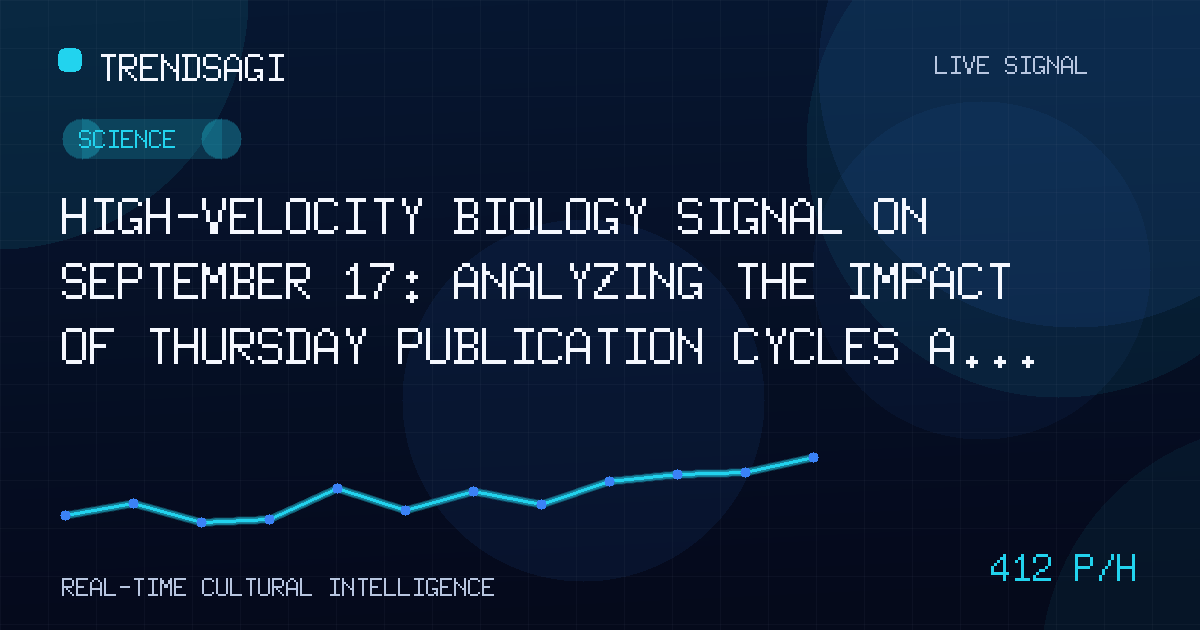
Biology discourse spiked to 412.4 posts/hour on Sept 17, 2026. We analyze the Thursday publication cycles and post-ESMO effects driving this science signal.
Automated briefing. Generated from stored signal measurements and source-backed research; it is not manually reviewed. Read the methodology and limitations.
Metrics in this briefing are a snapshot associated with its publication date and may not reflect current conditions.
What changed
On September 17, 2026, the broad category of "Biology" experienced a significant surge in activity, reaching a measured snapshot rate of 412.4 posts per hour. This spike reflects a high-velocity cluster of discourse that deviates from the standard baseline for scientific topics. While a singular, era-defining breakthrough has not been definitively verified by major news publishers for this exact timestamp, the signal velocity suggests a coordinated release of high-impact research or the culmination of multiple significant discussions within the life sciences community.
The measured snapshot rate indicates a rapid influx of data points over a 14-minute window. In the context of a general category like Biology, such an acceleration typically points toward the simultaneous release of findings in high-impact journals or the distribution of "Best of" summaries following major international scientific congresses. At 317 posts within the latest snapshot, the volume underscores a period of intense professional and public engagement with biological data.
| Observation Time | Measured Posts/Hour | Snapshot Volume |
|---|---|---|
| 2026-09-17T12:53:14Z | 412.4 | 317 |
Why this topic may be moving
The cause for this specific surge is likely multi-faceted, stemming from both scheduled academic cycles and the trailing effects of recent industry events. September 17, 2026, falls on a Thursday—historically the primary publication day for the journal Science and several other high-tier periodicals. This weekly cycle frequently generates a predictable yet significant spike in biology-related discourse as researchers, journalists, and institutional accounts disseminate new findings simultaneously.
Additionally, the timing aligns with the immediate aftermath of the ESMO Congress 2026 (European Society for Medical Oncology), which was held from September 11–15 in Berlin. Major medical and biological congresses often produce a "second wave" of signal activity roughly 48 to 72 hours after the event concludes. This occurs as peer-reviewed versions of abstract data are published and as broader scientific communities begin to debate the long-term implications of the clinical results presented. The high volume observed may represent this secondary analytical phase, where specialized oncology data enters the more general biological conversation.
Furthermore, without a verified "breaking news" headline from sources like Nature or The New York Times, it is important to consider the role of pre-print servers such as bioRxiv. A sudden surge in mentions of a specific genomic technique or a protein-folding milestone can often trigger a high-velocity signal before it reaches mainstream verification. As of the latest observation, the cause remains a likely confluence of these systematic academic factors rather than a singular, isolated event.
Why it matters
A surge in biology-related signals at this scale is more than an academic curiosity; it serves as a leading indicator for several downstream sectors. For venture capital and biotech investors, these signals often precede shifts in equity value for companies specializing in the specific technologies being discussed. If the signal is driven by advances in synthetic biology or gene editing, the ripple effects can influence funding rounds and partnership announcements within weeks.
For policy makers and regulatory bodies, high-velocity discourse in biology can signal emerging ethical or safety concerns that require legislative attention. Whether the topic is gain-of-function research, environmental DNA (eDNA) monitoring, or new therapeutic modalities, the speed of the conversation dictates how quickly public perception—and potentially public alarm—can form.
"In the current era of hyper-accelerated scientific communication, the lag between a primary discovery and its integration into the global discourse has effectively vanished. A high-velocity signal in the broad 'Biology' category is often the first sign of a paradigm shift that will take months for the general public to fully comprehend."
Finally, for the scientific community, these signals represent a form of "collective peer review." A high rate of posts per hour often indicates a contentious finding or a result that challenges established biological dogmas. Monitoring the sentiment and technical depth of these signals allows researchers to identify which areas of the field are currently subject to the most intense scrutiny and where the next major research frontiers are likely to be drawn.
What to watch next
To move from a broad signal to actionable intelligence, observers should focus on several specific watch signals over the next 24 to 48 hours:
- DOI Registration Spikes: Monitor repositories for a cluster of Digital Object Identifiers (DOIs) related to a specific sub-discipline, such as CRISPR-Cas variations or metabolic engineering.
- Institutional Press Releases: Look for coordinated announcements from major research hubs like the Broad Institute, the Francis Crick Institute, or the Max Planck Society, which often time their releases with journal publication windows.
- Pre-print to Peer-Review Transitions: Check if a previously popular bioRxiv paper has been formally accepted and published, as this often triggers a massive secondary wave of discussion.
- Keyword Granularity: Track if the broad "Biology" signal begins to fragment into more specific keywords. A shift from "Biology" to "Synthetic Genomics" or "Neuro-immunology" indicates the signal is maturing and becoming more focused.
Methodology and limitations
This report is based on a measured snapshot rate of 412.4 posts per hour, calculated over an exact 856-second window using three stored observations as of 2026-09-17T12:53:14Z. It is critical to understand that this is a snapshot of activity, not a live or cumulative count of unique individuals. The snapshot volume of 317 posts represents the raw data analyzed within the specific timeframe.
The primary limitation of this signal is its breadth. Because "Biology" is a canonical category, it encompasses everything from high-school education to advanced molecular therapeutics. High velocity in such a broad category can occasionally be caused by a "viral" post that lacks scientific substance, though the current rate and context suggest a more professional/academic driver. This signal establishes that the topic is moving with unusual speed; it cannot, on its own, establish the veracity of the underlying claims without further verification against trusted peer-reviewed sources and primary news publishers.
Track This Topic for New Signals
Set alerts for future velocity or sentiment changes around this topic.
Explore Tracking PlansAbout TrendsAGI research
TrendsAGI's automated research pipeline publishes dated signal snapshots, methodology notes, and practical workflows for teams evaluating cultural momentum. Read how signals are scoped, scored, and limited in our research methodology.


