1424-second window · 2 observations · Measured Aug 29, 2026, 1:36 AM UTC · Provider: go_recent_snapshot_v2
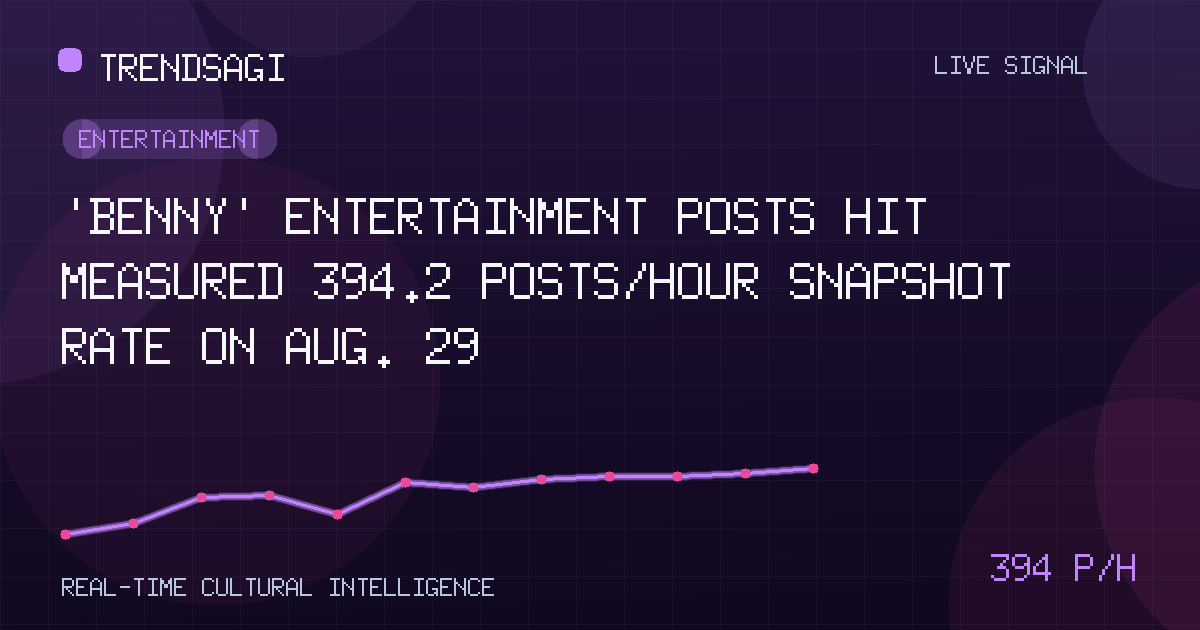
‘Benny’ Entertainment Posts Hit Measured 394.2 Posts/Hour Snapshot Rate on Aug. 29
Entertainment topic “Benny” hit 406 snapshot posts and a measured 394.2 posts/hour rate on Aug. 29, 2026. What the signal can and cannot tell you.
Automated briefing. Generated from stored signal measurements and source-backed research; it is not manually reviewed. Read the methodology and limitations.
Metrics in this briefing are a snapshot associated with its publication date and may not reflect current conditions.
What changed
At 2026-08-29T01:36:57Z, a monitoring snapshot of the Entertainment category found a topic labeled "Benny" at 406 captured posts. The measured snapshot rate was 394.2 posts/hour over the preceding 1,424 seconds. That is a sharp burst: the kind of movement usually associated with a developing story, a new release, or a viral clip — but the snapshot itself cannot tell you which one it is.
The figure is not a forecast and not a count of unique people, reach, or engagement. It is a measured rate of how quickly posts associated with the label "Benny" accumulated during the exact observation window.
| Observation time | 2026-08-29T01:36:57Z |
|---|---|
| Measured snapshot rate | 394.2 posts/hour |
| Snapshot volume | 406 posts |
Why this topic may be moving
"Benny" is one of the harder labels to interpret because it is a name, a nickname, and sometimes an idiom. In an entertainment context it could be connected to an actor, musician, film character, TV episode, song title, or internet meme. It can also be a false positive, such as casual words containing "benny" or unrelated accounts using the label.
As of this writing, the cause of the burst could not be verified from public sources. The timing alone does not distinguish between a breaking announcement and a coordinated fan-driven push, such as a birthday, anniversary, or curated hashtag trend. Public context could apply to several entertainment subjects named Benny, but none can be confirmed as the trigger from this snapshot alone.
What can be said plainly: the measured snapshot rate indicates that something crossed a volume threshold during the sampled period. The signal is useful as a triage alert, not as proof of a specific event.
Why it matters
For entertainment journalists, social media desk editors, and brand monitoring teams, a sudden spike in a short, common keyword can be both an opportunity and a trap. It can point you to a story before major outlets publish it, or it can waste time if you chase the wrong interpretation.
A spike in a keyword is not a verdict. It is a triage signal: volume tells you attention moved, but it does not tell you why attention moved, whether the movement is real, or whether it will last.
Because "Benny" is so underspecified, the risk of misreading is higher. A handful of related posts by a popular account can make a small sample look larger, and the snapshot does not reveal whether the 406 posts came from many accounts or a small number of highly active ones.
Still, the timing is worth acting on. If you cover entertainment, music, or pop culture monitoring, this is a moment to check dashboards, listen for audio or video contexts, and look for clips or statements that match the observed window.
What to watch next
- Confirm the referent: Filter for "Benny" plus discriminating terms such as "song," "film," "actor," "TV," "meme," or "event" to see which cluster accounts for the surge.
- Check the shape of the curve: Compare volume in the hour before and after the snapshot. Sustained growth means something is escalating; a single sharp peak suggests a one-off mention.
- Look for source timestamps: Find the earliest high-signal post in the window. If the earliest timestamp precedes the surge and the follower count is large, that explains the volume better than a broad trend.
- Monitor adjacent categories: If "Benny" is crossing from Entertainment into News, Music, or Viral, the context is probably bigger than a show or film character.
- Set a short follow-up check: Re-measure 12 to 24 hours after the snapshot. A true entertainment news event usually produces secondary posts, reactions, and associated terms.
Methodology and limitations
The numbers in this briefing come from two stored observations of a monitoring stream. The first and second observations were separated by exactly 1,424 seconds. The measured snapshot rate of 394.2 posts/hour is the change in captured post volume during that window divided by the elapsed time. The snapshot volume of 406 posts is the total captured count at the later observation time.
This method is good at surfacing abrupt changes, but it has strict limits. It does not measure posts missed by the stream, and it does not de-duplicate posts that have been reshared or quoted. The topic label "Benny" is treated as a raw filter; no manual cleanup or entity resolution was applied. As a result, "Benny" posts may include multiple real-world referents.
No stated rate in this briefing should be interpreted as a projected daily volume, a number of engaged users, or a measurement of influence. The appropriate use is early awareness and prioritization.
Track This Topic for New Signals
Set alerts for future velocity or sentiment changes around this topic.
Explore Tracking PlansAbout TrendsAGI research
TrendsAGI's automated research pipeline publishes dated signal snapshots, methodology notes, and practical workflows for teams evaluating cultural momentum. Read how signals are scoped, scored, and limited in our research methodology.