641-second window · 3 observations · Measured Oct 4, 2026, 11:51 PM UTC · Provider: go_recent_snapshot_v2
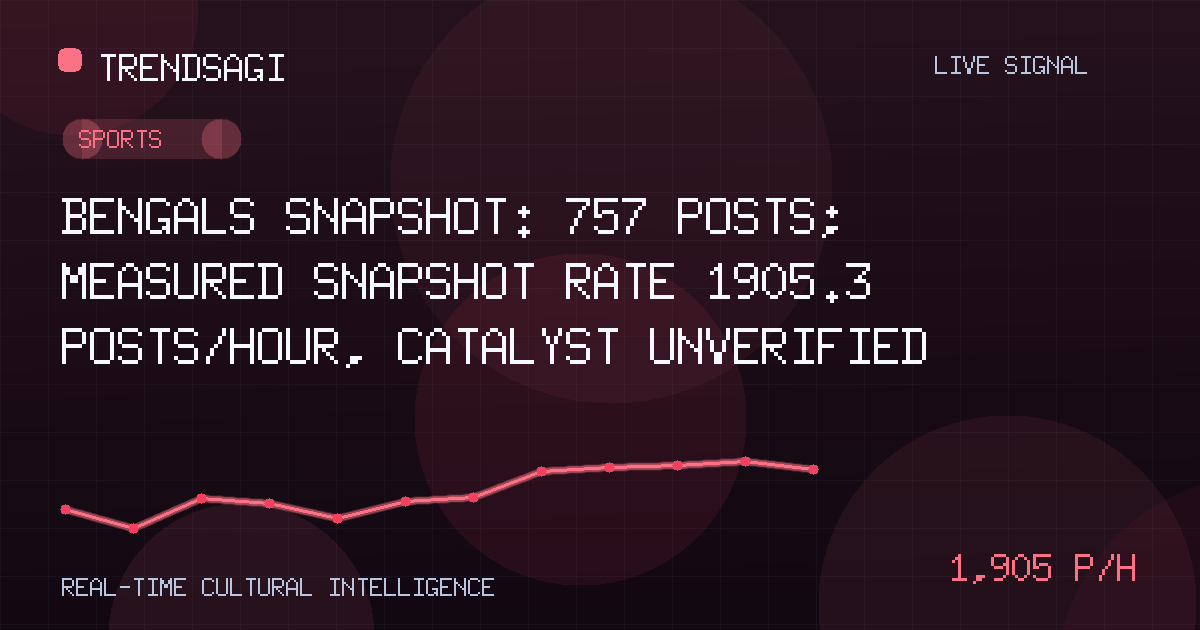
Bengals snapshot: 757 posts; measured snapshot rate 1905.3 posts/hour, catalyst unverified
Latest Bengals snapshot: 757 posts and a measured snapshot rate of 1905.3 posts/hour; the catalyst remains unverified.
Automated briefing. Generated from stored signal measurements and source-backed research; it is not manually reviewed. Read the methodology and limitations.
Metrics in this briefing are a snapshot associated with its publication date and may not reflect current conditions.
What changed
The tracked “Bengals” topic shows concentrated short-window posting activity, but no verified catalyst is established here. For a sports audience, the useful answer is that the signal merits monitoring and verification, not a confident explanation of why people are posting.
The latest stored observation, timestamped 2026-10-04T23:51:51Z, contains 757 posts. Over the exact 641-second window represented by three observations, the supplied measured snapshot rate is 1905.3 posts/hour. This is a short-window measurement, not a live or current rate, forecast, reach, engagement total, or count of unique people.
| Observation time | Measured snapshot rate | Snapshot volume |
|---|---|---|
| 2026-10-04T23:51:51Z | 1905.3 posts/hour | 757 posts |
The snapshot pairs an inventory of 757 posts with a measured pace across a brief interval. Because no earlier rate or normal baseline is supplied, it cannot show that activity is accelerating, is unusually high for this label, or will stay elevated.
Why this topic may be moving
No event description or verified public context in the available record identifies a triggering event. The cause remains unclear. A specific claim about a game, player move, injury, coaching decision, disciplinary matter, or another development would be speculation until a timestamped public source supports it.
The immediate verification questions are:
- Entity: Do the posts consistently concern one sports organization, another team, or a different subject sharing the word “Bengals”?
- Timing: Which posts appeared earliest, and can their timestamps be matched to a verified event rather than only to later reaction?
- Subject: Do the posts center on one topic, or combine unrelated game reactions, personnel news, criticism, historical debate, and general fandom?
- Distribution: Is the activity broad first-hand discussion, or concentrated around repeated text, a few high-visibility accounts, or a specific platform?
The signal establishes how many posts were present in the tracked snapshot and the measured pace across its observation window. It does not establish who posted, why they posted, whether the posts were original, or whether one event caused the activity.
Why it matters
Sports editors should treat this as a verification queue, not a ready-made story. A broad trend label can point toward breaking news, planned coverage, fan reaction, or conversation around older material; each requires different sourcing and timing.
Team and community teams should avoid interpreting volume as public approval, influence, or reach. The measured posting pace can reflect many distinct reactions, repeated material, or a narrow set of widely copied posts, none of which is demonstrated here. Before responding publicly, they need to identify the subject and verify the trigger.
Media analysts and audience teams should care because the next snapshots can distinguish persistence from a momentary cluster. They should also separate conversation volume from engagement quality: the supplied signal provides no reactions, replies, shares, or other engagement measures, so posting volume cannot be used as a proxy for engagement quality.
What to watch next
The next useful step is not to relabel the activity more dramatically. It is to collect evidence that narrows the cause.
- Resolve the entity and collection scope. Determine which team or subject the posts describe and whether the snapshot covers particular platforms, queries, regions, or languages. Without that scope, comparisons with broader public conversation are unsafe.
- Locate the earliest substantive posts. Record their timestamps, cited sources, and language, then check whether any claim predates later reaction. Original posts should not be treated as authoritative merely because they appeared first.
- Extend the time series with the same method. Add later stored observations and keep window length, counting rules, and snapshot volume separate. A sustained pattern across comparable windows would support a different conclusion from a brief concentration.
- Classify the content. Separate original commentary from quotations or reposts, and group verified subject matter into a small, auditable set. This can show whether discussion is converging on one issue or simply sharing the same label.
- Test the distribution pattern. Inspect repetition, account overlap, and posting sequences without assuming automation. Duplicates can inflate apparent conversation, while a genuine reaction wave can also produce repeated phrases.
- Seek public corroboration. Check timestamped reporting and official statements from relevant sports bodies, teams, or local reporters. If no credible catalyst can be verified, retain cause unclear rather than filling the gap with the most popular theory.
Watch for signals that would materially change the interpretation:
- A specific, timestamped event repeatedly named in the earliest substantive posts.
- New snapshots showing the measured snapshot rate persisting rather than dropping back within later comparable observation windows.
- A shift from general label use to clearly identified teams, people, or issues.
- A change in the mix of original posts, quotations, and repeated material.
- Credible public reporting that aligns with the timing of the cluster.
Methodology and limitations
The measured snapshot rate of 1905.3 posts/hour was measured at 2026-10-04T23:51:51Z across an exact 641-second window using three stored observations. The 757-post figure is latest snapshot volume, not a rate. Neither number should be read as platform-wide activity without collection coverage. The 757 posts should not be assumed to have all appeared during those 641 seconds because the volume interval is not defined.
Three observations provide limited evidence about duration. They may be sensitive to the timing of a cluster, and the observation timestamp does not reveal when discussion began. There is no historical baseline, account-level data, sentiment measure, engagement data, or verified event account in the supplied record.
The label is also broad, and the record does not state whether posts were deduplicated or whether all public platforms were included. As a result, the signal can establish the presence and measured pace of the tracked posts, but not cause, audience size, authenticity, sentiment, virality, or persistence. Those questions require the checks above.
Track This Topic for New Signals
Set alerts for future velocity or sentiment changes around this topic.
Explore Tracking PlansAbout TrendsAGI research
TrendsAGI's automated research pipeline publishes dated signal snapshots, methodology notes, and practical workflows for teams evaluating cultural momentum. Read how signals are scoped, scored, and limited in our research methodology.