1039-second window · 3 observations · Measured Oct 2, 2026, 12:56 AM UTC · Provider: go_recent_snapshot_v2
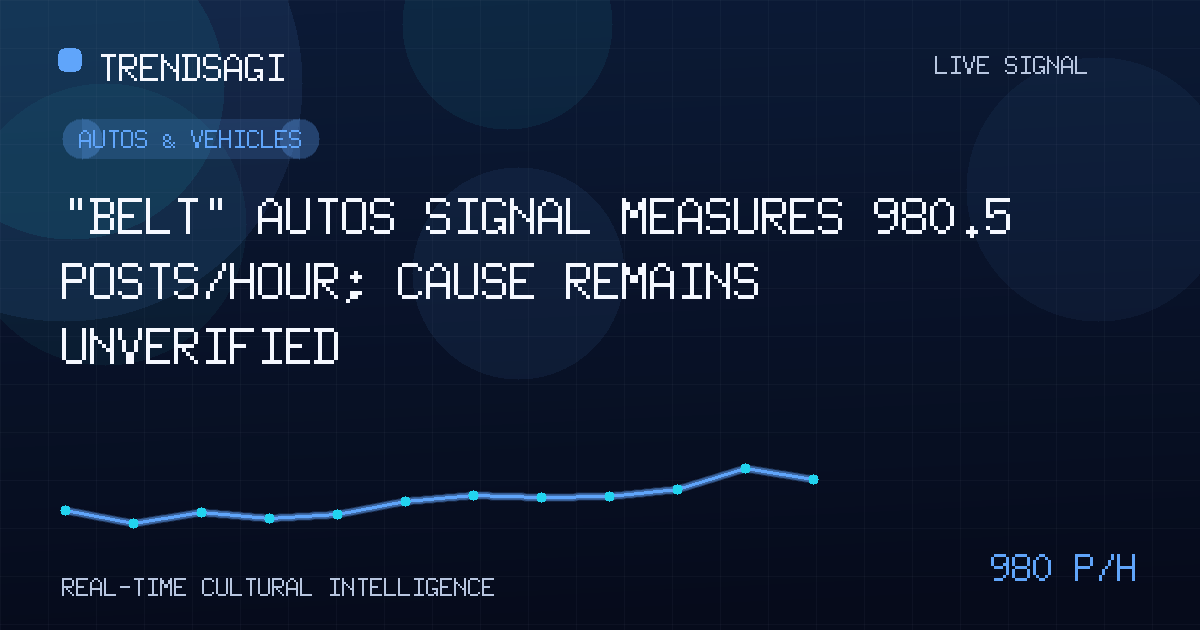
“Belt” autos signal measures 980.5 posts/hour; cause remains unverified
A stored “Belt” automotive signal measured a snapshot rate of 980.5 posts/hour over 1039 seconds; its cause and scope require verification.
Automated briefing. Generated from stored signal measurements and source-backed research; it is not manually reviewed. Read the methodology and limitations.
Metrics in this briefing are a snapshot associated with its publication date and may not reflect current conditions.
What changed
A stored Autos & Vehicles signal labeled “Belt” shows a measured increase in labeled posting, but no verified public context establishes why. The broad label and missing post-level context make this an attribution problem, not evidence of a specific automotive news event.
The measured change is 980.5 posts/hour, described as a measured snapshot rate over an exact 1039-second window using 3 stored observations at 2026-10-02T00:56:33Z. The latest snapshot volume is 654 posts. Those are distinct measures: 654 is the observed corpus count, while 980.5 posts/hour is the rate for the stated window. It is not a live or current rate, forecast, reach, engagement, or unique-person count.
| Metric | Stored value |
|---|---|
| Observation time | 2026-10-02T00:56:33Z |
| Measured posts/hour | 980.5 posts/hour, measured snapshot rate |
| Snapshot volume | 654 posts |
Why this topic may be moving
No verified cause can be assigned from the stored evidence alone. The signal has no descriptive text, and “Belt” can point to several subjects even inside autos: seat belts or restraints, timing belts, drive belts, aftermarket parts, or wording unrelated to vehicles. These are possibilities to test, not findings.
Several mechanisms could create the observed pattern:
- Event-driven discussion. A verified safety notice, recall, enforcement change, product issue, or campaign may be generating posts.
- Commercial or repair activity. A launch, maintenance cycle, pricing discussion, or service issue may be concentrating conversation.
- Semantic mixing. Seat-belt references, mechanical components, and unrelated uses of “Belt” may have been grouped under one broad label.
- Platform dynamics. Reposting, media amplification, coordinated activity, or a spam burst may inflate a short-window rate.
- Sampling effects. Collection cadence or corpus coverage may change across observations and shape the measured result.
Choosing among these explanations requires representative post text, named entities, source patterns, geography and language, a prior baseline, and matched public reporting. Those inputs are not present in the stored signal, so the cause remains unclear. It would be misleading to present a specific event as the driver without post-level evidence and verification.
The measured snapshot rate is evidence of posting intensity around a label at that moment, not evidence of a named event, audience size, or a trend that persists.
Why it matters
The immediate implication is triage, not conclusion. A concentrated label-level signal tells teams where to look, but not what happened or what readers believe.
- Automotive safety, recall, and compliance teams should check whether posts name a specific restraint, component, vehicle, incident, or official action before changing communications.
- Manufacturers, suppliers, dealers, and repair businesses should look for repeated model, part, or service terminology and distinguish customer questions from confirmed defects.
- Media and social teams can use the signal as a discovery queue, but should not describe “Belt” as a news event or infer public sentiment from volume alone.
- Analysts and taxonomy teams should test whether the category and label are precise enough to support a trend interpretation.
For all of these readers, the practical question is whether the activity resolves into a named, independently verifiable subject. Until then, the signal is useful for allocating attention, not for making operational, safety, or editorial claims.
What the signal can and cannot establish
The signal establishes that the stored corpus contained 654 posts at the observation time and registered a measured snapshot rate of 980.5 posts/hour over the stated window. That supports an attribution check within this dataset, but not a conclusion about scale in the wider public.
It does not establish:
- whether “Belt” refers to one subject or several unrelated subjects;
- whether the measured snapshot rate is unusual against the same label’s normal history;
- whether posts are original, replies, reposts, or automated copies;
- how many unique people were involved;
- reach, impressions, clicks, or engagement;
- sentiment, urgency, factual accuracy, or public importance;
- whether the movement will persist beyond the measured window.
Most importantly, volume is not causation. A large number of posts can reflect a real issue, repeated copying, ambiguous classification, or a temporary spike in collection activity. The current record cannot discriminate among those cases.
What to watch next
The next checks should turn the broad label into testable evidence:
- Classify the actual posts. Record what “Belt” means in each sampled item, then group by seat belts, restraints, timing belts, drive belts, or another topic. Preserve the exact phrase and surrounding context.
- Extract entities and event terms. Look for vehicle models, component names, locations, agencies, companies, incident language, and sources named inside the posts. Repetition of a specific entity would be a stronger clue than repetition of the label alone.
- Verify a public event before attributing the movement. Search for a development that credible publishers or relevant institutions describe at the same time and explicitly connect to the same belt-related subject. If no matching event can be verified, retain “cause unclear.”
- Audit duplication and coordination. Compare wording, account behavior, timestamps, and source chains to distinguish original reporting from replies, syndicated copy, repost bursts, or automated amplification.
- Compare like-for-like windows. Check prior and subsequent observations using the same query, category, language settings, and collection method. The key watch signal is persistence, not merely the existence of this one measured snapshot rate.
- Watch for attribution convergence. A meaningful development would be multiple independent posts resolving to the same subtopic and named event. Divergent meanings would instead indicate taxonomy or keyword ambiguity.
- Track corrections and migration. See whether the conversation acquires an official clarification, shifts to a more specific label, or disappears after the burst. Each outcome helps distinguish a durable event from transient noise.
Methodology and limitations
This briefing uses the canonical stored observation at 2026-10-02T00:56:33Z. The measured snapshot rate is 980.5 posts/hour over an exact 1039-second window using 3 stored observations. The latest snapshot volume of 654 posts is a separate count, not another rate. The empty signal description, lack of post samples, absence of a comparison baseline, and lack of verified public context limit causal interpretation. No daily extrapolation, forecast, or claim about the broader public is made.
Track This Topic for New Signals
Set alerts for future velocity or sentiment changes around this topic.
Explore Tracking PlansAbout TrendsAGI research
TrendsAGI's automated research pipeline publishes dated signal snapshots, methodology notes, and practical workflows for teams evaluating cultural momentum. Read how signals are scoped, scored, and limited in our research methodology.