904-second window · 3 observations · Measured Oct 10, 2026, 10:22 AM UTC · Provider: go_recent_snapshot_v2
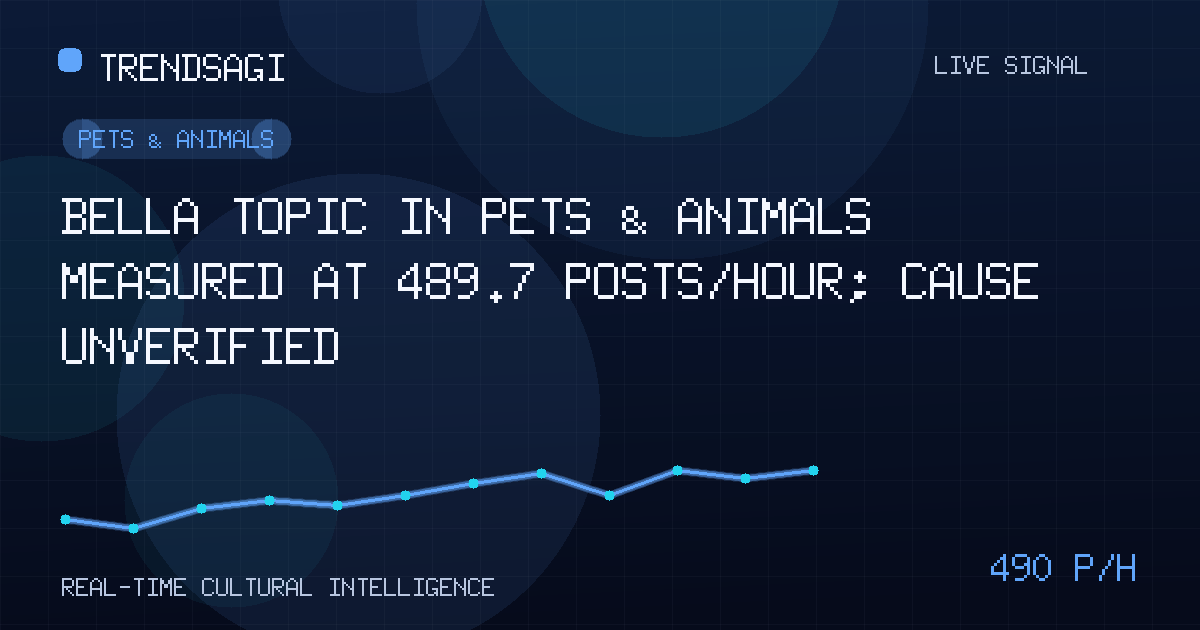
Bella topic in Pets & Animals measured at 489.7 posts/hour; cause unverified
Bella's stored Pets & Animals snapshot contains 648 posts and a measured 489.7 posts/hour rate; the cause remains unverified, with checks for follow-up.
Automated briefing. Generated from stored signal measurements and source-backed research; it is not manually reviewed. Read the methodology and limitations.
Metrics in this briefing are a snapshot associated with its publication date and may not reflect current conditions.
What changed
The clearest read is that Bella produced a fast-moving cluster in the stored Pets & Animals signal, but the cause of that movement is not verified. The record establishes concentrated activity around an underspecified label; it does not establish which Bella was involved, where the posts appeared, or whether the posts formed a coherent public event.
| Observation time | Measured snapshot rate | Snapshot volume |
|---|---|---|
| 2026-10-10T10:22:18Z | 489.7 posts/hour | 648 posts |
The measured change rate was 489.7 posts/hour across an exact 904-second window using three stored observations, with the latest observation at 2026-10-10T10:22:18Z. That latest recorded snapshot contained 648 posts. The figure is a measured snapshot rate, not a live or current rate, and it should not be read as a forecast, reach, engagement, or a count of unique people.
Why this topic may be moving
There is no defensible external attribution in the available record. No verified announcement, news report, campaign, or other public event is supplied that can be connected to this cluster. The stored category narrows the classification, but it does not prove that every matching post concerns a pet, an animal story, or the same named subject.
Several explanations are worth checking, but none should be presented as the cause:
- A specific animal or pet story may have prompted repeated mentions.
- A person, fictional character, business, or product sharing the label may be driving matches.
- A social post, media story, adoption effort, memorial, or controversy may have been reposted widely.
- Name ambiguity, duplicate content, or collection noise may account for part of the apparent cluster.
These are investigation hypotheses, not findings. Until a source resolves the referent and timing, the safest conclusion is that the topic is moving quickly and its cause remains unclear.
A fast-moving topic label is an alert to investigate, not yet evidence of a verified event. The next editorial value comes from resolving identity, cause, and persistence.
Why it matters
Editors and newsrooms should treat the signal as a prompt to inspect the underlying posts, not as automatic evidence of a news event. The measured rate can coexist with many posts around one story, repeated copying, a highly active community, or several unrelated uses of the same name. Each possibility has a different editorial response.
Teams connected to shelters, animal welfare, veterinary communication, and pet media should verify identity before drawing attention to a supposed Bella-related event. Acting on the label alone could amplify the wrong subject or intrude on a private person’s story. The useful question is not merely whether Bella is active, but whether the activity maps to a confirmed animal, organization, or event that those teams serve.
Trend analysts and brand-safety teams should also avoid using the snapshot as an audience estimate. The signal does not identify unique authors, impressions, sentiment, locations, platforms, or engagement. It is best used to decide what to inspect next.
What to watch next
A useful follow-up should answer several linked questions: what is being discussed, why it started, whether it persists, and how far it spread. The checks below preserve that order.
- Resolve the entity. Review a representative sample from the observation window and determine whether Bella is a pet name, a person, fictional character, brand, product, or another referent. Record ambiguous or irrelevant matches separately rather than assuming one shared story.
- Check catalyst timing. Compare the start of the cluster with verified first-party announcements and reputable reporting. A match should identify the same Bella and align with the observed period before it is offered as the reason.
- Establish a baseline. Use the same query, collection method, and time buckets for earlier periods. Without that comparison, the stored rate cannot show whether this is exceptional for Bella or ordinary for the category.
- Map the spread. Check platform, geography, language, and community concentration while separating original posts from copies, reactions, and unrelated name matches. This shows whether 648 posts represent broad discussion or repeated circulation of one item.
- Seek authoritative confirmation. A named shelter, animal-welfare organization, veterinarian, creator, or other responsible party may clarify the subject. Official confirmation would materially strengthen an editorial link but should be dated and compared with the signal.
- Test persistence. Look for additional same-method observations showing activity remains high relative to the baseline and for an identifiable event to generate fresh posts rather than recirculation. A quick fall after one burst would point toward a short-lived reaction.
Concrete confirmation signals are an official statement naming Bella, a verified story timestamp aligned with the cluster, and subsequent coverage focused on the same referent. Warning signs include continued ambiguity, unrelated match categories, and a rate that recedes as copying stops. Those distinctions determine whether this is a durable trend, an event spike, or a measurement artifact.
Methodology and limitations
The briefing uses the stored observation timestamped 2026-10-10T10:22:18Z. The measured change rate of 489.7 posts/hour uses three stored observations over an exact 904-second window. Snapshot volume is reported separately as 648 posts; it is neither the rate nor a unique-account total.
Several essential details are absent: the underlying post text, collection query, source platforms, geography and language settings, account-level deduplication, engagement data, and the earlier baseline. Consequently, the signal cannot establish topic breadth, sentiment, causation, or persistence. It also cannot show whether 648 represents distinct conversations or repeated circulation. Any characterization beyond a fast measured cluster should wait for direct inspection of the sample and collection method.
No external event is attributed because the available record contains no verified public explanation tied to Bella and the observation time. That is not proof that no catalyst exists; it means the evidence needed to name one is not available. The practical next step is entity resolution and source verification, followed by a same-method baseline and persistence check.
Track This Topic for New Signals
Set alerts for future velocity or sentiment changes around this topic.
Explore Tracking PlansAbout TrendsAGI research
TrendsAGI's automated research pipeline publishes dated signal snapshots, methodology notes, and practical workflows for teams evaluating cultural momentum. Read how signals are scoped, scored, and limited in our research methodology.


