895-second window · 3 observations · Measured Oct 1, 2026, 7:56 AM UTC · Provider: go_recent_snapshot_v2
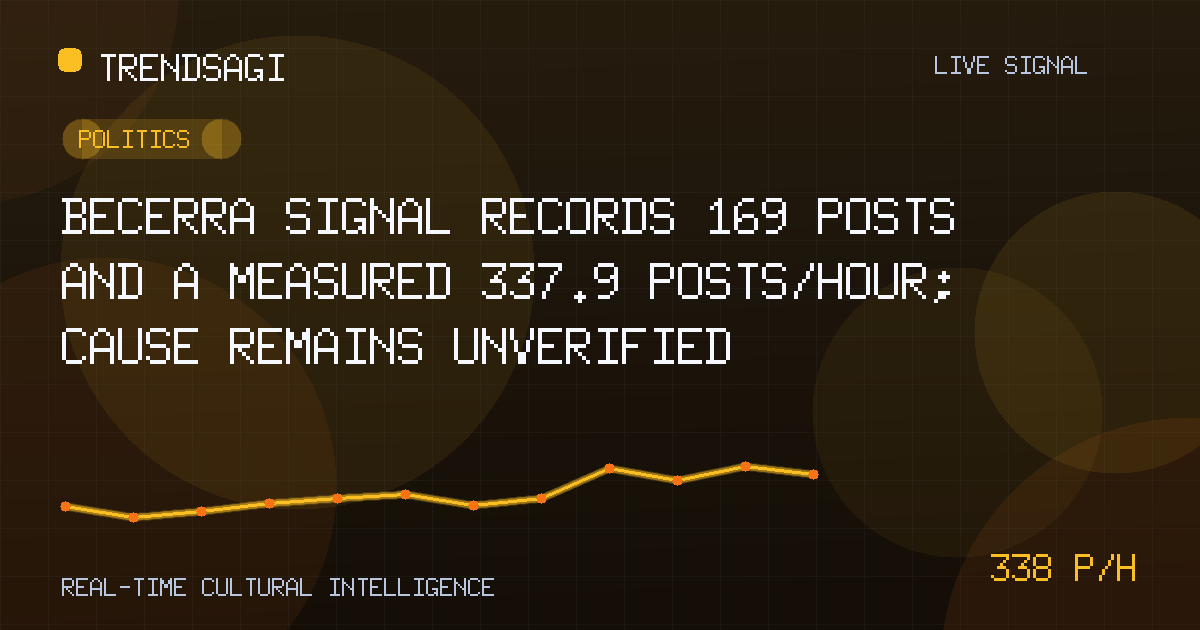
Becerra signal records 169 posts and a measured 337.9 posts/hour; cause remains unverified
A 169-post Becerra snapshot produced a measured 337.9 posts/hour over 895 seconds; the trigger is unverified and the label is ambiguous.
Automated briefing. Generated from stored signal measurements and source-backed research; it is not manually reviewed. Read the methodology and limitations.
Metrics in this briefing are a snapshot associated with its publication date and may not reflect current conditions.
What changed
The stored signal labeled “Becerra” shows a short-window burst in the Politics category: the latest snapshot contains 169 posts. The record does not identify which Becerra is being discussed, and no verified public context establishes a triggering event, so the cause remains unclear.
The measured change rate is 337.9 posts/hour, based on 3 stored observations over an exact 895-second window. This is a measured snapshot rate—not a live or current rate, forecast, reach estimate, engagement measure, or unique-person count. The 169 figure is snapshot volume, not a count of distinct authors.
| Observation time | Measured posts/hour | Snapshot volume |
|---|---|---|
| 2026-10-01T07:56:26Z | 337.9 posts/hour | 169 posts |
The signal establishes a dated change in recorded posting volume, but not what caused it. Without a historical baseline, it also cannot show whether this pace is unusual for the label or whether it persisted after the observation.
Why this topic may be moving
The most important finding is also a limitation: the cause is unverified. The stored description is empty, and the label supplies no full name, office, location, event, or originating source. That ambiguity is too large to responsibly connect the burst to a particular political development.
Several mechanisms could produce this pattern. A genuine political event could have prompted reaction; an entity-name collision could have combined unrelated conversations; or repeated posting and platform amplification could have raised volume without equivalent original discussion. These are hypotheses to test, not verified explanations, and none should be presented as the trigger.
The Politics classification makes a political context plausible, but classification alone does not prove that every post concerns politics or the same subject. Until the underlying posts are grouped by identity and context, the safest description is that posts carrying the label increased during the measured window.
A rapid rise in labeled posts is an alert to investigate identity and chronology; by itself, it is neither evidence of a specific trigger nor a measure of independent public reaction.
What the signal can and cannot establish
Within the stored record, the signal can establish:
- the observation time and latest snapshot volume of 169 posts;
- a measured change rate of 337.9 posts/hour based on 3 observations over an exact 895-second window;
- the assigned category, Politics.
It cannot establish:
- which real-world referent “Becerra” identifies;
- the event, statement, or decision that caused the movement;
- whether the rate is high relative to a normal baseline or persists beyond the measured window;
- sentiment, factual accuracy, geography, reach, or unique participation;
- whether posts were original, independent, or automatically amplified.
Why it matters
For political editors, ambiguity is an immediate editorial risk: a headline that assigns the spike to the wrong Becerra would turn a valid measurement into a false claim. Teams tracking a potential story need the same verification discipline before briefing stakeholders or recommending a response.
For researchers and analysts, the signal is useful as an alert for entity resolution and anomaly investigation, not as a public-opinion sample. Communication teams should continue to treat the cause as unknown until independent public evidence connects the label to a specific subject and event.
What to watch next
The next useful work is verification, not another unsupported explanation.
- Resolve the identity. Group posts by the people, offices, places, or issues they explicitly reference. If the label is combining different subjects, separate those clusters before interpreting the movement.
- Locate the start of the burst. Inspect the earliest distinct posts around the observation time and reconstruct their sequence. Separate original posts from quotations, reactions, and reposts.
- Verify a public trigger. Check whether a documented event, statement, hearing, vote, appointment, or other development actually involved the resolved Becerra. Confirm any proposed trigger with a primary record and independent reporting.
- Test duplication and amplification. Look for repeated wording, identical links, closely sequenced accounts, or sudden concentration on a small set of domains. Such patterns may indicate amplification, but none is established by the current record.
- Check persistence. Compare subsequent measured rates with 337.9 posts/hour and inspect whether activity continues across later observation windows. A return toward the label’s own baseline would suggest a short spike; sustained comparable rates would support a longer-lived burst, subject to coverage and deduplication changes.
- Watch for corroboration or disambiguation. A concrete event preceding a coherent set of posts would strengthen a news-driven explanation. Distinct names, places, or issues appearing under the same label would instead suggest aggregation. Stable volume dominated by repeated content would point more toward amplification than independent attention.
Methodology and limitations
The 337.9 posts/hour figure is a measured snapshot rate derived from 3 stored observations over an exact 895-second window. It is not extrapolated into a live or future rate. The record does not provide platform coverage, collection methods, deduplication rules, a historical baseline, or a complete account of geographic and user-level activity.
The 169-post snapshot volume and the measured rate describe labeled items recorded and how their count changed during the window. They do not measure how many people saw, authored, or joined the discussion.
No verified public event is tied to the label in the available record, so this briefing does not assign a cause. Entity resolution, chronological inspection, and independent corroboration remain necessary before the movement can be explained responsibly.
Bottom line
The stored measurement is clear; its cause is not. Treat “Becerra” as an entity-resolution and verification lead until public evidence identifies the subject and trigger.
Track This Topic for New Signals
Set alerts for future velocity or sentiment changes around this topic.
Explore Tracking PlansAbout TrendsAGI research
TrendsAGI's automated research pipeline publishes dated signal snapshots, methodology notes, and practical workflows for teams evaluating cultural momentum. Read how signals are scoped, scored, and limited in our research methodology.


