769-second window · 2 observations · Measured Sep 29, 2026, 12:54 AM UTC · Provider: go_recent_snapshot_v2
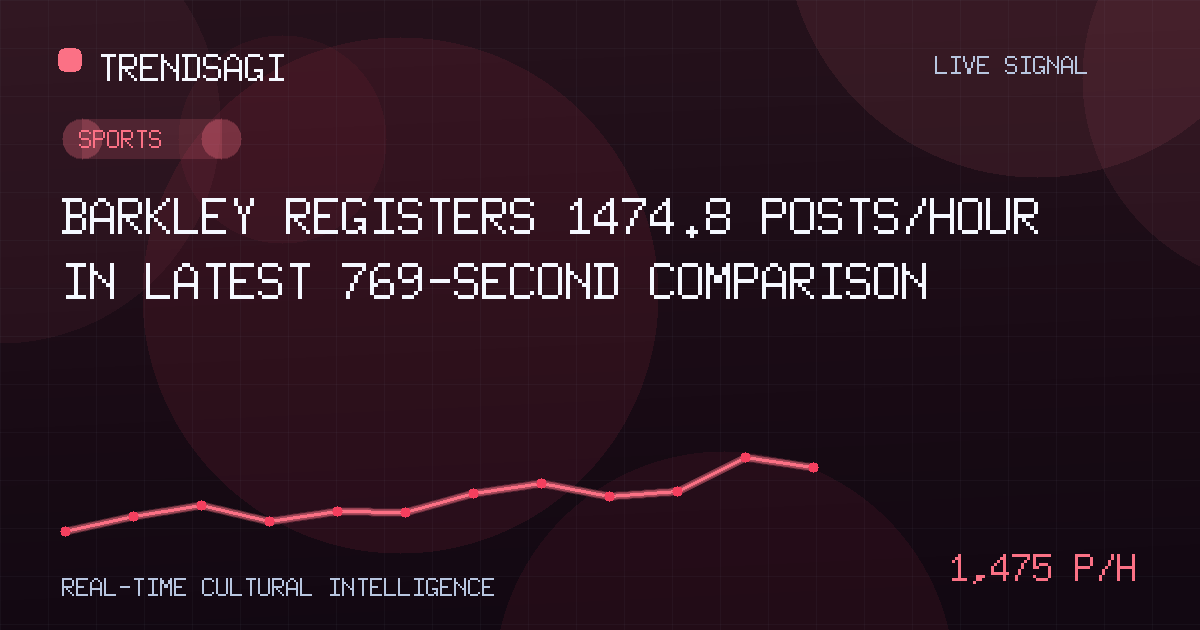
Barkley registers 1474.8 posts/hour in latest 769-second comparison
The latest Barkley signal measured 1474.8 posts/hour over 769 seconds, with 537 snapshot posts; this briefing separates the move from its unverified cause.
Automated briefing. Generated from stored signal measurements and source-backed research; it is not manually reviewed. Read the methodology and limitations.
Metrics in this briefing are a snapshot associated with its publication date and may not reflect current conditions.
What changed
Barkley shows a rapid, short-window rise in posting activity in the latest stored comparison. At 2026-09-29T00:54:08Z, the signal registered a measured snapshot rate of 1474.8 posts/hour across an exact 769-second window. The latest snapshot volume was 537 posts. The rate and volume are separate measurements: the first describes change during the window; the second describes the stored snapshot. The rate is historical, not a live or current rate, forecast, reach, engagement figure, or unique-person count.
The measured movement is clear, but its cause is not. No verified public context accompanies the signal, and the single-word label does not identify a specific event. Until a relevant report or primary statement is confirmed, the activity should not be attributed to a named person, team, game, announcement, or controversy.
| Observation time | Measured snapshot rate | Snapshot volume |
|---|---|---|
| 2026-09-29T00:54:08Z | 1474.8 posts/hour | 537 posts |
Why this topic may be moving
The stored category is Sports, but no event description is supplied. Entity resolution is therefore the first issue: the posts must be checked to determine whether they refer to the same subject under the same label. A concentrated burst by itself cannot resolve that ambiguity.
No verified publisher report or attributable primary statement establishes an external cause here. Plausible monitoring hypotheses include a live sports event, a news development, a social exchange, recycled media, or automated amplification. These are explanations to test, not established facts about this signal.
Each possibility requires a different follow-up. A breaking development should be checked against attributable reporting and the original source. Repetitive or concentrated posts require an account-level and duplication review. A broad event should produce activity beyond a narrow group of contributors. Without those checks, the safest description remains a rapid posting change associated with the Barkley label.
The defensible conclusion is that Barkley had a rapid measured posting change in this narrow window. Naming the event that caused it would go beyond the available evidence.
Why it matters
For editors, the measured snapshot rate is a triage signal: it says the topic merits an immediate check. It is not yet a story angle. A fast-moving conversation can create pressure to publish quickly, but speed does not cure an ambiguous label or replace verification. The first task is to establish what Barkley denotes and whether an attributable development exists.
Reporters, sports publishers, and followers should care because a short reaction window can be easy to miss. They should also avoid treating volume as proof of significance. Posts may reflect a substantive development, repeated material, a highly active account, or several unrelated uses of the same label. The sample itself must resolve that distinction.
For analysts and brand-safety teams, the key issue is breadth. The 537-post snapshot does not establish 537 unique participants, 537 independent opinions, or broad public attention. Nor does it show whether participants agree. Account concentration, originality, geography, language, and source diversity are all necessary before interpreting the burst as a wide audience response.
What the signal can and cannot establish
The signal establishes a time-stamped, positive measured posting change of 1474.8 posts/hour over the exact 769-second window, based on two stored observations. It also establishes that the latest snapshot contained 537 posts. Those are useful facts for deciding whether further investigation is warranted.
It does not establish:
- which entity or event the Barkley label represents;
- whether the rate is high compared with Barkley’s own historical baseline;
- whether a news event, scheduled competition, or social post triggered the movement;
- how many unique people participated or whether the activity was organic;
- whether posts represented agreement, criticism, curiosity, or automated repetition;
- whether the short-window change continued beyond the observation period.
Most importantly, the signal cannot support a causal headline. It can justify verification and monitoring, but not an explanation that has not been independently established.
What to watch next
- Resolve the label. Review the post text and linked context to determine whether Barkley consistently refers to one identifiable subject. The Sports category alone is not enough.
- Find an attributable trigger. Use public search to locate reporting or a primary statement connected to the timing. Include a cause in coverage only when a verifiable publisher or source supports it.
- Check persistence. Add comparable stored observations using the same method. Continued strength would support a sustained conversation; a quick reversal would be more consistent with a transient reaction.
- Measure concentration. Examine whether a small set of accounts generated much of the activity and whether posts are original, copied, or reformulations of the same material.
- Separate claims from confirmation. Identify what participants are asserting, then check those assertions independently. Repetition among posters is not verification.
- Look for independent spread. Multiple distinct contributors and separate reputable reporting would provide stronger evidence of broad relevance than one dominant account or a single narrative repeated across the snapshot.
Methodology and limitations
This briefing reproduces the stored observation at 2026-09-29T00:54:08Z and its measured snapshot rate of 1474.8 posts/hour. That rate covers an exact 769-second window and uses two stored observations. It has not been recalculated, extended, or converted into another rate. The 537-post figure is reported only as latest snapshot volume.
The topic is categorized as Sports, but no event description or verified public cause is attached. Accordingly, the briefing identifies the timing and scale of the change without assigning it to a real-world trigger. The available measurement does not establish historical typicality, unique participation, sentiment, geography, source mix, authenticity, or duration. Verified reporting or additional comparable observations would be needed to narrow those limitations.
Track This Topic for New Signals
Set alerts for future velocity or sentiment changes around this topic.
Explore Tracking PlansAbout TrendsAGI research
TrendsAGI's automated research pipeline publishes dated signal snapshots, methodology notes, and practical workflows for teams evaluating cultural momentum. Read how signals are scoped, scored, and limited in our research methodology.