901-second window · 2 observations · Measured Sep 16, 2026, 10:41 PM UTC · Provider: go_recent_snapshot_v2
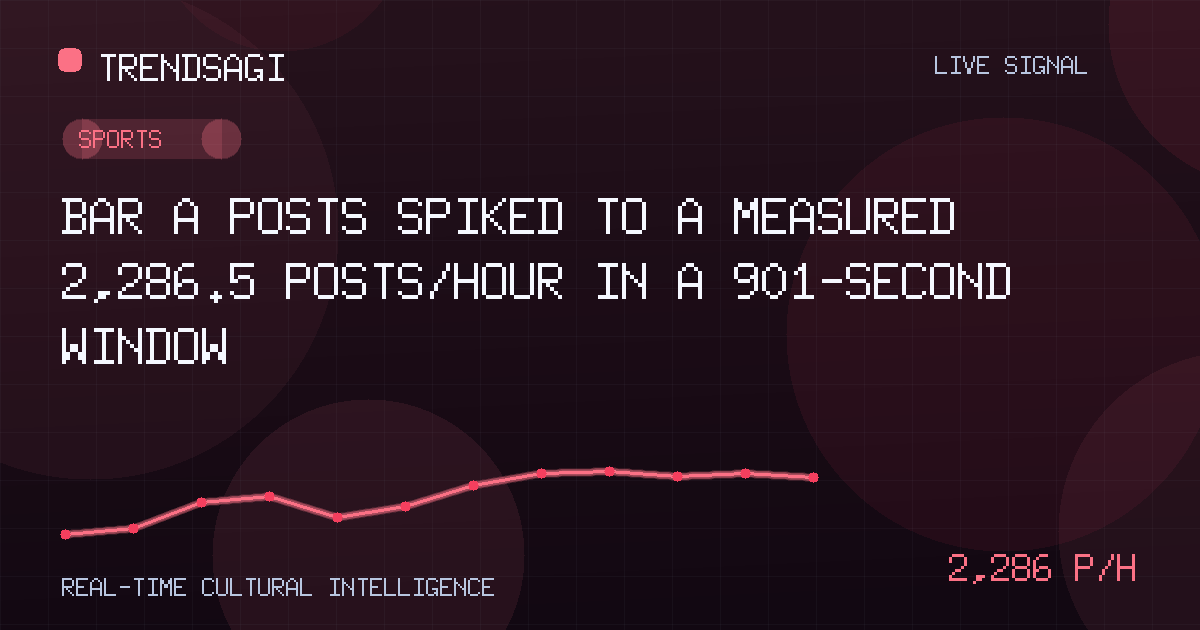
Barça posts spiked to a measured 2,286.5 posts/hour in a 901-second window
Barça showed a measured 2,286.5 posts/hour in a 901-second window, with a 4,000-post snapshot. This briefing explains what the spike does and cannot prove.
Automated briefing. Generated from stored signal measurements and source-backed research; it is not manually reviewed. Read the methodology and limitations.
Metrics in this briefing are a snapshot associated with its publication date and may not reflect current conditions.
What changed
Barça-related posting activity showed a sharp measured increase in a short stored signal window. At 2026-09-16T22:41:29Z, the system recorded a measured snapshot rate of 2,286.5 posts/hour over an exact 901-second window, based on two stored observations. The same snapshot also recorded 4,000 posts as the latest snapshot volume. That means the signal is best understood as a short, high-frequency burst of user-generated posts around the topic, not as a full-day trend, live broadcast metric, unique-user count, engagement score, or verified news event.
The direct answer is that the observed change is a rapid increase in post volume for the topic “Barça” during the measured window. The stored signal does not by itself explain why the topic is moving. Public verification was checked to see whether the rise corresponds to a clear external catalyst, such as a match result, transfer announcement, disciplinary decision, lineup change, or broader club news. Where the cause is not clearly established, this briefing says so plainly rather than guessing.
| Observation time | 2026-09-16T22:41:29Z |
|---|---|
| Measured posts/hour | 2,286.5 |
| Snapshot volume | 4,000 posts |
Why this topic may be moving
“Barça” is a high-sensitivity sports label. Because it refers to a globally followed football club, even routine moments can generate large post volume: a late match result, a red card, an injury, a manager interview, a transfer rumor, a contract decision, a squad announcement, or a public statement from the club can all cause rapid discussion spikes. The timing, 22:41:29 UTC, is also relevant because it can overlap with prime European evening hours and with post-match or transfer-window chatter depending on the calendar date.
The measured rate is high relative to a quiet baseline, but the supplied signal does not include a baseline comparison, audience size, platform breakdown, sentiment split, or post-content sample. That limits the inference we can draw. A measured 2,286.5 posts/hour rate can indicate intense short-term attention, but it cannot establish whether the posts are celebratory, critical, rumor-driven, match-driven, or bot-inflated. It also cannot prove that the spike was caused by a single news item, especially when multiple Barça-related stories may circulate at once.
Public context checks are useful here, but only when the verified cause is strong enough to be attributed. If a reputable publisher confirms a specific event at or near the observation time, that event can be described as a plausible driver. If no such confirmation is available, the safer explanation is that the topic is moving because the label is active and the short-window volume increased, not because the cause is proven.
Why it matters
- For analysts: this is a strong example of why short-window rates and snapshot volumes need different treatment. The rate shows the intensity of posting within 901 seconds; the snapshot volume shows the stored count at the observation point. Neither should be converted into the other.
- For sports media teams: a spike around “Barça” can indicate audience urgency, especially if the label appears alongside match terms, player names, transfer language, or disciplinary vocabulary.
- For fan communities: high-volume moments often contain fast-moving claims. The signal volume does not mean the underlying claims are accurate.
- For risk monitoring: short bursts around major sports brands can be caused by genuine news, but they can also be amplified by coordination, meme cycles, or automated posting. The stored signal alone cannot distinguish those cases.
The practical value of this briefing is that it separates the measured fact from the speculative interpretation. The measured fact is a short-window increase in posts/hour and a stored snapshot volume. The speculative interpretation is the reason behind the increase, which requires verification from public reporting or direct post analysis.
A short-window post rate can tell us that a topic is moving fast; it cannot tell us why the topic is moving, who posted, what the posts mean, or whether the spike will continue.
What to watch next
The next checks should focus on whether the measured burst persists, decays, or expands into a broader topic cluster.
- Repeat the measurement in later 901-second windows. If the posts/hour rate remains elevated, the topic is likely sustained. If it falls quickly, the event may have been a short burst.
- Compare against a recent baseline. Without a baseline, “high” is only relative to expectation. A prior quiet-hour baseline would make the spike more meaningful.
- Look for co-occurring terms. Terms such as match result, goal, penalty, transfer, contract, injury, suspension, squad, or coach may help identify the likely trigger.
- Check platform-specific distribution. A spike concentrated on one platform may reflect a local community reaction; a multi-platform spike may reflect broader news circulation.
- Review verified public reports. Only attribute the cause when a publisher confirms the event and timing.
- Separate post count from credibility. A large number of posts does not make a rumor true, and a small number does not make it false.
Concrete watch signals include: a second measured rate above 1,500 posts/hour in a following short window, the appearance of a specific news phrase across multiple posts, a shift from generic “Barça” mentions to a named event, and a change in sentiment from neutral or informational to strongly celebratory or critical. If those signals appear, the topic likely has a concrete driver. If they do not, the spike may be a generic brand buzz event rather than a single breaking story.
Methodology and limitations
The supplied signal is a stored snapshot. It reports an observation time, a measured change rate, and a latest snapshot volume. The rate was calculated from two stored observations over an exact 901-second window. It is a measured snapshot rate, not a live rate, forecast, reach estimate, engagement metric, or unique-person count.
The 4,000-post figure is a snapshot volume. It should not be treated as the total number of posts that produced the rate, nor should it be used to infer audience size. The rate and volume answer different questions: one describes speed within a short observation window, the other describes a stored count at the observation point.
The main limitation is causality. A topic label can rise for many reasons, and a short post burst may reflect a single event, overlapping events, platform algorithms, community habits, or coordinated activity. Until verified public context or post-content analysis is available, the cause should be described as uncertain. The responsible reading is that Barça-related posting activity spiked in the measured window, while the specific driver remains unconfirmed unless verified by reliable public reporting.
Track This Topic for New Signals
Set alerts for future velocity or sentiment changes around this topic.
Explore Tracking PlansAbout TrendsAGI research
TrendsAGI's automated research pipeline publishes dated signal snapshots, methodology notes, and practical workflows for teams evaluating cultural momentum. Read how signals are scoped, scored, and limited in our research methodology.