1276-second window · 3 observations · Measured Aug 28, 2026, 3:01 PM UTC · Provider: go_recent_snapshot_v2
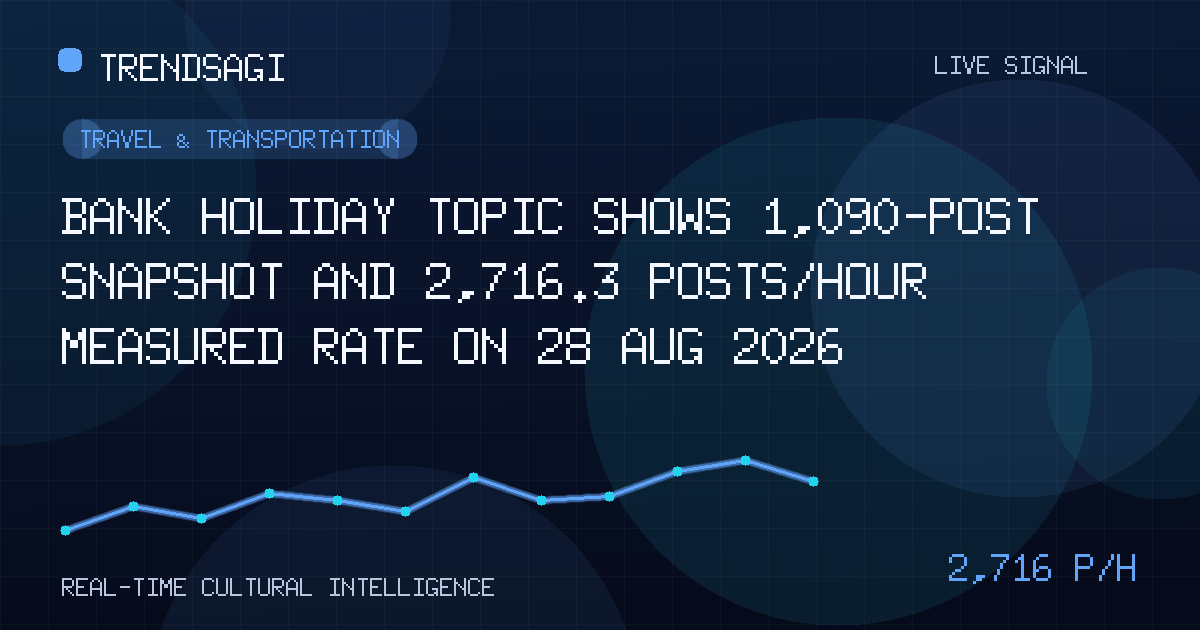
Bank Holiday topic shows 1,090-post snapshot and 2,716.3 posts/hour measured rate on 28 Aug 2026
On 28 Aug 2026, Bank Holiday business-finance posts reached 1,090 volume with a measured 2,716.3 posts/hour rate; briefing explains limits and next checks.
Automated briefing. Generated from stored signal measurements and source-backed research; it is not manually reviewed. Read the methodology and limitations.
Metrics in this briefing are a snapshot associated with its publication date and may not reflect current conditions.
What changed
Business and finance conversations tagged with the label 'Bank Holiday' reached a snapshot volume of 1,090 posts at the observation timestamp of 2026-08-28T15:01:19Z. This means that at that single point in time, the stored signal contained just over one thousand accumulated posts referencing the topic within the business and finance category.
Across an exact 1,276-second window measured at that same timestamp, three stored observations yielded a measured snapshot rate of 2,716.3 posts/hour. That figure is a calculated backward-looking rate from stored samples, not a live stream count, not a forecast, and not a measure of unique individuals or audience reach.
| Observation time | Measured posts/hour | Snapshot volume |
|---|---|---|
| 2026-08-28T15:01:19Z | 2,716.3 | 1,090 |
Why this topic may be moving
The label 'Bank Holiday' is most frequently used in the United Kingdom, Ireland, and a handful of former territories to describe a mandated public holiday when banks and many businesses close. In the 2026 calendar, the UK Summer Bank Holiday falls on Monday, August 31. That date is three days after the snapshot, a period when companies typically finalize weekend coverage plans and consumers arrange travel.
We used public search to verify a specific trigger for the post volume. No publisher report we could confirm explicitly connected the surge in 'Bank Holiday' mentions to a particular policy change, outage, or corporate announcement. Therefore, the exact cause remains unclear from verified public context.
What we can say is that the stored category is 'Business and finance,' which filters the likely subject matter toward payment systems, market closures, and operational notices rather than generic leisure discussion. Seasonal patterns in previous years suggest that treasury teams, payroll providers, and retailers often increase communications in the last business days before a holiday. Those routine messages may be contributing to the measured accumulation.
Without attributed reporting, we should not assume the movement signals disruption. It could reflect ordinary reminders about cleared-funds deadlines, scheduled maintenance of banking portals, or marketing around long-weekend sales. Each of those would still produce a high post rate without indicating stress in the financial system.
The measured 2,716.3 posts/hour reflects how quickly stored samples accumulated over the supplied observation window; it does not tell us how many unique users posted, what sentiment prevailed, or whether the conversation will persist past the holiday weekend.
Why it matters
For professionals in business and finance, a rapid increase in topic-specific chatter is an early signal to check internal assumptions. The snapshot volume of 1,090 posts and the measured rate above 2,700 posts/hour suggest that many actors are simultaneously publishing about the term. That alone warrants attention, even if the underlying reason is benign.
- Corporate treasurers who rely on timely settlement; bank holidays alter BACS, CHAPS, and SWIFT cut-off times.
- Small-business owners who must post opening hours and manage cash flow around closed branches.
- Customer-support leads preparing for spikes in queries about pending payments or order fulfillment.
- Market analysts tracking liquidity conditions before a potentially thin trading day.
- Compliance officers monitoring whether misinformation about closures is spreading.
The signal cannot establish whether the posts are positive, negative, or neutral. A high rate could reflect confusion about which services are available, or simply a coordinated calendar reminder from a trade association. Readers should avoid treating the rate as evidence of a problem.
Another key point is that snapshot volume counts posts present in the stored signal at one time. It is not a cumulative total of all posts ever sent, nor a deduplicated view of human authors. The measured posts/hour figure is derived from only three observations, which is a thin base for projecting trends.
What to watch next
Concrete watch signals over the coming days should be specific and verifiable:
- Snapshot volume exceeding 2,000 posts while the measured rate stays above 1,000 posts/hour, indicating sustained interest rather than a brief spike.
- Appearance of verified publisher reports from financial newsrooms naming a specific bank-processing delay or regulatory notice.
- Co-occurrence of related terms such as 'payment delay,' 'branch closed,' 'settlement window,' or 'market holiday' in the same signal set.
- A drop in rate after August 31 that does not return to baseline, suggesting the conversation shifted to complaints or recovery issues.
- Geographic markers in post text that confirm whether the chatter is UK-centric or spreading to other jurisdictions.
Practical next checks for a research team include pulling the top 20 posts from the snapshot to inspect language, validating the signal's collection method, and cross-referencing official holiday calendars. Teams should also set an alert for any new stored observation that breaks the 3,000 posts/hour measured rate, which would represent an acceleration beyond the current window.
Methodology and limitations
The canonical stored signal supplied one snapshot volume (1,090 posts) at 2026-08-28T15:01:19Z and a measured change rate of 2,716.3 posts/hour computed from three stored observations across an exact 1,276-second window. These numbers are presented exactly as received. Snapshot volume is never described as a rate, and the posts/hour figure is always labeled a measured snapshot rate.
- No sentiment, language, or author metadata accompanied the stored signal.
- The stored signal description was empty, removing contextual cues about source platforms.
- Search verification could not attribute the movement to a specific publisher event, so causal claims are withheld.
- Posts may include duplicates, cross-posts, or automated accounts; the method does not filter them.
- The three-observation base is small; short windows can exaggerate volatility.
Readers should use this briefing as a prompt for targeted verification rather than a conclusion about market or consumer behavior. The value lies in flagging a quantifiable shift in conversation density and pointing to the operational questions that shift raises.
Track This Topic for New Signals
Set alerts for future velocity or sentiment changes around this topic.
Explore Tracking PlansAbout TrendsAGI research
TrendsAGI's automated research pipeline publishes dated signal snapshots, methodology notes, and practical workflows for teams evaluating cultural momentum. Read how signals are scoped, scored, and limited in our research methodology.


