1816-second window · 3 observations · Measured Sep 1, 2026, 1:38 AM UTC · Provider: go_recent_snapshot_v2
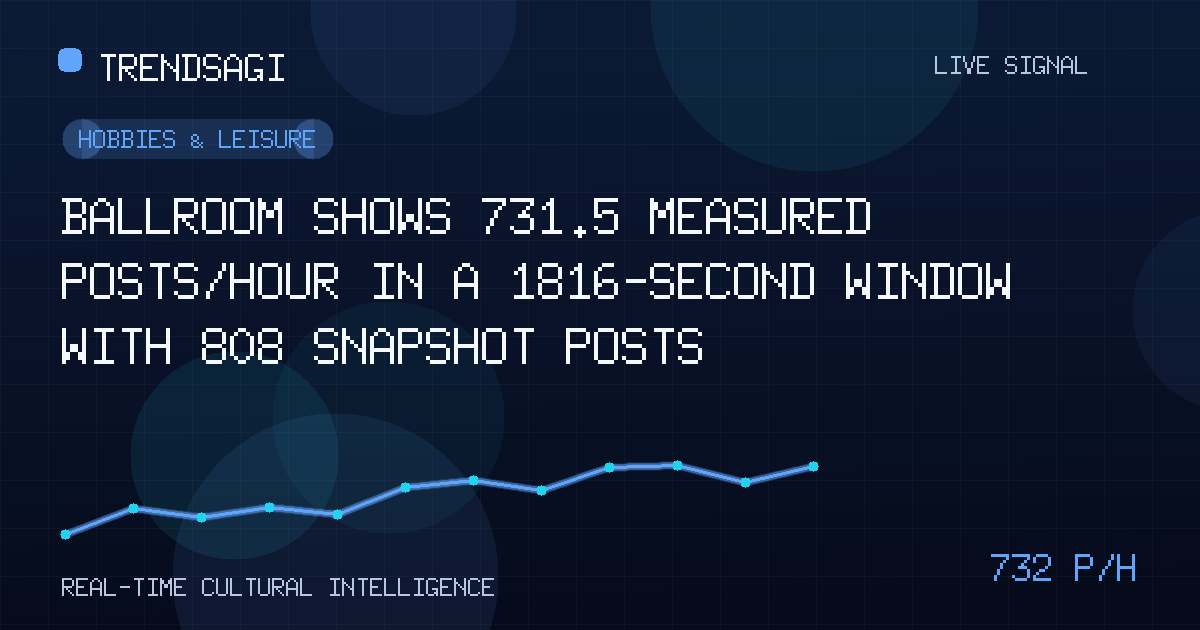
Ballroom shows 731.5 measured posts/hour in a 1816-second window with 808 snapshot posts
Ballroom had a measured 731.5 posts/hour snapshot rate and 808 stored posts; cause is unverified.
Automated briefing. Generated from stored signal measurements and source-backed research; it is not manually reviewed. Read the methodology and limitations.
Metrics in this briefing are a snapshot associated with its publication date and may not reflect current conditions.
What changed
Ballroom recorded a measured snapshot rate of 731.5 posts/hour at 2026-09-01T01:38:23Z, based on three stored observations across an 1816-second window. The latest snapshot volume was 808 posts. This is a short-window measurement, not a live rate, unique-user count, engagement score, or forecast.
| Observation time | 2026-09-01T01:38:23Z |
|---|---|
| Measured posts/hour | 731.5 |
| Snapshot volume | 808 posts |
Why this topic may be moving
The stored signal does not identify a cause, and this briefing does not verify an external explanation. Because the label is only Ballroom, the spike could come from a dance community, a venue announcement, a music or fashion discussion, a competition clip, a meme, a platform feature, or a short-lived news item. The stored category of Hobbies and Leisure makes a recreation-related reading plausible, but that does not prove it.
In ambiguous trending labels, the safest interpretation is that a cluster of posts became visible to the measurement system within the sampled window. That cluster may be organic discussion, a coordinated repost, a viral short, a scheduled event, or a moderation or recommendation effect. Without verified source pages or a content sample, the cause should be treated as unknown.
What the signal can and cannot establish
- It can establish that 808 posts were present in the latest stored snapshot and that three observations produced a calculated rate of 731.5 posts/hour over 1816 seconds.
- It can establish the observation timestamp and that the measurement is historical, not current.
- It cannot establish how many unique people posted, how many views occurred, how long the trend will last, or whether the posts are positive, negative, or spammy.
- It cannot establish the topic meaning, platform, region, language, or whether Ballroom refers to dance, architecture, event space, or another subject.
Why it matters
For hobby communities, short post-rate surges can reveal when an audience is suddenly paying attention. For event operators, dance studios, music labels, and platform editors, a spike around Ballroom may be useful if it aligns with a class, competition, release, ticket drop, or local event. The main value is timing: it flags a moment to inspect what people are actually posting before deciding whether the activity is a genuine community trend, a one-off clip, or noise.
A post-rate signal tells you when conversation accelerated. It does not tell you what the conversation means, who is driving it, or whether it will survive the next measurement window.
How to read the number
The 731.5 posts/hour figure should be read as a short historical average, not as the speed of a live feed. It means that, within the sampled 1816-second interval, the stored observations were consistent with an average of 731.5 posts per hour. If the next window shows 900, 400, or 50 posts/hour, the earlier number becomes context rather than a prediction. Because the window is only about 30 minutes, a single viral post, a scheduled class, or a small coordinated share can move the average materially.
The 808-post snapshot volume is a separate fact. It tells the system how many posts were captured in the latest stored sample. It does not mean 808 new posts occurred during the rate window, nor does it mean 808 people saw or discussed the topic. The two numbers are related by the measurement process, but they should not be merged into a single claim.
Who should care
- Dance educators and studios can use the spike as a cue to check whether a technique, routine, or class format is getting unexpected attention.
- Event organizers and venue managers should verify whether Ballroom refers to a specific location, gala, exhibition, or competition.
- Community managers and editors can use the timing to prioritize review of related posts, comments, and emerging sub-topics.
- Researchers studying short-lived interest can track whether the label broadens into named entities or collapses after one window.
Practical next checks
- Review a sample of posts to identify the dominant meaning of Ballroom: dance style, venue, event, song, meme, or place.
- Check whether the posts cluster around a specific event time, location, hashtag, creator, or platform recommendation surface.
- Compare the 808-post snapshot with earlier snapshots to see if the rate is rising, flattening, or decaying.
- Look for credible news, venue, organization, or community pages that explain a related announcement.
- Check for duplicate content, bot patterns, or rapid reshares that could inflate the post count without broad interest.
What to watch next
- A second measured rate: if the posts/hour value falls, the first window was likely a burst. If it holds, the topic has sustained attention.
- Growth in unique account count, replies, saves, shares, or video views, if available, because these better indicate depth than post count alone.
- New named entities such as a city, competition, artist, dance style, venue, or organization that reduce ambiguity.
- Presence of official commentary from a dance federation, event organizer, studio, or platform if the topic is event-driven.
- Changes in tone, especially if the posts become critical, safety-related, or location-sensitive.
Methodology and limitations
The reported 731.5 posts/hour is a measured snapshot rate derived from three stored observations across an exact 1816-second window. The 808-post figure is the latest snapshot volume. Neither number is a live current rate, a forecast, a reach figure, or a unique-person count. The topic label is ambiguous, the stored description is empty, and no external cause has been verified. The briefing therefore limits itself to what the stored signal measures and flags the unknown cause plainly.
Track This Topic for New Signals
Set alerts for future velocity or sentiment changes around this topic.
Explore Tracking PlansAbout TrendsAGI research
TrendsAGI's automated research pipeline publishes dated signal snapshots, methodology notes, and practical workflows for teams evaluating cultural momentum. Read how signals are scoped, scored, and limited in our research methodology.


