899-second window · 3 observations · Measured Sep 30, 2026, 9:37 AM UTC · Provider: go_recent_snapshot_v2
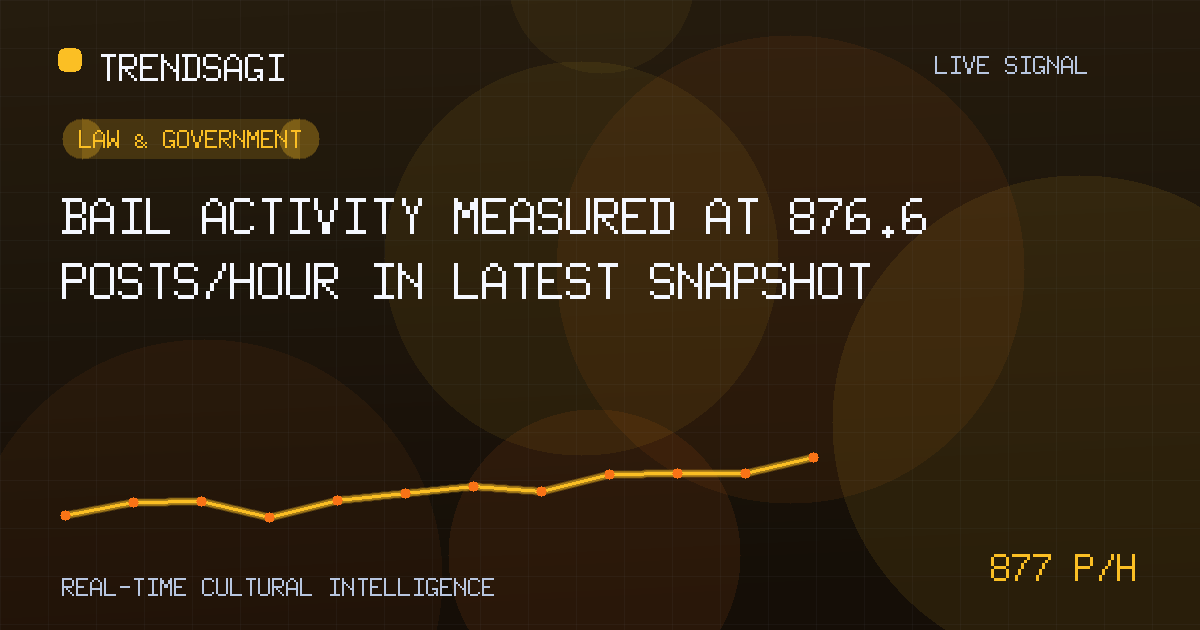
Bail activity measured at 876.6 posts/hour in latest snapshot
Bail activity measured at 876.6 posts/hour in a short snapshot, with the key limits and next checks decision-makers need.
Automated briefing. Generated from stored signal measurements and source-backed research; it is not manually reviewed. Read the methodology and limitations.
Metrics in this briefing are a snapshot associated with its publication date and may not reflect current conditions.
What changed
The stored signal shows a concentrated burst of posts classified under “Bail”: 876.6 posts/hour, measured over an exact 899-second window at 2026-09-30T09:37:00Z. This is a measured snapshot rate, not a live or current rate, forecast, reach figure, engagement count, or estimate of unique people.
The latest snapshot contains 660 posts, and the rate comes from three stored observations. Those facts establish rapid activity during the measurement window, but not whether it exceeds the topic’s normal baseline, how long it persists, or what caused it.
| Observation time | 2026-09-30T09:37:00Z |
|---|---|
| Measured snapshot rate | 876.6 posts/hour |
| Latest snapshot volume | 660 posts |
Why this topic may be moving
The cause is unclear. No verified public context is established for this snapshot, so attributing the increase to a court ruling, legislative action, campaign, protest, celebrity story, or viral post would be speculation. Those are items editors could test, not established explanations.
The stored Law & Government category makes a legal or policy reading plausible, but it does not prove one. “Bail” can describe a legal mechanism, while the same term may also appear in names, titles, lyrics, or unrelated conversation. A classifier centered on one meaning can therefore create a spike without a corresponding real-world legal event. Reviewing the underlying posts is necessary before saying that courts, policy, or public safety became the subject of the spike.
The number tells us how quickly classified posts were arriving during one short window; it does not tell us what happened, who posted, whether sentiment changed, or whether the activity mattered beyond the platform.
What the signal can—and cannot—establish
It supports three narrow conclusions:
- Observed pace: Posts assigned to the topic were arriving at the stated measured snapshot rate during the stated window.
- Snapshot size: The latest collection contained 660 posts. That is a collection-volume measure, not the hourly rate and not the total volume for the day, week, or event.
- Review priority: The combination is large enough to justify checking classification quality and possible triggers before the topic is dismissed.
It does not establish:
- whether the rate is statistically unusual without earlier comparison windows;
- whether the increase came from many authors or repeated, coordinated, or automated posting;
- the posts’ geography, platform distribution, sentiment, factual accuracy, or engagement;
- whether the activity reflects a genuine policy development, ordinary high-volume coverage, or keyword ambiguity; or
- whether the burst continued after the snapshot.
Why it matters
The main risk is a causal story outrunning the evidence. A legal team may act on a conversation spike as if it represented an immediate operational change. A newsroom may use a generic label in a headline. A platform analyst may mistake repeated material for broad public attention. None of those interpretations is warranted from volume alone.
Newsrooms and public-sector communications teams should care because they need to distinguish a verified event from a classification artifact before publishing updates or preparing responses. Legal, policy, and justice organizations should care because public discussion can reveal confusion or demand for plain-language information, but only after the sample confirms that legal bail is actually being discussed. Researchers and trust-and-safety teams should care because short, concentrated spikes can be useful for triage while also being especially vulnerable to duplicates, coordinated behavior, and changes in collection coverage.
For readers, the practical value is a disciplined next step rather than a conclusion: inspect the posts, verify the timing, and determine whether the activity reflects a real event or a noisy label.
What to watch next
- Validate the topic fit. Review a representative cross-section of the 660 posts and label each as legal bail, another bail-related use, or unrelated. A rising share of ambiguous matches would point toward a classification issue; a consistent legal sample would justify deeper event research.
- Find the earliest verified trigger. Compare post timestamps with court records, public notices, legislation, official statements, and reporting from identifiable publishers. The first verified event should precede or align with the spike; a later article is more likely a response than an explanation.
- Test persistence. Compare adjacent equal-length windows and later snapshots using the same collection and classification method. A brief peak that quickly recedes has a different meaning from sustained activity, and the current record cannot distinguish them.
- Check concentration. Separate original posts from duplicates and reposts, then examine whether activity is dominated by a few accounts, jurisdictions, platforms, or a single narrative. Broad distribution and one-source concentration answer different questions.
- Read the substantive mix. Classify the legal sample by issue—such as release conditions, cost, policy, court practice, or rights—and compare sentiment and questions across those groups. This reveals whether “Bail” is functioning as a shared civic topic or a catch-all with several unrelated conversations.
- Watch for concrete confirmation. Useful signals include a verified event timestamp near the onset, repeated elevated measured snapshot rates, movement across independent sources and platforms, or a clearly dominant legal subtopic. None of those confirmations is established in the present snapshot.
Decision rule: Treat the signal as a monitoring priority until a sampled review confirms topic relevance and either a verified event or subsequent persistence explains the activity. Do not headline the cause before both checks are resolved.
Methodology and limitations
The reported rate is a measured snapshot rate based on three stored observations across an exact 899-second window, observed at 2026-09-30T09:37:00Z. The separate 660-post figure describes the latest snapshot volume. The rate should not be recomputed from the volume, extrapolated forward, or described as a live or current count.
No historical baseline, collection frame, platform mix, deduplication method, classifier accuracy, account count, sentiment analysis, or verified event link is provided. These omissions limit every interpretation: the window may be too short to establish a durable trend, and a high rate may coexist with a routine baseline if the topic normally receives substantial coverage. Conversely, a real event may be hidden by broad keyword matching.
The defensible conclusion is therefore narrow but useful: the snapshot documents rapid posting activity labeled “Bail” and warrants review; the trigger, persistence, audience, and real-world significance remain unconfirmed.
Track This Topic for New Signals
Set alerts for future velocity or sentiment changes around this topic.
Explore Tracking PlansAbout TrendsAGI research
TrendsAGI's automated research pipeline publishes dated signal snapshots, methodology notes, and practical workflows for teams evaluating cultural momentum. Read how signals are scoped, scored, and limited in our research methodology.