2695-second window · 3 observations · Measured Oct 7, 2026, 12:56 AM UTC · Provider: go_recent_snapshot_v2
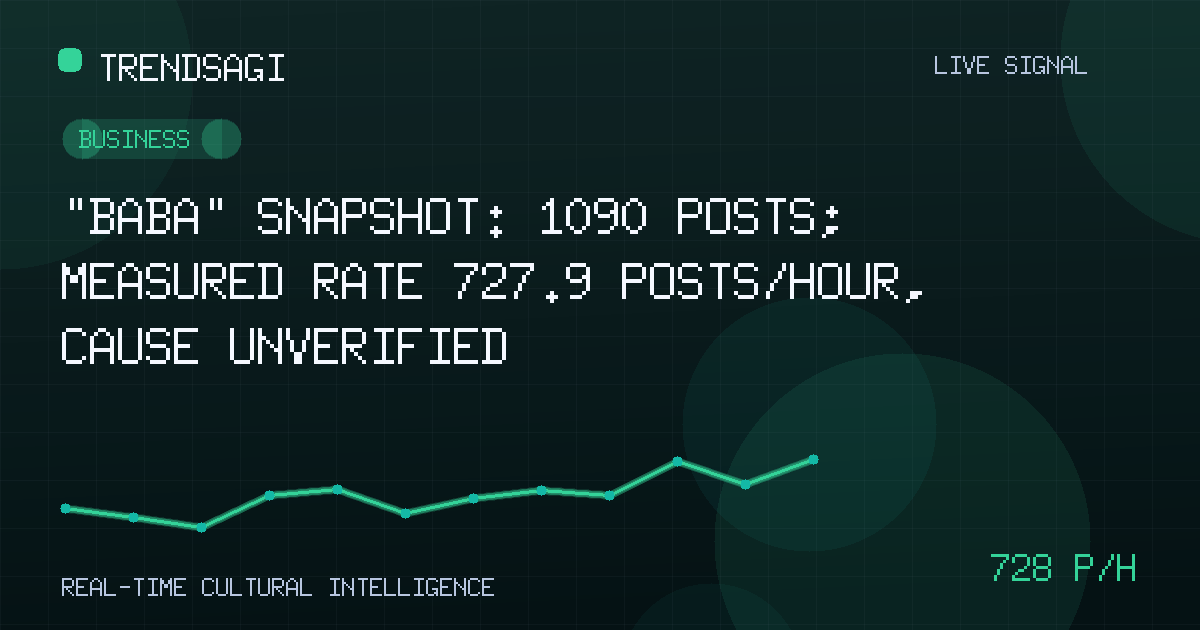
“Baba” snapshot: 1090 posts; measured rate 727.9 posts/hour, cause unverified
The latest Baba snapshot holds 1090 posts and a measured 727.9 posts/hour, but the label's meaning and cause remain unverified.
Automated briefing. Generated from stored signal measurements and source-backed research; it is not manually reviewed. Read the methodology and limitations.
Metrics in this briefing are a snapshot associated with its publication date and may not reflect current conditions.
What changed
The latest stored signal shows a measurable burst of posts assigned to “Baba,” but the record does not identify what “Baba” denotes or verify why the topic is moving. The defensible conclusion is narrow: the ambiguous label produced a measured snapshot rate that warrants investigation, not a confirmed company, product, person, event, market, or public narrative.
The snapshot observed at 2026-10-07T00:56:04Z contains 1090 posts. From 3 stored observations, the supplied series yields a measured change rate of 727.9 posts/hour over an exact 2695-second window. This is a measured snapshot rate—not a live rate, forecast, reach, engagement total, or unique-person count. Because no comparison rate is supplied, the record cannot establish whether activity is accelerating, sustaining, or fading relative to an earlier baseline.
| Observation time | Measured snapshot rate | Snapshot volume |
|---|---|---|
| 2026-10-07T00:56:04Z | 727.9 posts/hour | 1090 posts |
In this record, “Baba” is a tracking label with measurable volume, not an identified subject. Any stronger interpretation would outrun the available evidence.
Why this topic may be moving
The label itself may be the first analytical problem. A short string can be used as a name, nickname, keyword, product shorthand, or search term, and the same surface form can point to unrelated subjects. No sample post text, matched account names, linked destinations, or entity records are supplied, so those possibilities cannot be separated.
- Referent collision: Unrelated conversations may share the label. If so, their posts would be aggregated even though they do not describe one event.
- Repetition and circulation: Quoted, copied, or repeatedly syndicated posts can raise raw volume without adding equivalent original discussion. The snapshot does not show whether that occurred.
- A real but unverified catalyst: A news event, announcement, campaign, or live conversation could drive a burst. No verified public source in the record ties “Baba” to any one of them.
- Routing or classification effects: The stored Business category may come from source metadata, a query, or an automated label. It does not by itself prove that the posts concern commerce.
These are testable explanations, not findings. The immediate missing evidence is semantic: first establish what the label captures, then test whether an external catalyst exists. Assigning the movement to a launch, earnings event, celebrity item, or coordinated campaign before that point would be unsupported.
What the signal can—and cannot—establish
The signal establishes only the observation time, the latest snapshot volume, the measured posts/hour figure, and the Business category assigned by the system. Those facts are enough to prioritize verification because they show where and when concentrated labeled activity appeared.
It cannot establish the topic’s identity; a verified cause; sentiment; whether posts are original, reposted, or automated; the number of distinct authors; geography or language; audience size; commercial impact; or a durable trajectory. The 1090-post snapshot is a volume observation at one time, while 727.9 posts/hour is a supplied rate from a separate 2695-second measurement window. They should not be substituted for one another.
Why it matters
For editors and analysts, “Baba” is a triage signal, not yet an interpretable trend. A dashboard can correctly report the label’s supplied volume and rate at this timestamp while still lacking the context needed to explain who generated the posts or what happened. That distinction protects downstream briefs from attaching a plausible but false story to a high-volume token.
For communications and business teams, the potential cost of acting early is misidentification. If “Baba” maps to a monitored organization, the activity could justify attention; if it does not, a response could create a false association. Entity verification should therefore precede alerting, reputation assessment, customer-service action, or market interpretation.
For data teams, the case also exposes a semantic-quality problem: short labels can combine unrelated conversations. Resolving referents and measuring original participation would make the next update more useful than simply repeating the headline rate.
What to watch next
The next useful update would answer verification questions in sequence:
- Resolve the referent. Inspect representative posts for the exact label, surrounding words, account names, and linked entities. Record whether the same term consistently points to one subject and note spelling or alias variants separately.
- Find a timestamped catalyst. Use Google Search to locate a primary document or attributable publisher report that connects the verified subject to an event. Publish the cause only when the source supports the specific claim.
- Separate repetition from participation. Check original posts against quotes, reposts, duplicates, and repeated phrasing. Look for concentration among a small set of accounts without turning that check into an unsupported claim of coordination.
- Test persistence with like-for-like metrics. Compare later stored observations using the same label definition. Keep snapshot volume distinct from the measured rate, and do not describe either as live activity.
- Validate category and collisions. Review whether the matched posts are genuinely business-related and whether multiple meanings are being blended. A category correction or label split would matter more than another volume-only update.
- Watch consequences after confirmation. If an entity is verified, then check for an official response, material customer discussion, or credible commercial data. None of those should be inferred from post volume alone.
Methodology and limitations
The reported rate comes from 3 stored observations across an exact 2695-second window, measured at 2026-10-07T00:56:04Z. This briefing reproduces the supplied 727.9 posts/hour figure and 1090-post snapshot separately; neither is recalculated, extrapolated, or presented as a current total.
The record does not include the underlying posts, observation values, collection and deduplication rules, matching logic, historical baseline, or verified publisher context. As a result, the signal supports a precise statement about tracked volume at a specific time, but not a causal explanation. Until the label is resolved and the catalyst is sourced, “Baba” should be described as an unresolved monitoring signal rather than a confirmed business trend.
Track This Topic for New Signals
Set alerts for future velocity or sentiment changes around this topic.
Explore Tracking PlansAbout TrendsAGI research
TrendsAGI's automated research pipeline publishes dated signal snapshots, methodology notes, and practical workflows for teams evaluating cultural momentum. Read how signals are scoped, scored, and limited in our research methodology.