894-second window · 3 observations · Measured Oct 7, 2026, 1:41 PM UTC · Provider: go_recent_snapshot_v2
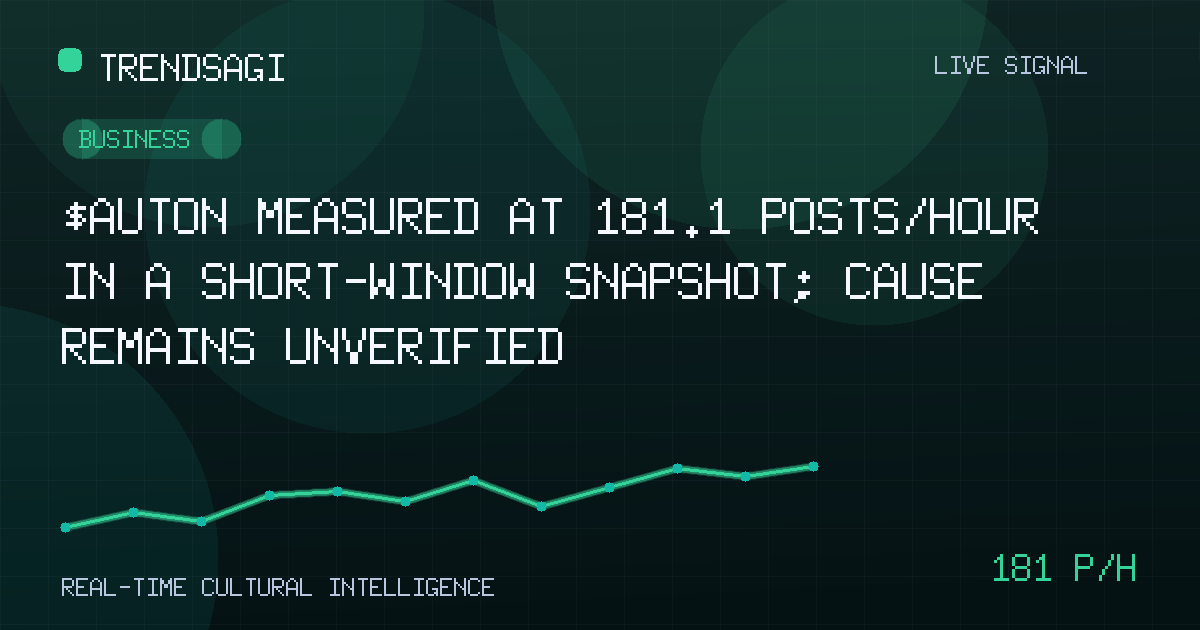
$AUTON measured at 181.1 posts/hour in a short-window snapshot; cause remains unverified
$AUTON recorded 94 posts in the latest snapshot and a measured 181.1 posts/hour rate; here are the limits and next checks.
Automated briefing. Generated from stored signal measurements and source-backed research; it is not manually reviewed. Read the methodology and limitations.
Metrics in this briefing are a snapshot associated with its publication date and may not reflect current conditions.
What changed
Answer: Posts carrying the $AUTON label registered a concentrated short-window burst, but the available record does not establish a verified news catalyst. The latest stored snapshot contains 94 posts, while the supplied measured snapshot rate is 181.1 posts/hour. That is enough to flag activity around the label, but not enough to explain it: no issuer, project, announcement, article, or other attributable trigger is identified. The cause remains unclear.
Measured change: The rate was measured at 2026-10-07T13:41:45Z over an exact 894-second window using 3 stored observations. It describes posting pace during that measured window only. It is not a live or current rate, forecast, reach, engagement figure, unique-person count, or evidence of market impact. The 94-post figure is snapshot volume, a different metric; the two figures should not be combined or reconciled without definitions of how the observations were collected.
| Observation time | Measured snapshot rate | Snapshot volume |
|---|---|---|
| 2026-10-07T13:41:45Z | 181.1 posts/hour | 94 posts |
Why this topic may be moving
The evidence supports a movement alert, not a causal story. Several mechanisms could produce this pattern, and each needs separate verification before it can be reported as the reason behind the topic's activity.
- Unverified catalyst: The stored record contains no signal description and names no dated announcement, filing, product event, incident, or reputable report. Its Business category is not itself an explanation. No attributable public trigger is included here because none can be tied confidently to the observed movement.
- Identity ambiguity: The $AUTON label does not identify an issuer, project, asset, company, or account in the supplied record. Discussion may therefore need to be separated by entity before its patterns are combined. A dollar-prefixed label should not automatically be treated as referring to a tradable instrument.
- Repetition and reaction effects: Replies, quotations, reposts, duplicate wording, or coordinated posting can increase post counts without representing the same breadth of interest. The totals do not show whether these behaviors occurred, so automation or manipulation should be treated as questions for review, not findings.
- Brief-window sensitivity: The rate comes from a short, exact window and the supplied aggregate observations. A burst can decay quickly, and the record does not provide a longer comparison that would establish persistence, novelty relative to normal activity, or a recurring pattern.
A high posting rate can mark the beginning of a broader trend, a brief reaction, or duplicated chatter. Without source-level inspection and a verified catalyst, the defensible conclusion is unusual activity—not its cause.
Why it matters
The signal is most useful as a prompt for faster verification. Acting before the entity and catalyst are resolved could turn an ambiguous social burst into a mistaken trading, reputation, or business conclusion.
- Traders and investors: Rapid discussion can attract attention, but the exact $AUTON entity, relevant venue, and any price or volume response must be confirmed before the signal is used in a market decision.
- Project, company, and community teams: A concentrated conversation may reveal stakeholder concern, a developing story, or coordinated messaging. It does not by itself show sentiment, audience size, or operational significance.
- Editors and reputation teams: The missing catalyst creates attribution risk. Reports should distinguish confirmed facts from assumptions and avoid assigning the movement to an unrelated organization that shares the label.
- Researchers and monitoring systems: This is a useful example of why posting rate, post volume, unique authors, engagement, and source quality should remain separate measurements rather than substitutes for one another.
What to watch next
Use the alert to answer concrete verification questions rather than to amplify an unexplained number.
- Resolve what $AUTON denotes. Check the exact company, project, security, account, or other entity named by the posts. Confirm whether similarly labeled subjects are being discussed together and whether the dollar sign has a defined meaning in each context.
- Inspect the underlying posts. Review original text, cited links, account history, duplicate phrasing, and the mix of original posts, replies, quotations, and reposts. Look for distinct human participation rather than relying on raw repetition.
- Find primary evidence for a catalyst. Search for a dated announcement, regulatory filing, product release, incident, partnership, or other first-party statement. Attribute a secondary news report to its publisher and require it to connect clearly to the same $AUTON entity.
- Test whether activity persists. Compare subsequent equal-length collection windows with the measured window and with an appropriate historical baseline. A durable trend requires repeated activity under the same collection method; a single snapshot does not establish that.
- Seek independent confirmation. Watch for distinct credible accounts, substantive original discussion, and relevant external data. If $AUTON refers to a financial instrument, check price and volume separately rather than inferring market movement from social activity.
- Watch for clarification or denial. A correction, official statement of non-affiliation, evidence of ticker confusion, or evidence that the burst was coordinated would materially change the interpretation.
Methodology and limitations
The measurement is reported exactly as supplied: the observation time is 2026-10-07T13:41:45Z, the measured snapshot rate is 181.1 posts/hour, the rate covers an exact 894-second window using 3 stored observations, and the latest snapshot volume is 94 posts. The rate has not been recalculated, extrapolated, or described as current activity.
Snapshot volume and posting rate answer different questions. Volume describes the count in the latest snapshot; the measured rate describes the observed change statistic from the stored observations. Neither establishes how many people were involved. No post-level text, author identities, engagement data, sentiment distribution, source links, audience geography, or complete historical baseline is included in the available record.
Most importantly, no external fact is attributed as the cause because the evidence does not yet establish one. The appropriate conclusion is a verified measurement of short-window $AUTON posting activity with an unverified explanation. It should trigger identity, source, and persistence checks—not a causal claim or immediate action.
Track This Topic for New Signals
Set alerts for future velocity or sentiment changes around this topic.
Explore Tracking PlansAbout TrendsAGI research
TrendsAGI's automated research pipeline publishes dated signal snapshots, methodology notes, and practical workflows for teams evaluating cultural momentum. Read how signals are scoped, scored, and limited in our research methodology.


