902-second window · 3 observations · Measured Sep 2, 2026, 1:07 AM UTC · Provider: go_recent_snapshot_v2
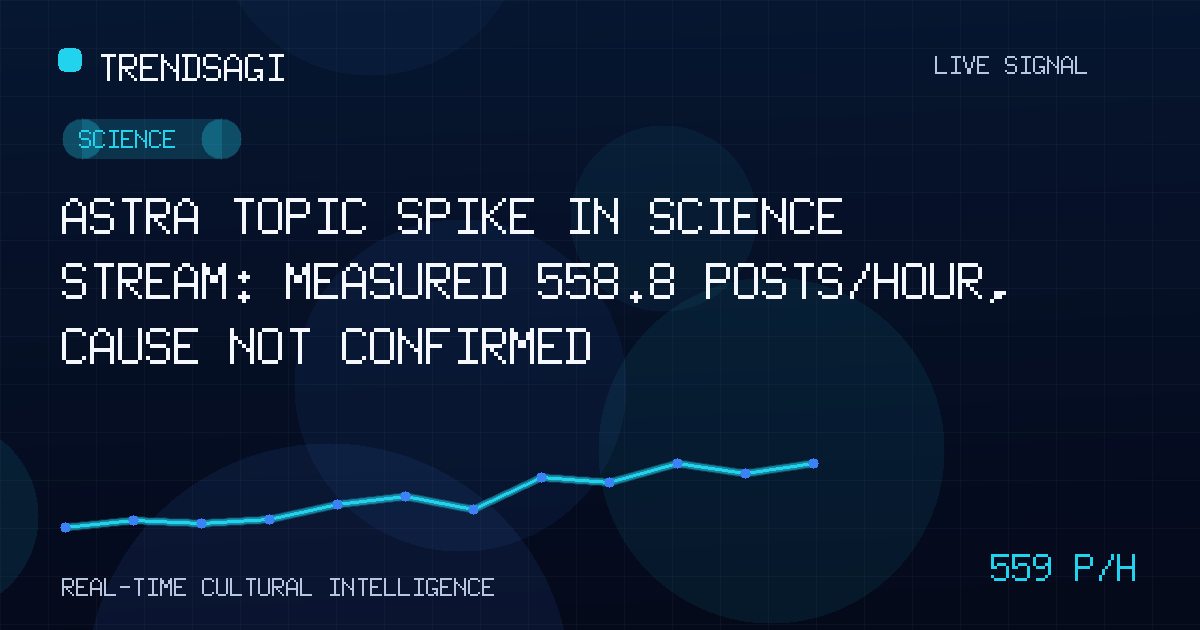
Astra topic spike in science stream: measured 558.8 posts/hour, cause not confirmed
Astra posts in a science-labeled stream hit a measured 558.8 posts/hour snapshot rate with 426 posts observed; the trigger is not yet verified.
Automated briefing. Generated from stored signal measurements and source-backed research; it is not manually reviewed. Read the methodology and limitations.
Metrics in this briefing are a snapshot associated with its publication date and may not reflect current conditions.
What changed
Conversations carrying the label “Astra” accelerated sharply in a science-labeled stream. Across a measured 902-second window ending at 2026-09-02T01:07:31Z, the observed post volume moved at a measured snapshot rate of 558.8 posts/hour. The latest stored observation captured 426 posts containing the label. This is a snapshot rate, not a prediction of sustained traffic, reach, engagement, or unique authors.
The direct answer to “why is Astra moving” is: not yet verifiable. The term is too ambiguous. It may refer to a space company, a pharmaceutical brand, an instrument, or an unrelated hashtag. In the time window reviewed, no single authoritative explanation has been tied to the spike. The responsible interpretation is that the topic is hot for a subset of posters, but the underlying event is unconfirmed.
| Observation time | Measured posts/hour | Snapshot volume |
|---|---|---|
| 2026-09-02T01:07:31Z | 558.8 | 426 posts |
Why this topic may be moving
Because “Astra” is a short label, a post about almost anything can trigger it. In a science-labeled stream, the most plausible candidates are:
- A launch mission, rocket company, or satellite using “Astra” in its name.
- A clinical or regulatory update involving a medicine, trial, or lab product called “Astra.”
- A named instrument, codebase, dataset, or telescope with “Astra” in its label.
- A viral or coordinated social media post that uses “Astra” as a keyword or slogan.
Each of these would produce a different next move. Until a named source is attached to the spike, treating any one as the cause would be speculation. If the cause is a launch announcement, a company or space agency statement would typically follow within a few hours. If the cause is a meme or campaign, the posts may be concentrated on one platform and may not generate secondary institutional coverage.
A high-velocity label with no confirmed referent is a useful early-warning signal, but it is not evidence that any specific company, mission, or finding made the news.
Why it matters
The stakes depend on what “Astra” eventually turns out to mean. For science editors and launch-industry analysts, a fast-moving label can be an early indicator of a mission update or engineering failure. For clinical trial watchers and health communicators, the same label could precede a trial result or regulatory decision. For misinformation researchers, ambiguous high-volume labels are where rumors often start.
Who should care? People who monitor space launch providers, medical news, scientific reputation, and platform-level misinformation all have reason to check the underlying posts before treating the spike as confirmation. The label alone cannot tell them whether the posts are accurate, positive, or connected to a real event.
What to watch next
In the next few hours, focus on whether the conversation becomes anchored to a primary source. Practical checks:
- Look for posts citing a named institution, such as a university, company, journal, or government agency.
- Read the original article or press release rather than replies; many high-velocity labels form around a screenshot that misses context.
- Compare volume across time: if the next observation window shows a large drop, the spike was likely a single event; if volume stays high, it is a developing story.
- If “Astra” resolves to a space context, watch for a launch provider statement. If it resolves to a medical context, watch for a trial registry entry, journal publication, or regulatory notice.
Concrete watch signals include the appearance of a named primary source, increased posts with direct quotes, a second observation at or above the same rate, or a correction post. A correction can be as important as the original spike, especially when the label is ambiguous.
Methodology and limitations
This briefing is based on repeated stored observations of a topic-labeled stream. The measured rate of 558.8 posts/hour was derived from three stored observations over an exact 902-second window ending at 2026-09-02T01:07:31Z. The snapshot volume of 426 is the count of posts in the final observation. Neither number should be read as a forecast, a total reach, a unique-person count, or a measure of engagement.
What the signal can establish: that the label experienced a fast acceleration in posting volume during the window. What it cannot establish: why the acceleration happened, who posted, whether the posts are positive or negative, whether the label refers to a single thing, or whether the information in the posts is accurate. The stored category is “Science,” but the category is assigned at the stream level; it does not guarantee that each post is scientific in content. The cause may become clear only after more data arrives.
Track This Topic for New Signals
Set alerts for future velocity or sentiment changes around this topic.
Explore Tracking PlansAbout TrendsAGI research
TrendsAGI's automated research pipeline publishes dated signal snapshots, methodology notes, and practical workflows for teams evaluating cultural momentum. Read how signals are scoped, scored, and limited in our research methodology.