903-second window · 2 observations · Measured Oct 8, 2026, 4:26 AM UTC · Provider: go_recent_snapshot_v2
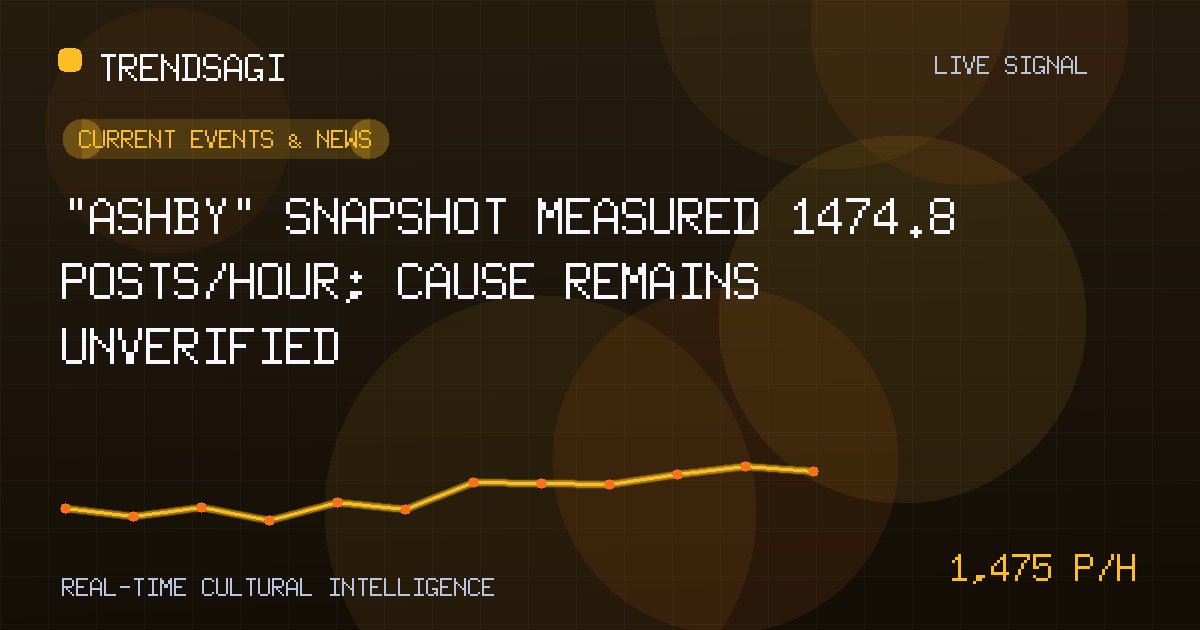
“Ashby” snapshot measured 1474.8 posts/hour; cause remains unverified
The stored “Ashby” snapshot contains 765 posts and a measured snapshot rate of 1474.8 posts/hour over 903 seconds; verify the cause before interpretation.
Automated briefing. Generated from stored signal measurements and source-backed research; it is not manually reviewed. Read the methodology and limitations.
Metrics in this briefing are a snapshot associated with its publication date and may not reflect current conditions.
What changed
The latest stored “Ashby” signal records short-window movement in posting activity, but it does not identify what the label refers to or establish a triggering event. The latest snapshot contained 765 posts, which is a collection count—not a rate, audience estimate, or engagement measure.
The measured snapshot rate was 1474.8 posts/hour over an exact 903-second window, based on 2 stored observations and measured at 2026-10-08T04:26:34Z. This is a historical point-in-time measurement, not a live or current rate, forecast, reach, or count of unique people.
| Observation time | 2026-10-08T04:26:34Z |
|---|---|
| Measured snapshot rate | 1474.8 posts/hour |
| Window and observations | 903 seconds; 2 stored observations |
| Snapshot volume | 765 posts |
Why this topic may be moving
No verified public context is attached to the stored record, and its topic description is blank. “Ashby” is therefore treated as an unresolved label, not as a confirmed person, organization, place, product, or event. The stored Current Events & News classification suggests an editorial context, but it is not evidence of a specific catalyst.
Several mechanisms could produce this pattern, but none is established:
- A newly reported event may have prompted discussion and rapid recirculation.
- Several unrelated conversations may already have used “Ashby,” with monitoring newly combining them.
- Reposting, quoting, or coordinated amplification may have increased apparent activity without independent attention.
- A change in collection behavior, tags, or ingestion may have altered what was counted.
The measured rate shows how quickly the monitored collection changed; it does not identify the subject, establish the cause, or show that the posts came from independent people.
On present evidence, the cause is unclear. The defensible conclusion is limited to rapid movement within the monitored collection during the stated window.
The 903-second interval captures only the stated window and cannot distinguish a sustained shift from a temporary spike. The 765-post snapshot describes volume at the endpoint, not the starting level, so the posts/hour figure should not be compared with daily or weekly activity unless collection rules and windows match.
Why it matters
The immediate issue is whether “Ashby” joins a coherent event or combines unrelated subjects. A change rate without a baseline cannot establish whether activity is unusual, and post volume cannot establish how many people were involved.
- Editors and researchers need entity resolution before treating the cluster as one story or measuring reaction to it.
- Communications, public-information, and reputation teams monitoring the name should avoid responding until the referent and catalyst are confirmed.
- Analysts and readers should not treat repetition, volume, or the current-news label as proof of broad public interest.
A fast-moving signal can shape coverage while its meaning is still uncertain. At this stage, verification has more value than speed because an incorrect attribution can redirect attention to the wrong subject.
What to watch next
The next checks should move from quantity to attribution:
- Identify the referent. Inspect representative posts for full names, aliases, context, and the claim being discussed. Resolve whether they point to the same subject.
- Establish chronology. Find the earliest verifiable public report or announcement, then compare its timestamp with the movement. A repost time is not automatically the origin.
- Corroborate independently. Look for credible public sources with different reporting chains converging on the same event, rather than many references tracing to one original item.
- Test persistence. Gather later snapshots under the same collection rules. Compare like-for-like windows, calculate each interval separately, and never carry 1474.8 posts/hour forward as a current figure.
- Audit composition. Check duplicate text, repeated source references, author concentration, synchronized timing, language, and geography where metadata permits. These fields can indicate aggregation or coordination.
- Make an editorial call only after identity, catalyst, and source quality align. If samples split among referents, split the signal; if later windows reverse, report the reversal.
The decisive watch signals are a resolved entity, a verified catalyst, independent corroboration, and continued movement in comparable measurements.
Methodology and limitations
The stored evidence supports a point-in-time statement: the snapshot observed at 2026-10-08T04:26:34Z contained 765 posts, and the measured snapshot rate was 1474.8 posts/hour over 903 seconds using 2 observations. It does not support a causal account.
- The collection platform, query or tag, geography, language, and inclusion rules are not supplied, so representativeness cannot be assessed.
- A 903-second interval based on 2 observations can be sensitive to endpoint timing; it does not reveal the normal baseline or longer trajectory.
- Posts may include duplicates, reposts, quotations, or automated activity. The volume is not a unique-author or unique-person count.
- Without content-level coding, the signal cannot establish sentiment, event type, source reliability, or organic attention.
No external fact is attributed here because no verified public source could be tied uniquely to the label. Readers should use 1474.8 posts/hour as a historical measured snapshot rate and 765 posts as volume at the stated time—not as a live trend forecast. The signal can establish that the monitored collection moved during the recorded interval; it cannot establish that the wider public did, that “Ashby” meant the same thing throughout, or that the movement was durable.
Track This Topic for New Signals
Set alerts for future velocity or sentiment changes around this topic.
Explore Tracking PlansAbout TrendsAGI research
TrendsAGI's automated research pipeline publishes dated signal snapshots, methodology notes, and practical workflows for teams evaluating cultural momentum. Read how signals are scoped, scored, and limited in our research methodology.