890-second window · 3 observations · Measured Oct 6, 2026, 12:11 AM UTC · Provider: go_recent_snapshot_v2
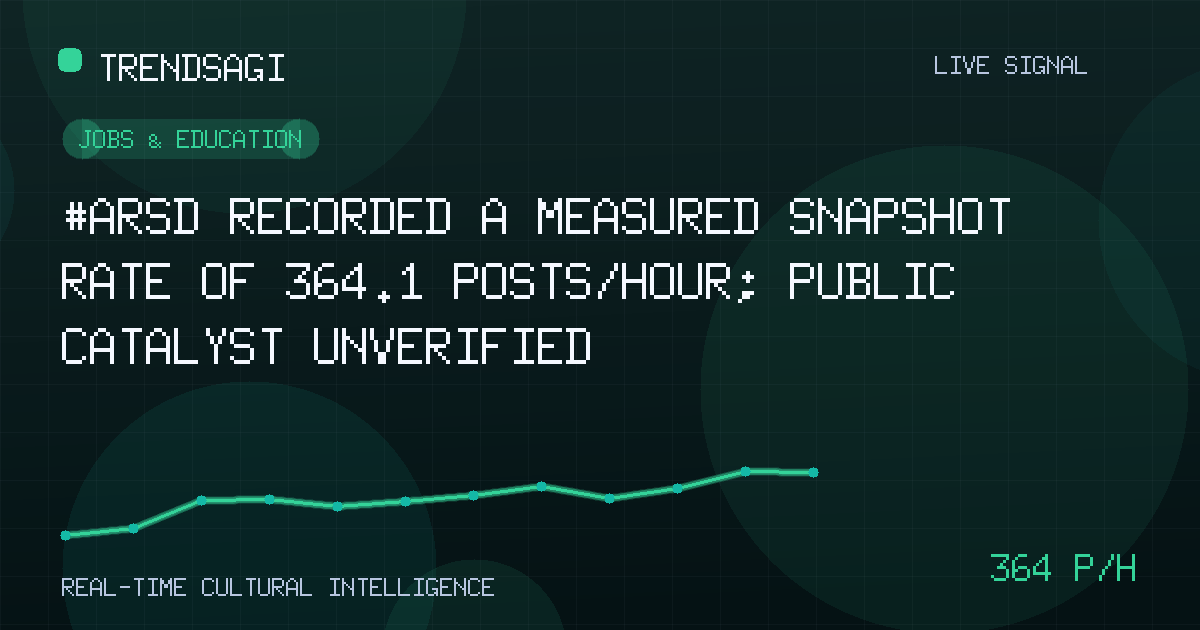
#arsd recorded a measured snapshot rate of 364.1 posts/hour; public catalyst unverified
#arsd registered a measured snapshot rate of 364.1 posts/hour in the stored series; cause and audience impact remain unverified.
Automated briefing. Generated from stored signal measurements and source-backed research; it is not manually reviewed. Read the methodology and limitations.
Metrics in this briefing are a snapshot associated with its publication date and may not reflect current conditions.
What changed
The stored signal shows a concentrated burst of posts using #arsd in the Jobs & Education category. At the 2026-10-06T00:11:29Z snapshot, latest snapshot volume was 183 posts. The measured snapshot rate was 364.1 posts/hour over an exact 890-second window using 3 stored observations. The movement is measurable within the tracked series, but no verified public catalyst has been established.
| Observation time | Measured snapshot rate | Snapshot volume |
|---|---|---|
| 2026-10-06T00:11:29Z | 364.1 posts/hour | 183 posts |
The 364.1 figure applies only to the measured interval; it is not a live or current rate, forecast, reach estimate, engagement measure, or unique-person count. Snapshot volume is a separate count: 183 is the number of posts in the latest snapshot, not a number posted per hour. Together, the fields establish a short-window burst at the stated time. They do not establish duration, audience size, authenticity, sentiment, or spread beyond the dataset.
Why this topic may be moving
No verified public context links the increase to a named announcement, news event, platform change, campaign, class, hiring update, or educational issue. The record does not expand #arsd, and its Jobs & Education category does not prove that the posts concern jobs or education. A specific causal story would therefore be speculation.
Candidate explanations to test include:
- A new conversation may have made existing shorthand more useful, bringing prior participants back into the tag.
- A time-bound public event may have produced a concentrated reaction or information request.
- Quotes, reposts, automated accounts, or a coordinated network may account for a large share of the apparent burst.
- Acronym ambiguity or category error may place unrelated content in a trend feed designed for employment and education audiences.
These possibilities can look identical in a burst of volume. Distinguishing them requires examining the posts, accounts, and nearby public context rather than inferring a cause from the hashtag or category alone.
What the signal can establish
The signal establishes that the exact tag appeared in enough collected posts to produce a measured short-window change. It also establishes the observation time, the latest snapshot volume, and the category assigned by the series. That makes #arsd a legitimate monitoring candidate rather than a confirmed substantive trend.
- Whether the burst came from original text, replies, quotes, reposts, or repeated content.
- Whether a small set of accounts drove it and whether posting behavior appears coordinated.
- Whether the semantic topic matches the stored category and whether the burst persists beyond this interval.
The measured snapshot rate establishes the pace of change within one stored interval; it does not identify the people involved, explain why they posted, or show how far the signal traveled.
Keeping those boundaries clear matters because a fast feed can make a narrow measurement feel like a broad shift. The data supports triage and follow-up; it does not support an event claim, market conclusion, or audience claim on its own.
Why it matters
For job seekers, educators, recruiters, and workforce-development teams, a tag is valuable only if it points to relevant information. The stored category creates a reason to inspect the activity, not a reason to draw labor-market conclusions. A false-positive burst could waste time; a genuine resource or alert could be missed if the signal is dismissed without inspection.
The audience for this briefing is therefore twofold: people who may care about the content, and people who need to verify whether a platform-level burst is genuine, coordinated, or misclassified.
- Job and education readers should seek original posts and confirm dates, locations, eligibility, and publisher identity before acting.
- Recruiters and educators should check whether discussion adds credible information rather than simply repeating the tag.
- Trend and trust teams should examine duplication, account concentration, and category fit before escalating the signal.
Until those checks are done, the responsible interpretation is narrow: #arsd registered a measured short-window burst in this series, while its relevance and cause remain unresolved.
What to watch next
A useful next step is to convert the burst into a testable set of observations.
- Inspect a representative sample of posts and code what #arsd denotes in context. Record whether each item is an original post, reply, quote, repost, link share, or automated repetition.
- Check account-level concentration. A burst spread across independent accounts has a different interpretation from one dominated by repeated posting, shared media, or synchronized activity.
- Measure duplication and uniqueness without replacing the reported post count. Determine how much of the snapshot consists of repeated text, reused links, or near-identical messages.
- Extend the timeline. Compare later windows with earlier ones, using consistent definitions, to see whether the measured snapshot rate falls back, remains elevated, or produces another burst.
- Review co-occurring hashtags, domains, phrases, locations, and languages. These can reveal the subject and audience more reliably than the opaque tag alone.
- Seek a primary public source for any proposed catalyst, then check independent coverage. Publish an attribution only if the source clearly connects the event to use of #arsd.
Concrete watch signals are continued persistence in later windows, broader participation beyond a narrow account cluster, a clearer relationship to Jobs & Education content, and a documented public trigger. A rapid reversal, heavy duplication, or category mismatch would instead weaken the case for a substantive trend.
Methodology and limitations
The reported measured snapshot rate is 364.1 posts/hour across an exact 890-second window from 3 stored observations, with the latest snapshot observed at 2026-10-06T00:11:29Z. It applies only to that measured interval. It should not be described as the current rate, an average for the day, a forecast, reach, engagement, or a count of unique authors.
The latest snapshot volume is 183 posts. Without the underlying post-level records, this briefing cannot assess uniqueness, duplication, geography, sentiment, account quality, or semantic relevance. A short window and limited observations may amplify a momentary burst, while a platform-specific collection method may not represent wider public conversation. No verified external context was available to attribute the movement, so the cause remains unclear. The result is best used as a monitoring lead pending content inspection and independent public verification.
Track This Topic for New Signals
Set alerts for future velocity or sentiment changes around this topic.
Explore Tracking PlansAbout TrendsAGI research
TrendsAGI's automated research pipeline publishes dated signal snapshots, methodology notes, and practical workflows for teams evaluating cultural momentum. Read how signals are scoped, scored, and limited in our research methodology.


