901-second window · 3 observations · Measured Sep 26, 2026, 12:55 AM UTC · Provider: go_recent_snapshot_v2
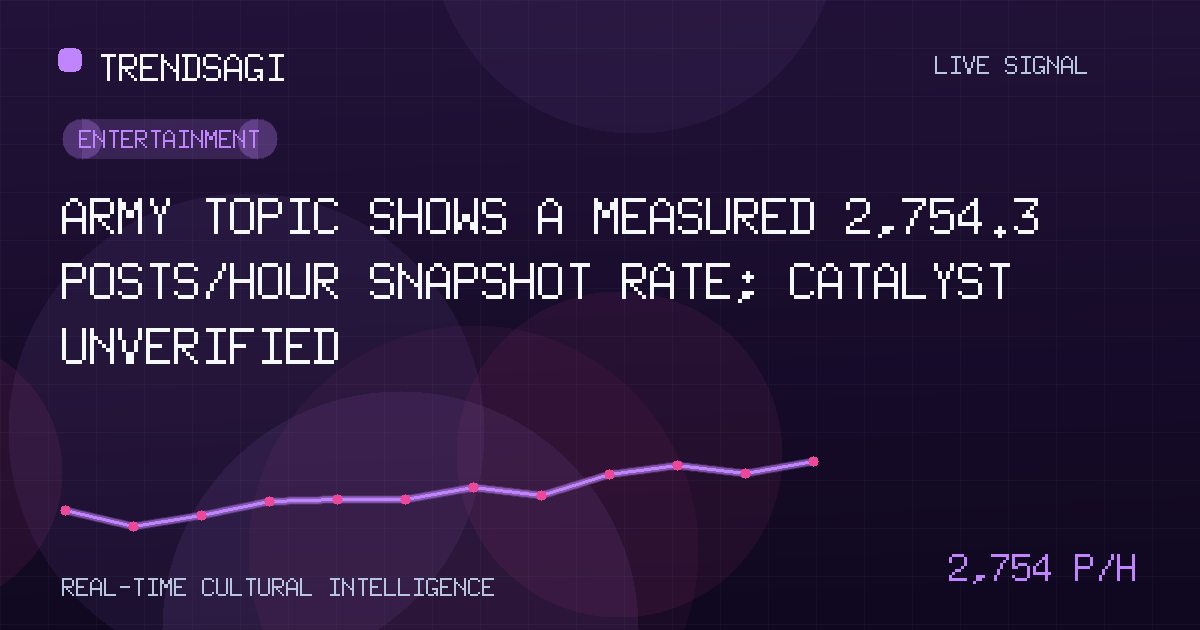
Army topic shows a measured 2,754.3 posts/hour snapshot rate; catalyst unverified
Army showed a measured snapshot rate of 2,754.3 posts/hour over 901 seconds, with 1,636 posts in the latest snapshot; verify the trigger before acting.
Automated briefing. Generated from stored signal measurements and source-backed research; it is not manually reviewed. Read the methodology and limitations.
Metrics in this briefing are a snapshot associated with its publication date and may not reflect current conditions.
What changed
The monitored “Army” topic produced a measured change signal at the latest observation. The dataset records 2,754.3 posts/hour over an exact 901-second window using 3 recorded observations, and the latest snapshot volume was 1,636 posts at 2026-09-26T00:55:49Z. The direct answer is that the monitored topic was rising at that measured snapshot rate, but the event behind the movement remains unverified.
| Measure | Value |
|---|---|
| Observation time | 2026-09-26T00:55:49Z |
| Measured snapshot rate | 2,754.3 posts/hour |
| Snapshot volume | 1,636 posts |
The rate and volume answer different questions. The 2,754.3 posts/hour figure is a measured snapshot rate—not a live or current rate, forecast, reach estimate, engagement measure, or unique-person count. The 1,636 figure is the latest snapshot volume, not a rate. Together, they document concentrated activity around the observation; they do not reveal whether the posts were original, copied, related to one another, or visible to a large audience.
Why this topic may be moving
The cause is still unclear. No verified public context ties this particular change to a named release, person, team, organization, controversy, or news event. Assigning any one of those explanations now would go beyond the available evidence.
The available classification is Entertainment, but that is a monitoring bucket rather than evidence of what the posts discuss. “Army” is also semantically broad: it could describe a title, song, sports side, military subject, brand, nickname, or the ordinary word “army.” Without examining the underlying text and links, the category cannot resolve those possibilities.
- A scheduled release, promotion, performance, or announcement may have created a concentrated response. This is a hypothesis to test, not a verified catalyst.
- A high-visibility account may have introduced the term, while reposts made the keyword appear broader than the original reaction.
- A controversy, clip, meme, or public exchange may have pushed an ambiguous term into common use.
- Duplicate, automated, or synchronized posting may account for part of the observed count; volume alone cannot distinguish these patterns.
These possibilities explain why post samples and source context matter. Until they are checked, “Army” should be described as a fast-moving monitored label rather than attributed to a specific cultural or entertainment event.
Why it matters
For entertainment editors and media teams, the immediate issue is attribution. A generic keyword spike should not be turned into a story about a film, artist, club, or franchise until the dominant entity is clear. The same caution applies to communications and brand teams: “Army” may be a campaign term, an unrelated proper name, or military language rather than entertainment content.
Researchers and audience analysts should also resist equating post volume with public reach. A short-lived cascade and a sustained conversation can produce similar snapshots, while a single highly active account can produce many posts without broad participation. The useful questions are whether distinct authors converged on the same subject, whether an identifiable source initiated the activity, and whether posting continued after the observed window.
A high measured posting rate can locate a moment of attention, but it cannot identify the subject, audience, or cause until the underlying posts are inspected.
This matters most to editors planning coverage, communications teams checking reputation, platform teams studying recommendation or abuse behavior, and analysts maintaining topic dashboards. Each needs a verified entity and source pattern before treating the signal as a meaningful event or acting on it.
What to watch next
Several checks would turn an unexplained keyword signal into a defensible trend assessment:
- Check persistence. Compare later observations with the 2,754.3 posts/hour reference. A rate near that level across additional observation points would support a continuing burst; a sharp retreat would be more consistent with a transient event. Neither outcome is established yet.
- Identify what “Army” means. Review a representative sample of the earliest and most frequent posts, preserving exact wording, links, named entities, and language variants. Determine whether discussion centers on one work, person, team, organization, issue, or unrelated senses of the word.
- Separate original posts from copies. Look for repeated text, common source links, account chains, and tightly synchronized timestamps. This can show whether the snapshot reflects independent reaction, reposting, automated activity, or some combination.
- Find the earliest credible catalyst. Check whether an official publisher, rights holder, creator, team, company, or public authority posted or released something before the rise. Then look for independent reporting that confirms the timing and content. An official post could explain a trigger, but it would not by itself prove broad reach.
- Test breadth rather than assuming it. Compare platforms, regions, languages, and source types if those fields are available. Independent activity across separate channels is different from many posts derived from one channel, even when the total is identical.
- Watch the next snapshots. Note whether the rate remains elevated, whether the 1,636-post snapshot is followed by sustained volume or rapid decay, and whether discussion becomes more or less concentrated around one interpretation.
Concrete confirmation would require converging evidence: multiple original posts referring to the same entity, independent source activity, and timing that connects clearly to a public event. A verified catalyst would explain why the label moved; only source and distribution analysis can indicate how broadly it moved.
Methodology and limitations
The 2,754.3 posts/hour figure is a measured snapshot rate calculated across an exact 901-second window from 3 recorded observations. It should not be extrapolated as a live rate, forecast, or total for a larger period. The 1,636 posts are a separate snapshot volume. Unless the collection method is known, snapshots may overlap and should not be added together.
The observation timestamp fixes when the signal was captured, not how long the activity lasted. No baseline is provided, so the record cannot establish how unusual the rate is relative to normal “Army” activity. The topic-level record also does not expose the matched post sample, language and geography filters, account distribution, engagement, sentiment, authenticity, or downstream actions. Those omissions limit claims about audience size, impact, and causation.
What can be established is narrow but useful: at the recorded moment, the monitored keyword showed 2,754.3 posts/hour and the latest snapshot contained 1,636 posts. What cannot yet be established is why it happened, who drove it, whether it was organic, or whether it represented a broader cultural event. Verification should precede publication or operational response.
Track This Topic for New Signals
Set alerts for future velocity or sentiment changes around this topic.
Explore Tracking PlansAbout TrendsAGI research
TrendsAGI's automated research pipeline publishes dated signal snapshots, methodology notes, and practical workflows for teams evaluating cultural momentum. Read how signals are scoped, scored, and limited in our research methodology.