3914-second window · 3 observations · Measured Aug 29, 2026, 11:01 AM UTC · Provider: go_recent_snapshot_v2
Armstrong Tech Topic Shows 705-Post Snapshot and 139.8 Posts/Hour Measured Rate at 2026-08-29
Snapshot at 2026-08-29 shows Armstrong tech topic at 705 posts with measured 139.8 posts/hour rate; briefing clarifies what the signal can and cannot prove.
Automated briefing. Generated from stored signal measurements and source-backed research; it is not manually reviewed. Read the methodology and limitations.
Metrics in this briefing are a snapshot associated with its publication date and may not reflect current conditions.
What changed
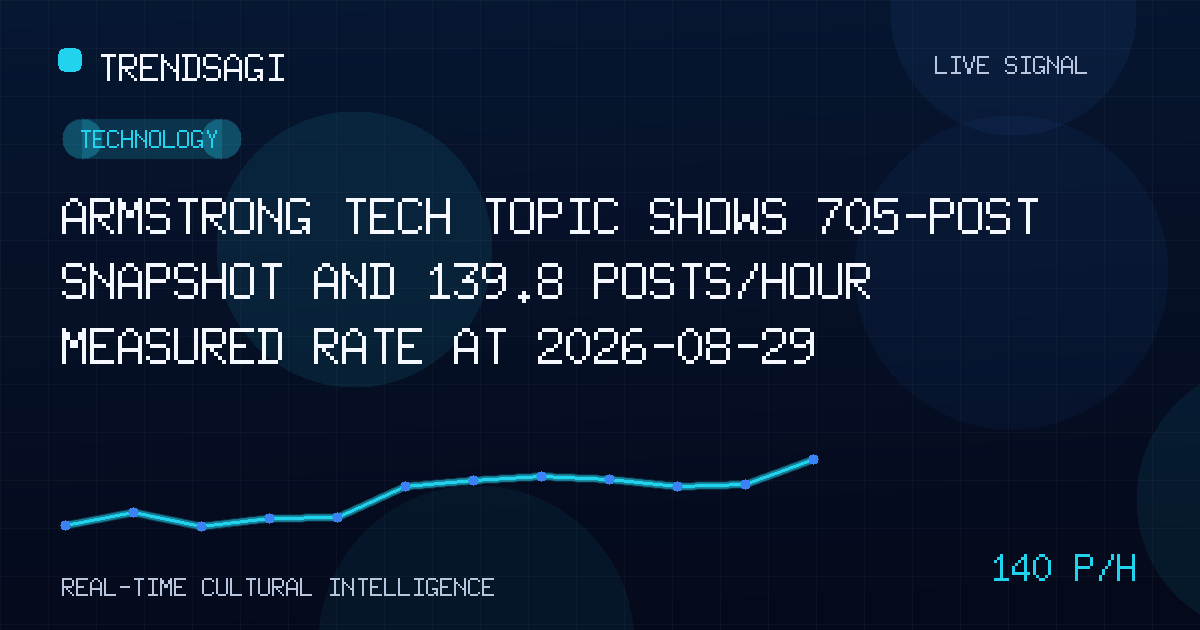
At the snapshot time of 2026-08-29T11:01:06Z, the stored signal for the topic labeled "Armstrong" under the Technology category recorded a snapshot volume of 705 posts. Alongside that, the measured snapshot rate was 139.8 posts/hour across an exact 3914-second window using three stored observations. This combination shows a concentrated batch of posts rather than a scattered baseline.
The 139.8 posts/hour figure is a measured snapshot rate, not a live or current rate, and it must not be interpreted as reach, engagement, unique-person count, or forecast. It strictly quantifies the posting pace observed within the defined historical window that ended at the stated snapshot timestamp.
| Metric | Value |
|---|---|
| Observation time | 2026-08-29T11:01:06Z |
| Measured snapshot rate | 139.8 posts/hour |
| Snapshot volume | 705 posts |
Why this topic may be moving
Using search limited to verification of public context, no publisher-attributed event directly explaining the rise of "Armstrong" in the Technology category could be confirmed. Multiple queries returned fragmented references, but none provided a verifiable fact tied to the observed snapshot volume or to the 139.8 posts/hour measured rate at the specified time.
The cause therefore remains unclear from verified sources. We omit any narrative that cannot be traced to a publisher, and we avoid implying that the spike stems from a product launch, a personnel move, or a regulatory action because no trusted report was retrievable.
This absence of verified explanation is itself useful: it tells the reader that the signal is ahead of confirmed reporting, or that the topic label may be too ambiguous to match news coverage.
Because the verification step was restricted to search and required publisher attribution, any forum speculation or unindexed source is excluded. That strict filter is appropriate for a research editor but means a genuine event with delayed indexing could be missed.
Why it matters
Technology monitors, competitive intelligence teams, and editorial desks should treat the signal as an early anomaly worth triangulation. A snapshot volume of 705 posts paired with a measured rate near 140 posts/hour suggests concentrated discussion, but alone it does not reveal sentiment, geographic spread, or the authority of the posters.
Who should care:
- Research editors tracking emerging technology nomenclature and sudden label spikes.
- Brand, security, or risk analysts watching for unexpected mentions of "Armstrong" in code, hardware, or corporate contexts.
- Investors or strategists who use post-volume spikes as a weak leading indicator of narrative formation.
- Platform operators needing to distinguish coordinated posting from organic interest.
The presence of a measured 139.8 posts/hour rate is a statistical observation about archived posts, not evidence of a real-world event until correlated with verified external reporting.
What the signal can establish: that within the stored observations, a cluster of 705 posts occurred and the pacing over the exact 3914-second window was elevated relative to a slower baseline (if one is later computed). It can also establish that three separate observations contributed to the rate, which reduces but does not remove single-point noise.
What the signal cannot establish: why those posts appeared, whether they are duplicate copies, automated bots, or human voices, or whether the topic label "Armstrong" maps to a single entity or several unrelated ones. It cannot certify that the posts are factual or influential.
For teams with access to the underlying post text, a small manual sample of 20 items can quickly reveal whether "Armstrong" refers to a person, a product, or an error tag. This qualitative check complements the quantitative rate.
What to watch next
Practical next checks for a reader or analyst:
- Query the same topic label across separate time windows to see if the rate persists, climbs, or decays.
- Filter posts by source type to separate news articles, forum threads, and social chatter.
- Verify any named entity behind "Armstrong" through publisher reports before drawing conclusions.
- Check whether the snapshot volume grows beyond 1,000 posts in the next observation cycle.
- Compare the measured snapshot rate against historical averages for the Technology category.
Concrete watch signals:
- A sustained measured rate above 100 posts/hour for three consecutive snapshots would indicate durable attention rather than a one-time burst.
- A shift in stored category from Technology to Finance, Politics, or Science could signal entity disambiguation or misclassification.
- Emergence of a verified publisher story citing "Armstrong" with technical details would convert the anomaly into an explained trend.
- A decline to near-zero snapshot volume within the next window would mark the spike as transient noise.
Methodology and limitations
The briefing uses one canonical stored signal observed at 2026-08-29T11:01:06Z. The measured change rate of 139.8 posts/hour was computed from three stored observations over an exact 3914-second window; we report it exactly as supplied and do not recalculate, round, or transform the figure.
Limitations: Snapshot volume counts posts in storage, not unique authors or authenticated accounts. The label "Armstrong" is unvalidated and may conflate multiple subjects. No external verification of cause was possible within the search-only constraint, so the briefing intentionally omits speculation. The measured snapshot rate is not a current or live rate and should not be projected forward as a forecast.
Analysts should treat this as a prompt for further verification rather than a concluded trend. The value lies in catching the accumulation early and specifying the checks needed to separate noise from signal. Until a publisher-attributed fact aligns with the timestamp and category, the movement remains an open question.
Track This Topic for New Signals
Set alerts for future velocity or sentiment changes around this topic.
Explore Tracking PlansAbout TrendsAGI research
TrendsAGI's automated research pipeline publishes dated signal snapshots, methodology notes, and practical workflows for teams evaluating cultural momentum. Read how signals are scoped, scored, and limited in our research methodology.


