891-second window · 3 observations · Measured Sep 27, 2026, 12:26 AM UTC · Provider: go_recent_snapshot_v2
Arch signal measures 497.1 posts/hour; trigger and topic meaning remain unverified
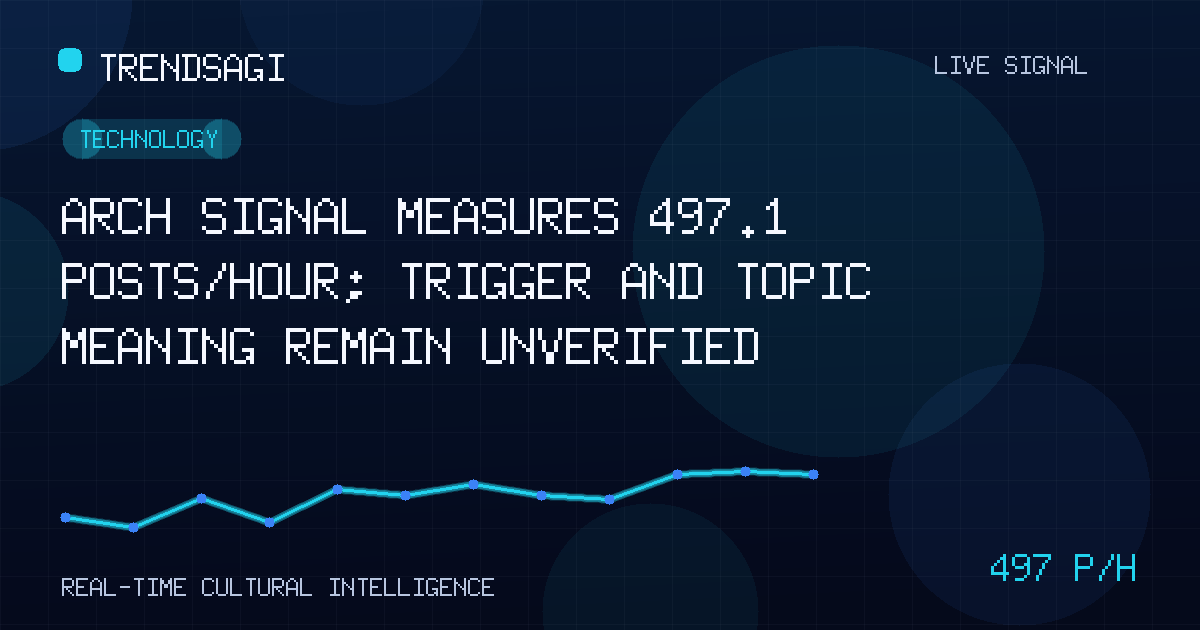
The “Arch” signal measured 497.1 posts/hour in an 891-second window; the latest snapshot held 418 posts, but its cause remains unverified.
Automated briefing. Generated from stored signal measurements and source-backed research; it is not manually reviewed. Read the methodology and limitations.
Metrics in this briefing are a snapshot associated with its publication date and may not reflect current conditions.
What changed
The immediate finding is a concentrated posting burst around the Technology-category label “Arch,” not a verified explanation of what the label means. The stored record does not resolve whether the posts concern a product, project, discipline, person, or another entity, and it contains no verified event link. This is a volume-and-velocity alert that needs semantic validation before it can become a story about a particular community or issue.
For the exact 891-second window built from three stored observations, the measured change rate was 497.1 posts/hour. The latest snapshot at 2026-09-27T00:26:44Z contained 418 posts. The posts/hour value is a measured snapshot rate—not a live or current rate, forecast, reach, engagement metric, or count of unique people. The 418 figure is snapshot volume, not another rate. The supported conclusion is limited to posting activity in the monitored stream during the recorded window; neither the cause nor the topic’s precise meaning is established.
| Observation time | Measured snapshot rate | Latest snapshot volume |
|---|---|---|
| 2026-09-27T00:26:44Z | 497.1 posts/hour | 418 posts |
Why this topic may be moving
The canonical signal includes no verified public context, so there is no defensible publisher-attributed explanation to report. Possible explanations—such as a keyword collision, a new announcement, a controversy, coordinated reposting, or automated repetition—are hypotheses only. The label does not favor any one of them.
The key distinction is between a real event and a measurement artifact. A genuine event can concentrate attention, but unrelated conversations can share a keyword, while repeated or automated posts can inflate volume without representing broad interest. Until the underlying text and provenance are checked, describing this as an Arch-related news event would go beyond the evidence.
Before the referent and trigger are verified, the responsible conclusion concerns measured posting activity—not an assumed Arch event.
What the signal can—and cannot—establish
The signal is useful because it identifies a place for focused investigation. It supports a limited set of factual observations:
- The latest stored snapshot contained 418 posts at the specified time.
- The measured change rate was 497.1 posts/hour over the exact 891-second window.
- The result provides a reference point for comparison with later stored observations.
It does not, by itself, establish:
- what “Arch” denotes in the participating posts;
- whether the activity represents the wider public conversation;
- how many unique people participated or were reached;
- whether the posts express positive, negative, or neutral sentiment;
- whether the activity is organic, duplicated, coordinated, or automated;
- whether the burst continued beyond the recorded observation.
Why it matters
For technology editors, trend analysts, and monitoring teams, an ambiguous high-rate label creates a verification problem rather than a ready-made news angle. A fast keyword can combine unrelated conversations or repeated content, either of which can resemble a sudden event. The immediate operational priority is to determine what the posts actually discuss before assigning a narrative or notifying a potentially affected community.
For readers and communities that may be connected to the label, premature amplification could create confusion about the cause, scale, and significance of the activity. The practical distinction is simple: the measured rate says where to look, while semantic, provenance, and public-context checks determine whether there is a substantiated story worth reporting.
What to watch next
- Resolve the referent. Inspect representative posts from across the window and identify the entities, topics, products, or communities they actually mention. The category label and keyword alone are insufficient.
- Separate conversation from repetition. Group posts into threads and subject clusters, then look for duplicated text, cross-posting, quoted material, or repeated links that may inflate apparent activity.
- Check provenance. Examine account history, posting patterns, source links, and whether original posts are being recopied. Account volume should not be treated as a unique-person count.
- Verify a candidate trigger. A Google Search can locate contemporaneous public pages, but a cause should be attributed only if a publisher’s report or primary item supports the connection. A matching keyword by itself is not verification.
- Test persistence. Compare later stored observations with this snapshot to determine whether activity persists, decays, or recurs. The present measurement should not be treated as a live rate beyond its stated observation point.
Concrete watch signals
- Referent convergence: posts consistently describe the same entity or issue.
- Source diversity: activity comes from independent contributors rather than repeated copies.
- Event alignment: a dated public item matches both the subject and timing of the posts.
- Rate persistence: subsequent stored observations show continued activity rather than an isolated burst.
- Authenticity: account behavior does not indicate mass repetition, automation, or coordinated amplification.
- Taxonomy resolution: the monitoring system can map “Arch” to a specific, defensible subject.
Methodology and limitations
This briefing uses the supplied stored measurements: the observation time, Technology category, ambiguous label, exact 891-second window, three observations, measured rate of 497.1 posts/hour, and latest snapshot volume of 418 posts. The rate is descriptive of that monitored corpus and window; no live conditions are inferred.
No sampling frame, collection method, geographic or language coverage, deduplication rules, or account-authenticity data is provided. Three observations over the exact window provide a narrow evidence base and do not demonstrate persistence or representativeness. The blank stored signal description and ambiguous label further limit interpretation. Because no candidate external trigger is verified in the available record, this briefing does not assert a cause. A later assessment should revise the interpretation if semantic, provenance, or public-context checks resolve the topic.
Track This Topic for New Signals
Set alerts for future velocity or sentiment changes around this topic.
Explore Tracking PlansAbout TrendsAGI research
TrendsAGI's automated research pipeline publishes dated signal snapshots, methodology notes, and practical workflows for teams evaluating cultural momentum. Read how signals are scoped, scored, and limited in our research methodology.