899-second window · 3 observations · Measured Sep 24, 2026, 7:54 PM UTC · Provider: go_recent_snapshot_v2
Apple Watch posts show a measured increase; the cause remains unverified
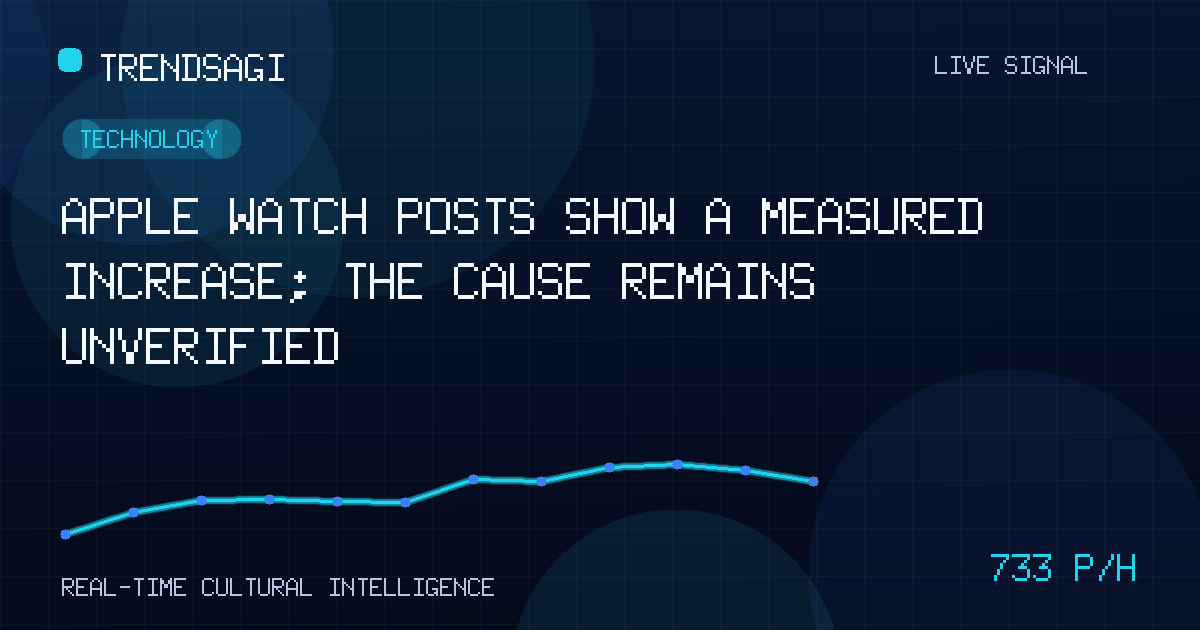
Apple Watch posts rose at a measured snapshot rate of 732.9 posts/hour; the trigger is unverified, so readers should check evidence before acting.
Automated briefing. Generated from stored signal measurements and source-backed research; it is not manually reviewed. Read the methodology and limitations.
Metrics in this briefing are a snapshot associated with its publication date and may not reflect current conditions.
What changed
Apple Watch post activity increased across the stored observation window, but the cause is still unclear. The measured snapshot rate is 732.9 posts/hour, based on 3 stored observations over an exact 899-second window and recorded at 2026-09-24T19:54:40Z. This describes historical movement in the stored series, not a live rate, forecast, reach, engagement, or count of distinct people.
The stored latest snapshot contains 521 posts. That is a collection count at the observation point, not a rate or evidence that 521 different people participated. It is also not the count underlying the rate. The figures support increased observed posting activity around the timestamp; they do not establish an announcement, product event, public reaction, or market effect.
| Measure | Stored value |
|---|---|
| Observation time | 2026-09-24T19:54:40Z |
| Measured snapshot rate | 732.9 posts/hour |
| Latest snapshot volume | 521 posts |
The signal establishes a measured rise in posting activity, not the identity of the event behind it. Treating the cause as known would go beyond the evidence.
Why this topic may be moving
The available record contains no verified public explanation for the movement, so attributing it to a particular development would be speculative. The Technology category and Apple Watch topic label identify how the material is classified; they do not identify a news event. A post count also does not show whether the posts discuss the same subject.
Several different patterns could produce an increase in stored posts. New information could prompt discussion, a scheduled event could concentrate attention, or an existing story could be recirculated. Collection or query changes could also alter observed volume without a comparable real-world change. Repetition and automated activity may add to volume without equivalent human interest. These are hypotheses to test, not verified explanations of this signal.
It would therefore be unsupported to attach the increase to a release, update, health-related story, pricing change, availability issue, or controversy. None is established by the stored observations. A credible causal account needs dated evidence from a relevant publisher or official source, plus a plausible timing match to the measured rise. A topical label by itself is not causal evidence.
Why it matters
For readers following Apple Watch, the useful takeaway is to investigate, not to assume that a major event has occurred. The measured rise can justify a prompt check of available reporting and official notices. It cannot, by itself, confirm what happened, whether the posts are favorable, or whether attention is translating into behavior.
For product, customer-support, and communications teams, the content pattern matters more than volume alone. A rise could reflect new questions, repeated claims, a shared access problem, renewed discussion of an existing topic, or unrelated material captured by the same label. Those situations call for different responses. Checking the posts themselves is necessary before deciding whether the movement represents a meaningful issue.
For people making purchase or broader market decisions, the rate is not evidence of demand, sales, adoption, satisfaction, or financial impact. Those are separate questions requiring separate evidence. A measured rise in posts can be useful as an early warning while remaining too ambiguous to support a confident conclusion.
What to watch next
The most useful follow-up is to test persistence, concentration, and cause. These are checks, not predictions.
- Repeat the measurement consistently. Take another snapshot with the same query, collection rules, deduplication approach, and time-recording method. A comparably elevated result would strengthen the case for sustained movement; a return to prior levels would suggest the increase may have been brief. Either outcome should be reported with its own timestamp and scope.
- Inspect content and timing. Determine whether posts repeatedly mention the same subject, whether links or quotations are being copied, and whether activity clusters around a particular time. Where available, separate original contributions from repeated or automated posts. A shared subject and clear timing concentration would support an event-driven interpretation; varied, unrelated posts would instead raise questions about topic matching or collection effects.
- Verify an external trigger. Check for a specific, dated public explanation. Official Apple Watch announcements or release information, if available for the relevant period, should be compared with independent reporting that can be verified. A source that merely mentions Apple Watch after the observed timestamp does not establish the cause. The relevant test is whether its content and publication time fit both the posts and the measured rise.
- Check collection integrity. Look for changes in source mix, query coverage, collection limits, duplicate handling, or time-zone boundaries. These can affect a count independently of real-world activity. Nothing in the supplied signal shows that any such change occurred, so collection integrity remains a check rather than an explanation.
- Look for corroborating signals. Compare the topic with an independent measurement, such as a separate search-interest series or verified publisher timeline. Agreement can strengthen confidence that movement was real, but it will not by itself reveal sentiment, participation, or reach. Keep external evidence distinct from the canonical stored count.
A strong confirmation would connect a named event, verifiable timing, and post content that actually discusses that event. Without that chain, retain the restrained conclusion: Apple Watch posts increased at a measured snapshot rate of 732.9 posts/hour, while the cause remains unverified.
Methodology and limitations
The reported 732.9 posts/hour is a measured snapshot rate from 3 stored observations over an exact 899-second window, with the measurement timestamp shown above. The 521-post figure is snapshot volume, not another expression of that rate. These values have different scopes and should be reported separately.
The series is limited to the supplied observation window and sparse stored points. It can show increased activity relative to earlier observations. It cannot establish how long movement will last, its cause, sentiment, organic participation, or total exposure. There is no supplied baseline for judging whether the change is unusual relative to a longer period.
Content samples, historical baselines, query definitions, geographic coverage, deduplication details, and engagement measures are not provided. Those gaps prevent confident judgments about what was discussed, who participated, where activity occurred, or whether repetition inflated the count. The appropriate use is an alert for verification, not proof of a news event or business impact.
Track This Topic for New Signals
Set alerts for future velocity or sentiment changes around this topic.
Explore Tracking PlansAbout TrendsAGI research
TrendsAGI's automated research pipeline publishes dated signal snapshots, methodology notes, and practical workflows for teams evaluating cultural momentum. Read how signals are scoped, scored, and limited in our research methodology.


