902-second window · 3 observations · Measured Sep 10, 2026, 3:25 PM UTC · Provider: go_recent_snapshot_v2
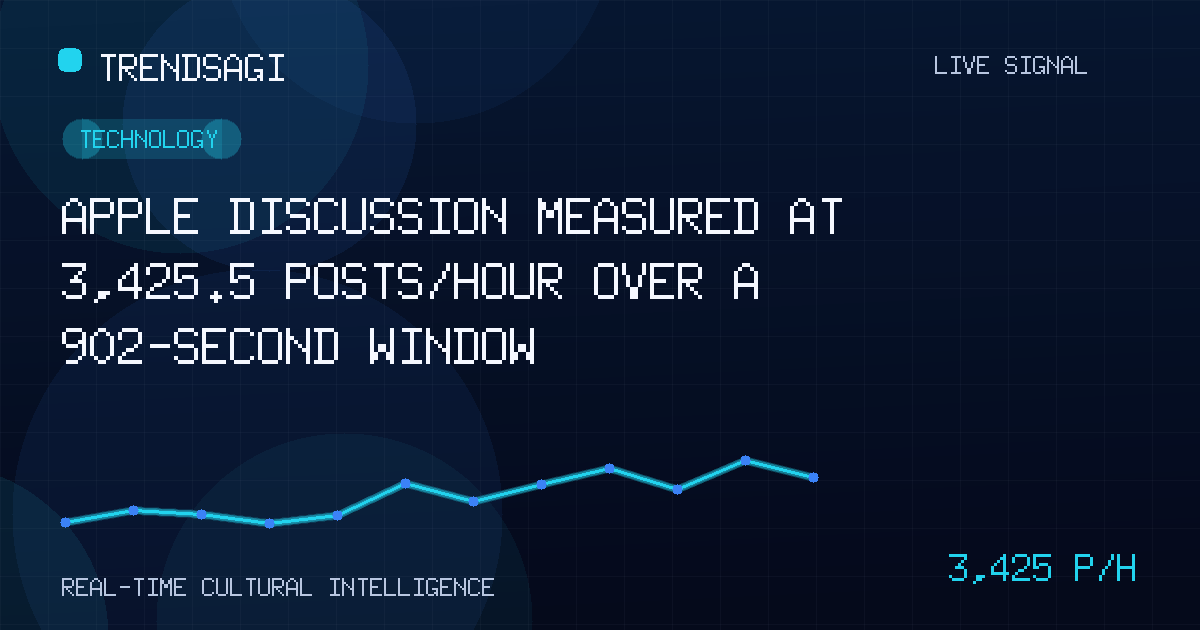
Apple discussion measured at 3,425.5 posts/hour over a 902-second window
A stored Apple signal shows 6,000 snapshot posts and a measured 3,425.5 posts/hour over 902 seconds, with cause unconfirmed.
Automated briefing. Generated from stored signal measurements and source-backed research; it is not manually reviewed. Read the methodology and limitations.
Metrics in this briefing are a snapshot associated with its publication date and may not reflect current conditions.
What changed
The direct answer: the stored Apple signal shows a latest snapshot volume of 6,000 posts and a measured snapshot rate of 3,425.5 posts/hour. This is a volume observation, not evidence of a live current rate, forecast, reach, engagement, or unique-person count. The topic is stored under Technology, but no stored description explains why Apple was moving.
The measured change was calculated over an exact 902-second window using 3 stored observations, measured at 2026-09-10T15:25:47Z. The snapshot was observed at the same timestamp.
| Observation time | Measured posts/hour | Snapshot volume |
|---|---|---|
| 2026-09-10T15:25:47Z | 3,425.5 | 6,000 posts |
Why this topic may be moving
Because the stored signal description is empty and no verified public context is supplied in this record, the cause remains unclear. The most honest interpretation is that Apple generated a measurable burst of posts in the observed window, but the data alone cannot distinguish between a product announcement, a service outage, a market or regulatory story, a viral user clip, a celebrity mention, or a broad news cycle.
The topic label Apple is broad. Apple-related volume can move for reasons that have very different business meanings:
- A hardware or software release, such as a new iPhone, iPad, Mac, wearable, operating system, or major app update.
- A supply-chain, chip, pricing, or retailer story that affects investors and analysts.
- A privacy, data, regulation, antitrust, or app-store policy issue.
- A celebrity, sports, entertainment, or lifestyle story that uses Apple as a backdrop.
- A technical malfunction or customer-service complaint wave.
The measured rate tells us how fast stored observations changed, not what people were saying, whether the activity was organic, or whether it will persist.
Why it matters
Apple matters because it sits at the intersection of consumer hardware, software, services, finance, privacy, and platform policy. A short burst in mention volume can matter even if it does not become a long trend, because Apple stories can quickly move from social chatter to search, app-store behavior, customer support load, retail demand, and investor sentiment.
For different readers, the practical value is different:
- Journalists should treat this as a prompt to verify what specific Apple story, if any, is generating the posts.
- Product teams should check whether the spike aligns with an update, bug, or support disruption.
- Investors and analysts should look for the driver before interpreting it as sentiment, because volume alone is not price, earnings, or demand evidence.
- Competitors should monitor whether the story is about capability, pricing, regulation, or customer dissatisfaction.
- Consumers should verify claims before acting on rumors, especially around purchases, upgrades, or personal data.
The signal is useful as an early-warning indicator, not as proof. It can establish that Apple-related stored posts were present at scale in a specific window and that the measured change rate was high relative to the observation sample. It cannot establish that the posts are accurate, that they are from unique humans, or that the topic is currently rising beyond the stored sample.
What to watch next
The next checks should focus on separating a one-time burst from a sustained movement and identifying the driver. The most useful watch signals are specific, time-bound, and tied to source verification.
- Look for a clear headline trigger: a launch event, press release, regulatory filing, court ruling, outage notice, or widely shared report tied to the observation window.
- Check whether the volume persists across at least two later snapshots rather than collapsing after one measurement.
- Compare the measured posts/hour with earlier stored baselines, if available, instead of comparing it to unmeasured normal chatter.
- Examine post language for repeated entities: a model name, app, service, executive, supplier, region, bug, price, or support phrase.
- Check whether official Apple channels, major publishers, or independent monitors are discussing the same event at the same timestamp.
- Watch for follow-up behavior: search queries, app-store reviews, customer-support queues, retailer stock pages, or developer forums.
- Monitor for sentiment shift, especially if the early volume is mixed between excitement and complaint.
A practical next check is to pull the raw posts or a representative sample from the same 902-second window and ask three questions: What Apple object is being named? What action is people describing? What source are they citing? If the sample cannot be tied to a verifiable public event, the briefing should remain cause unclear.
Methodology and limitations
This briefing uses a canonical stored signal for the topic label Apple. The stored category is Technology. The latest snapshot volume is 6,000 posts. The measured change rate is 3,425.5 posts/hour, calculated over an exact 902-second window using 3 stored observations and measured at 2026-09-10T15:25:47Z. The snapshot was observed at the same timestamp.
The measurement has important limits:
- Snapshot volume is a count in a stored sample, not a live count of all posts, impressions, reach, or users.
- The posts/hour figure is a measured snapshot rate from a short window, not a live current rate or forecast.
- Three stored observations are enough to calculate a short-window rate, but they may not represent a stable trend.
- The topic label can aggregate many different Apple stories, making the cause harder to identify from volume alone.
- Without verified public context, the cause should not be asserted. The safest statement is that Apple-related volume moved measurably in the stored sample, while the driver remains unconfirmed.
Readers should use this as a decision prompt: verify the specific Apple story, check persistence in later observations, and avoid converting a short measured spike into a conclusion about product success, market sentiment, or company performance.
Track This Topic for New Signals
Set alerts for future velocity or sentiment changes around this topic.
Explore Tracking PlansAbout TrendsAGI research
TrendsAGI's automated research pipeline publishes dated signal snapshots, methodology notes, and practical workflows for teams evaluating cultural momentum. Read how signals are scoped, scored, and limited in our research methodology.


