895-second window · 3 observations · Measured Oct 8, 2026, 9:26 PM UTC · Provider: go_recent_snapshot_v2
Anne Carson topic measures 434.4 posts/hour; cause remains unverified
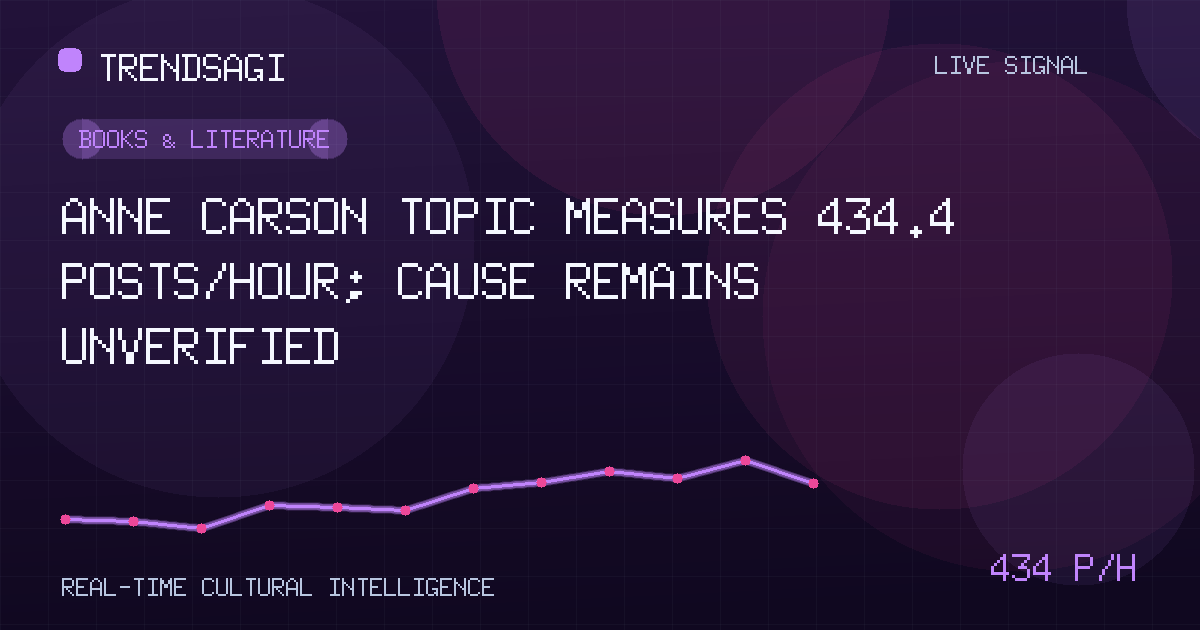
The Anne Carson signal measured 434.4 posts/hour with 356 snapshot posts; editors should verify a public catalyst before interpreting the literary trend.
Automated briefing. Generated from stored signal measurements and source-backed research; it is not manually reviewed. Read the methodology and limitations.
Metrics in this briefing are a snapshot associated with its publication date and may not reflect current conditions.
What changed
The stored signal labeled Anne Carson is moving quickly enough to warrant verification: its latest measured snapshot rate is 434.4 posts/hour. The record contains no verified public catalyst, however, so the reason for the movement remains unclear. It should not yet be described as a response to a book, appearance, award, adaptation, or other specific event.
The rate was measured over an exact 895-second window using 3 stored observations and was recorded at 2026-10-08T21:26:32Z. It is a measured snapshot rate, not a live or current rate, forecast, reach, engagement, or unique-person count. The latest snapshot contains 356 posts, a separate count of posts at the observation time rather than an hourly rate or audience size.
| Observation time | 2026-10-08T21:26:32Z |
|---|---|
| Measured posts/hour | 434.4 posts/hour |
| Snapshot volume | 356 posts |
Why this topic may be moving
No verified public item explains the rapid activity in the stored material. Without that context, possible drivers should be treated as hypotheses rather than reported facts.
- A time-sensitive announcement from a creator, publisher, institution, or event organizer could concentrate discussion.
- An interview, reading, publication, translation, reissue, prize result, or adaptation could give the name a new reason to circulate.
- A quotation or passage associated with the topic may have entered a broader cultural conversation and prompted name-based posts.
- Recommendation, ranking, or algorithmic exposure on the source platform could amplify otherwise ordinary discussion.
- Reposting, duplication, coordinated behavior, confusion with another person, or a similarly named topic could also inflate a name-based signal.
None of these possibilities is confirmed here. The reliable next step is to identify the earliest substantive posts and trace them to direct, dated sources instead of inferring a cause from velocity alone.
What the signal can establish
The signal establishes that the stored sample registered the reported rate during the stated window, that the topic is assigned to the stored Books & Literature category, and that the latest observation contained 356 posts. That is enough to justify closer monitoring and source checking.
The signal establishes that the stored sample changed quickly. It does not establish what happened, who caused the change, or whether the sample represents the wider conversation.
It cannot establish which post started the movement, whether posts are original or duplicates, whether people are reacting to the same subject, how sentiment is distributed, or what share is organic. It also cannot support claims about sales, readership, cultural influence, or the wider public’s interest. A topic label can capture a conversation without explaining its content.
Why it matters
For editors, the signal is useful because speed can reveal a conversation worth checking before it disappears. It is not sufficient grounds for a news peg: an event claim needs a direct, verifiable source and matching timing. A rate alone cannot distinguish a meaningful literary development from repetition, platform effects, or an unrelated cluster.
For publishers and booksellers, the signal may indicate attention but not demand. Any operational response should wait for evidence that discussion is sustained, specific, and connected to a named work or event. For readers and researchers, the value is diagnostic: it identifies where to look, not what to believe.
What to watch next
The next checks should move from volume to provenance.
- Find the earliest substantive posts. Inspect their timestamps, quoted text, linked source, and whether they add information or merely repeat a headline.
- Verify a direct source. Look for a dated announcement or event page from the relevant creator, publisher, institution, or organizer, and confirm that its timing fits the observed burst.
- Check independent corroboration. Distinct reporting or primary documentation would make a proposed catalyst more credible than many outlets copying the same unattributed claim.
- Test persistence. Compare later stored snapshots for continued activity, falling volume, or a return to the prior pattern, while keeping every snapshot’s time and volume separate.
- Inspect content quality. Determine whether posts discuss a particular work, passage, interview, or event, or merely mention the name in passing.
- Screen for distortion. Check for duplicate wording, automated reposting, coordinated timestamps, mis-tagged subjects, and mistaken identity.
- Track source breadth. Note whether the apparent conversation is concentrated on a single platform, geography, or language, or supported across independent communities.
A confirmed catalyst should therefore have a named entity, a dated source, a clear connection to the label, and independent discussion referencing the same event. If those checks fail, the correct status remains “cause unverified,” even if the measured snapshot rate remains elevated.
Methodology and limitations
The stored category is Books & Literature, but category assignment does not verify why posts were collected or whether the label is complete. The rate comes from 3 observations in an exact 895-second window; the record does not provide a baseline, sampling coverage, platform mix, deduplication method, bot controls, or uncertainty estimate. Accordingly, this snapshot cannot establish historical acceleration, a record, statistical significance, or a live trend.
The 434.4 posts/hour figure is valid only as the supplied measured snapshot rate. The 356 posts figure is valid only as latest snapshot volume. Neither should be extrapolated. Because no verified public context accompanies the record, the cause is still unclear rather than merely disputed.
The defensible conclusion is straightforward: the stored Anne Carson signal warrants attention, and the next reporting decision should depend on source verification—not on the headline-like speed of the metric alone.
Track This Topic for New Signals
Set alerts for future velocity or sentiment changes around this topic.
Explore Tracking PlansAbout TrendsAGI research
TrendsAGI's automated research pipeline publishes dated signal snapshots, methodology notes, and practical workflows for teams evaluating cultural momentum. Read how signals are scoped, scored, and limited in our research methodology.


