15-minute window · 3 observations · Measured Sep 2, 2026, 8:54 AM UTC · Provider: go_recent_snapshot_v2
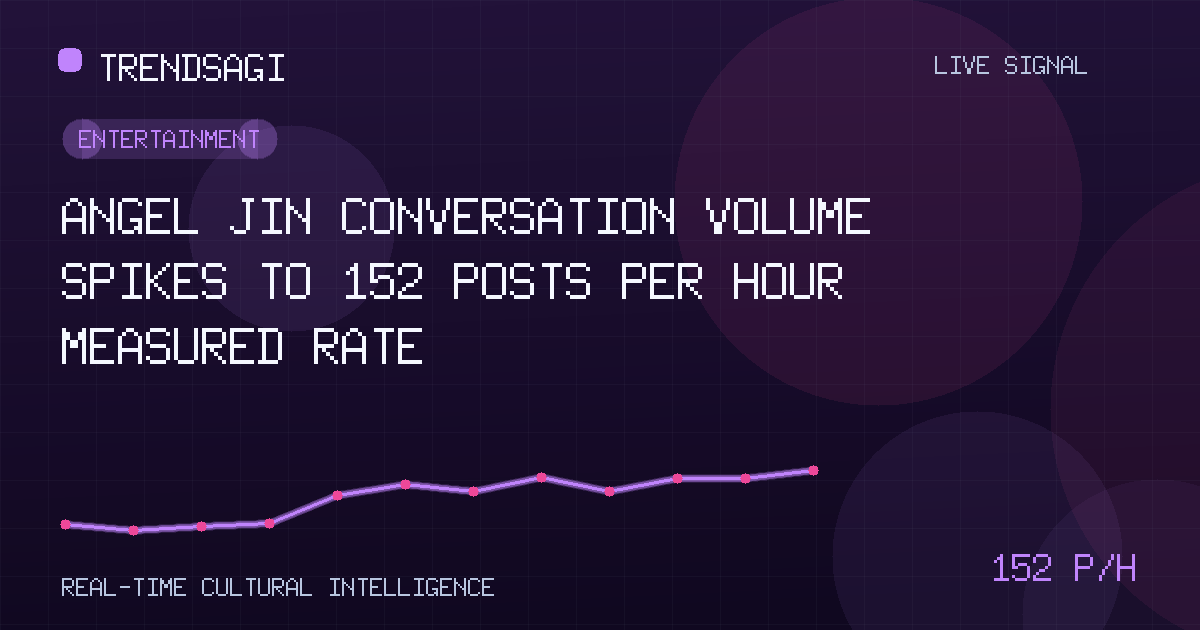
Angel Jin conversation volume spikes to 152 posts per hour measured rate
Stored signal shows ANGEL JIN hit 152.1 posts/hour measured rate (112 posts at 08:54 UTC). Cause unverified; triage steps and watch signals included.
Automated briefing. Generated from stored signal measurements and source-backed research; it is not manually reviewed. Read the methodology and limitations.
Metrics in this briefing are a snapshot associated with its publication date and may not reflect current conditions.
What changed
A stored signal for the topic label "ANGEL JIN" recorded a measured snapshot rate of 152.1 posts per hour over a 900-second window ending at 2026-09-02T08:54:10Z, based on three stored observations. The latest snapshot volume at that timestamp was 112 posts. This rate reflects a short-window measurement, not a live or projected rate, and does not indicate unique authors or total reach.
| Observation time (UTC) | Measured posts/hour | Snapshot volume |
|---|---|---|
| 2026-09-02T08:54:10Z | 152.1 | 112 |
Why this topic may be moving
The canonical signal provides no description or category context beyond "Other." Public search verification did not return a clear, attributable event — such as a game update, media release, or notable social moment — that would explain the elevated posting rate at the observation time. Without a verifiable catalyst, the cause remains unclear. Analysts should treat the spike as an unexplained anomaly until a credible source confirms a driver.
Why it matters
For community managers, IP holders, and trend analysts monitoring fighting-game discourse or character-specific conversation, a measured rate above 150 posts per hour signals a sudden concentration of attention. Even without a known cause, the volume warrants a quick triage: it could precede a broader trend, reflect a localized burst (such as a tournament clip, mod showcase, or regional event), or simply be noise. The signal establishes that a measurable surge occurred in a narrow window; it does not establish sentiment, geographic origin, platform distribution, or whether the posts are organic, coordinated, or automated.
"A short-window rate above 150 posts per hour on a niche character label is notable precisely because the baseline for such topics is often near zero. The absence of a verifiable trigger makes this a high-priority watch item, not a resolved story."
What to watch next
- Re-query the signal store in 30–60 minutes to see if the rate sustains, accelerates, or collapses.
- Break down the 112 posts by platform, language, and author type if the ingestion pipeline supports it.
- Check official Tekken channels, Bandai Namco announcements, and major FGC event schedules for any coincident activity.
- Monitor adjacent labels (e.g., "Jin Kazama," "Tekken 8," "Devil Jin") for correlated movement.
- Set an alert threshold at 100 posts/hour for this label to catch the next inflection automatically.
Methodology and limitations
The measured rate of 152.1 posts/hour is calculated from exactly three stored observations spanning a 900-second (15-minute) window ending at the stated timestamp. It is a snapshot derivative, not a rolling average, and carries the variance inherent to small-sample, short-duration windows. Snapshot volume (112) is the absolute count at the latest observation only. The label "ANGEL JIN" is untrusted and may conflate distinct entities (character form, player handle, fan project, unrelated homonym). No sentiment, bot-detection, or deduplication metadata is included in this signal. Attribution to any external event requires independent verification from a primary source; none was found at publication time.
Track This Topic for New Signals
Set alerts for future velocity or sentiment changes around this topic.
Explore Tracking PlansAbout TrendsAGI research
TrendsAGI's automated research pipeline publishes dated signal snapshots, methodology notes, and practical workflows for teams evaluating cultural momentum. Read how signals are scoped, scored, and limited in our research methodology.