997-second window · 2 observations · Measured Sep 28, 2026, 9:55 PM UTC · Provider: go_recent_snapshot_v2
Andre Swift snapshot registers 765.7 posts/hour; trigger remains unverified
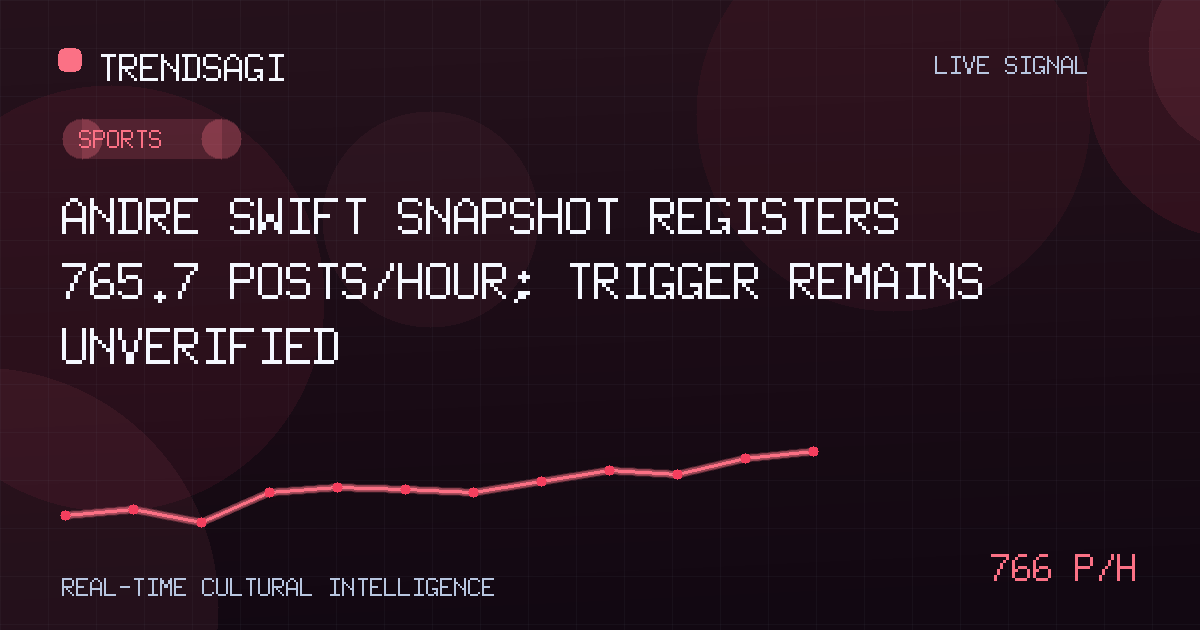
Andre Swift's snapshot shows 302 posts and a measured 765.7 posts/hour rate, helping readers separate short-window volume from verified news.
Automated briefing. Generated from stored signal measurements and source-backed research; it is not manually reviewed. Read the methodology and limitations.
Metrics in this briefing are a snapshot associated with its publication date and may not reflect current conditions.
What changed
The available record shows concentrated short-window posting activity around the Sports topic labeled Andre Swift, but it does not establish what triggered the activity. The latest observation, timestamped 2026-09-28T21:55:26Z, contained 302 posts. The cause remains unverified, so the activity is a monitoring lead rather than evidence of a breaking development.
The measured snapshot rate is 765.7 posts/hour, based on 2 stored observations across an exact 997-second window. This is a historical rate attached to that short interval, not a live or current rate, forecast, reach, engagement result, or unique-person count. With no comparison baseline displayed here, the figure also does not show how unusual the activity is relative to normal.
| Metric | Recorded value |
|---|---|
| Observation time | 2026-09-28T21:55:26Z |
| Measured snapshot rate | 765.7 posts/hour |
| Snapshot volume | 302 posts |
| Measurement basis | Exact 997-second window; 2 stored observations |
The strongest conclusion is temporal, not causal: the Andre Swift label was associated with short-window posting activity, while the available evidence does not identify the event behind it.
Why this topic may be moving
No verified, time-matched public development is available to explain the timing, so the cause is unclear. It would be inappropriate to attribute the activity to a match result, injury, roster decision, transfer, official post, or rumor without a source that aligns with the observation window. These are candidate explanations, not facts about Andre Swift.
A high count can emerge from several mechanisms: genuine reaction to a new event, repeated discussion of one post, resurfacing older material, concentration among a small number of accounts, or automated amplification. The stored Sports category narrows the context but verifies none of these mechanisms. Nor does the signal establish sentiment, source reliability, or the number of independent participants. The snapshot and rate are compatible with both a real news event and a temporary attention spike.
What the signal can and cannot establish
The signal establishes that the label was attached to 302 posts at the stated time and that the supplied measurement registered 765.7 posts/hour over 997 seconds. That is sufficient to flag the interval for follow-up, check recent public information, and collect additional evidence.
It does not establish who posted, whether the posts were original, how many people saw or engaged with them, what sentiment dominated, or whether the activity continued. The snapshot is not a census of people: 302 posts may include reposts, duplicates, syndicated text, and repeat contributions from the same accounts. The rate does not correct those limitations.
The limited observations also cannot show persistence, a normal baseline, or the distribution across accounts. The figures should not be converted into claims of mass attention, public approval, or a confirmed event.
Why it matters
For fans and general readers, the key distinction is between conversation volume and verified news. A fast cluster of posts can justify a search, but it is not itself a reliable report. An official participant, club, publisher, or other accountable source should confirm both the fact and its timing before the activity is described as a news event.
- Media editors and reporters should use the signal to prioritize verification, not as a story angle on its own.
- Teams, agents, and reputation teams can use the timestamp to check whether a public statement, appearance, or availability question needs a response.
- Platform analysts and researchers should examine repetition, account concentration, and sentiment before calling the activity broad interest.
- Sponsors and commercial stakeholders should not treat post count as audience size or evidence of impact.
Because the 997-second interval can capture a reaction peak, scheduled release, or temporary cluster around one post, it is a weak basis for forecasting persistence. Decisions should wait for a later snapshot and corroborating information.
What to watch next
- Find the first timestamped catalyst. Run time-bounded Google searches for Andre Swift with the observation date, then check whether any result predates and plausibly explains the burst. An item published after the snapshot cannot explain its onset.
- Prefer accountable sources. Look for a first-party statement or a named publisher reporting named facts. Secondary commentary can help locate the origin, but repetition is not confirmation.
- Collect adjacent measurements. Add timestamps and snapshot volumes before and after the interval using a consistent window. Persistence would support a continuing signal; an immediate fall would point to a brief burst.
- Test concentration and originality. Review whether posts are independent, whether a few accounts dominate, and whether duplicate wording or automated behavior inflates the count before interpreting the 302 posts as distinct expressions of interest.
Concrete follow-up signals would include an official update that aligns with the timing, independent publishers converging on the same factual development, or later snapshots showing that activity remains elevated. Warning signs include inconsistent accounts of the alleged event, heavy duplication, sharp concentration among a small group, or a rapid collapse after the initiating item leaves the conversation. Those patterns would materially change how confidently the signal could be interpreted.
Methodology and limitations
This briefing uses the supplied snapshot at 2026-09-28T21:55:26Z: 302 posts in the latest snapshot, plus a measured snapshot rate of 765.7 posts/hour based on 2 stored observations over an exact 997-second window. Volume and rate measure different things: the first describes the observed collection of posts; the second describes change during the specified interval.
The window is short and the observation count is limited. No baseline, account distribution, sentiment breakdown, engagement data, or verified time-matched catalyst is supplied. The signal can show where posting activity appears concentrated and what should be checked next; it cannot establish cause, participation, spread, or continuation. Until a time-matched public source is verified, the safest conclusion is that the Andre Swift label registered measurable posting activity, with its cause and significance still open.
Track This Topic for New Signals
Set alerts for future velocity or sentiment changes around this topic.
Explore Tracking PlansAbout TrendsAGI research
TrendsAGI's automated research pipeline publishes dated signal snapshots, methodology notes, and practical workflows for teams evaluating cultural momentum. Read how signals are scoped, scored, and limited in our research methodology.