1505-second window · 3 observations · Measured Sep 27, 2026, 2:51 AM UTC · Provider: go_recent_snapshot_v2
Andrade signal records 93 posts at a measured 74.2 posts/hour
The “Andrade” signal logged 93 posts at a measured 74.2 posts/hour, but its cause is unverified; editors should resolve identity and context.
Automated briefing. Generated from stored signal measurements and source-backed research; it is not manually reviewed. Read the methodology and limitations.
Metrics in this briefing are a snapshot associated with its publication date and may not reflect current conditions.
What changed
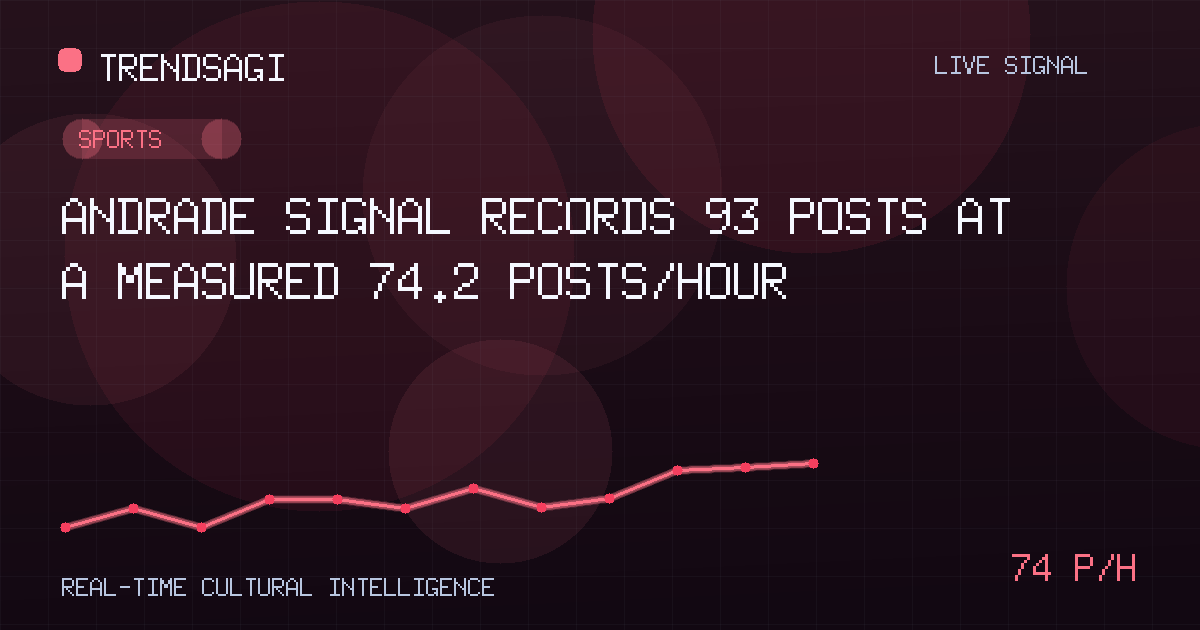
The sports-category signal labeled “Andrade” recorded 93 posts at the observation time, with a measured snapshot rate of 74.2 posts/hour. The direct conclusion is that recorded activity around an ambiguous surname merits monitoring, but not a causal headline: the stored record does not establish which Andrade, sport, event or development generated the posts.
The measured change of 74.2 posts/hour was calculated over an exact 1505-second window using 3 stored observations. It is a measured snapshot rate, not a live or current rate, forecast, reach, engagement level or count of unique people. The separate figure of 93 is the latest snapshot volume of posts, not a rate or audience size.
| Measure | Stored value |
|---|---|
| Observation time | 2026-09-27T02:51:32Z |
| Measured posts/hour | 74.2 posts/hour |
| Latest snapshot volume | 93 posts |
Why this topic may be moving
No verified public context has been established for the timing, so the reason this topic may be moving remains unclear. “Andrade” is not a specific event name, and the stored Sports category does not prove that the posts concern one athlete, match, team or announcement. People and organizations can share the same name, potentially combining unrelated conversations. A responsible briefing therefore reports the activity without assigning an unverified trigger.
The following explanations should be treated as diagnostic possibilities, not findings:
- Event-driven discussion: Timestamped original posts repeatedly refer to the same result, announcement, controversy or development once the relevant Andrade is identified.
- Name collision: The label combines posts about different people or contexts that happen to share the surname.
- Reposting or automation: Volume comes from repeated, copied or machine-generated messages rather than distinct developments.
- Collection or classification artifact: The collection query captures broader uses of the name, or the Sports category is broader than the actual conversation.
Evidence that could distinguish among these possibilities includes exact query text, raw post samples, account and source composition, and a verified event timeline. Without that evidence, any claim about why the signal moved would be speculation.
Why it matters
The immediate implication is verification priority, not event confirmation. A sports desk should not turn a surname-level burst into a result story, while a general newsroom should check whether apparently connected posts concern different people. Measurement teams need to know whether the rate reflects a genuine event cluster, a name collision or duplicate distribution.
A measured post rate establishes activity around a label; it does not establish the identity, cause or real-world importance of that activity.
Who should care:
- Sports editors and reporters: The label may become actionable only after it is tied to a specific person, competition or verified development.
- Social and audience teams: Aggregate volume can indicate where monitoring should intensify, but it cannot reveal reach or sentiment by itself.
- Fact-checkers and reputation teams: Identity ambiguity creates a risk of attaching a viral-looking signal to the wrong person or story.
- Trend and data teams: The sampling window, query definition, deduplication and source mix determine whether 74.2 posts/hour is meaningful.
What to watch next
A disciplined follow-up should answer these questions in order:
- What entity does “Andrade” denote? Resolve first names, aliases, handles, teams, leagues, countries and nearby event terms. Keep competing identities separate until the posts show which one is intended.
- What do the raw posts contain? Review a representative sample across the window for links, quoted text, timestamps, geography, language, and whether each item is original, copied or automated. This can reveal topic drift.
- What happened first? Build a short chronology from the earliest substantive references to later reposts. An early verified item may explain the timing, but sequence alone does not prove causation.
- Can the candidate cause be verified? Use a targeted Google Search to test exact-name, date and event combinations, then confirm any explanation with a contemporaneous first-party record and an independent publisher. Downstream claims should be attributed to the publisher that verified them.
- Does the activity persist? Collect additional comparable windows using the same query rules and deduplication method. A momentary burst and sustained activity imply different stories; neither should be inferred from the available snapshot alone.
- Does coverage converge? Compare the social cluster with timestamped reporting and any available official sports record. Independent references to the same concrete details provide stronger context than volume around a bare surname.
Concrete watch signals
- An identifiable original post aligns with a timestamped event, result or announcement.
- Independent publishers converge on the same identity and factual details.
- Posts cluster around one geography, language, competition or set of facts rather than scattered uses of the name.
- Later comparable windows remain active after the initial cluster, indicating persistence rather than a momentary burst.
- A correction, clarification or official update changes the conversation and is reflected in more specific posts.
Methodology and limitations
The observation time is 2026-09-27T02:51:32Z. The available measurement is 74.2 posts/hour over an exact 1505-second window using 3 stored observations. No previous rate, baseline or comparison series is supplied, so the record cannot quantify an increase, percentage change or acceleration relative to another period.
The snapshot provides no raw post text, post-level sample, query definition, collection coverage, deduplication rules, geographic or language breakdown, source mix, sentiment or verified public explanation. It therefore cannot establish unique authors, organic reach, authenticity, sentiment, public importance or the cause of the activity. “Sports” is a stored category, not confirmation of the posts’ subject matter.
Until identity and cause are verified, 74.2 posts/hour should be treated only as the measured snapshot rate, while 93 posts is the volume captured at that observation. The key question is not simply whether the count increases, but whether a verified event, a name collision or duplicate distribution explains it.
Track This Topic for New Signals
Set alerts for future velocity or sentiment changes around this topic.
Explore Tracking PlansAbout TrendsAGI research
TrendsAGI's automated research pipeline publishes dated signal snapshots, methodology notes, and practical workflows for teams evaluating cultural momentum. Read how signals are scoped, scored, and limited in our research methodology.


