898-second window · 3 observations · Measured Oct 10, 2026, 10:21 AM UTC · Provider: go_recent_snapshot_v2
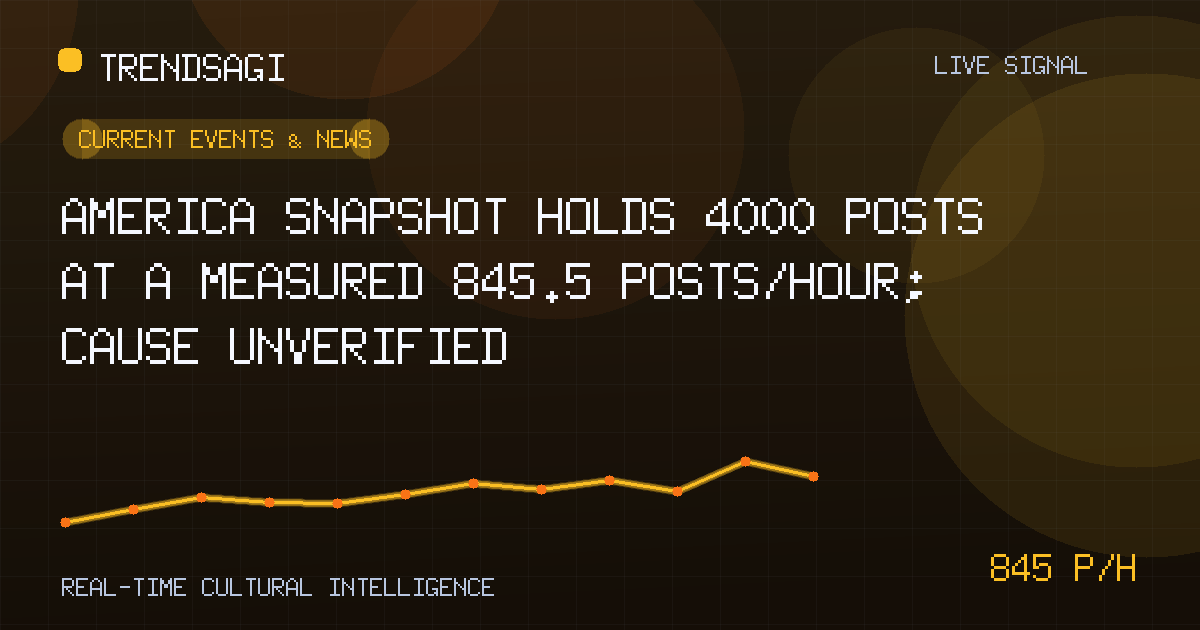
America snapshot holds 4000 posts at a measured 845.5 posts/hour; cause unverified
The America snapshot contains 4000 posts and a measured 845.5 posts/hour rate; this briefing separates the observed signal from an unverified catalyst.
Automated briefing. Generated from stored signal measurements and source-backed research; it is not manually reviewed. Read the methodology and limitations.
Metrics in this briefing are a snapshot associated with its publication date and may not reflect current conditions.
What changed
The stored “America” signal contains 4000 posts in the latest snapshot. Its measured change is a snapshot rate of 845.5 posts/hour, derived over an exact 898-second window using 3 stored observations. The figure describes posting tempo in that short window; it is not a live rate, forecast, reach figure, engagement measure, or count of unique people.
The direct conclusion is limited to tempo: monitored posting moved at that rate during the comparison window. The cause is unclear. “America” is a broad label, the stored signal description is empty, and no specific public catalyst can be verified from the available context. The signal warrants review, but it does not support attributing the movement to politics, conflict, economics, or another named development.
| Observation time | Measured snapshot rate | Snapshot volume |
|---|---|---|
| 2026-10-10T10:21:45Z | 845.5 posts/hour | 4000 posts |
Why this topic may be moving
The records are assigned to the broad Current Events & News category, but that classification does not identify an underlying story. “America” can function as a geographic reference, a general descriptor, part of an event name, or a label attached by a topic-classification system. These are possible meanings, not confirmed explanations for this sample.
- One dominant event: A closely related set of posts about the same development could be producing the measured rate.
- Several unrelated stories: The label may be combining different political, economic, cultural, or social conversations.
- Repetition or distribution: Reposts and repeated framing could amplify activity without representing equally distinct reactions.
- Label mismatch: Some posts included under “America” may concern a person, organization, phrase, or broader region rather than the country.
The signal does not distinguish among these possibilities, so each remains a hypothesis requiring inspection rather than an explanation that can be reported as fact.
An 845.5 posts/hour measured snapshot rate establishes the tempo of the monitored flow, not the identity, importance, or cause of the underlying stories.
Why it matters
The rate is most useful as a triage signal. It indicates that the topic merits timely examination, but it does not by itself establish public sentiment, significance, or a real-world catalyst.
- Newsrooms and editors: The alert can guide verification, but a broad trend label is not strong enough to become a headline or characterization of public opinion.
- Communications and reputation teams: Teams should identify the entities, stories, and source types behind the volume before deciding whether the activity is relevant to them.
- Researchers and platform teams: The episode illustrates why event-level clustering, taxonomy quality, and stable baselines are necessary for interpreting aggregate topic activity.
- Civic and policy readers: High posting volume should not be treated as evidence that Americans agree, are angry, are informed, or are responding to one particular event.
For all these audiences, the immediate value is diagnostic: determine what the aggregate label contains before drawing a substantive conclusion from it.
What to watch next
Use the next checks in this order:
- Persistence: Compare subsequent observations from the same series and label. Continuing activity would support a sustained conversation, while an immediate fall would be consistent with a short burst. Use comparable collection windows.
- Event concentration: Inspect the snapshot and group posts by named events, people, institutions, locations, and recurring phrases. A dominant, coherent cluster is stronger evidence of a real trend than raw volume alone.
- Source behavior: Separate original posts from quotations, reposts, and cross-platform copying. Check whether activity comes from diverse accounts or a narrow distribution pattern, without labeling it automated without evidence.
- Scope and label quality: Determine whether “America” is being used for the United States, the wider Americas, a person or institution, or unrelated language. Audit representative examples for false positives and category overlap.
- External verification: Connect the activity to a real-world event only when verified public reporting, timing, and terminology support that connection. Search results can establish that an event occurred, but they cannot alone prove that it caused the observed posting rate.
A concrete confirming signal would be a rapidly repeated, event-specific cluster of original posts, followed by persistence in later observations and alignment with verified reporting. If the posts remain dispersed across unrelated subjects or the rate quickly recedes, the broad label or a temporary collection of conversations is the safer interpretation.
Methodology and limitations
The rate of 845.5 posts/hour was supplied from 3 stored observations spanning an exact 898-second window associated with the snapshot observed at 2026-10-10T10:21:45Z. A short series can be sensitive to a few high-volume posts and does not show whether activity was rising, stable, or falling beyond that window. The figure is a measured snapshot rate, not a live or current rate, and it does not measure forecast volume, reach, engagement, sentiment, or unique participants.
The snapshot volume of 4000 posts is a separate count of posts contained in the latest snapshot. It is not the posts/hour figure and should not be interpreted as 4000 people, 4000 independent viewpoints, or 4000 original contributions. Without collection details, the volume also cannot be used to reconstruct the rate or infer how duplicates were handled.
The record does not identify the source platform, collection boundary, earlier baseline, geographic scope, language coverage, duplicate treatment, or topic-classification method. The observation time also does not establish when individual posts were first published. No external catalyst has been verified, so the cause of the movement remains unresolved rather than being filled with speculation.
Track This Topic for New Signals
Set alerts for future velocity or sentiment changes around this topic.
Explore Tracking PlansAbout TrendsAGI research
TrendsAGI's automated research pipeline publishes dated signal snapshots, methodology notes, and practical workflows for teams evaluating cultural momentum. Read how signals are scoped, scored, and limited in our research methodology.


